
Habitat
This species is found in small clusters or scattered groups. It typically inhabits disturbed landscaped areas, particularly in wood chip beds. It is also found in gardens, meadows, and occasionally in woodland openings.
Photos
Appearance
- Cap
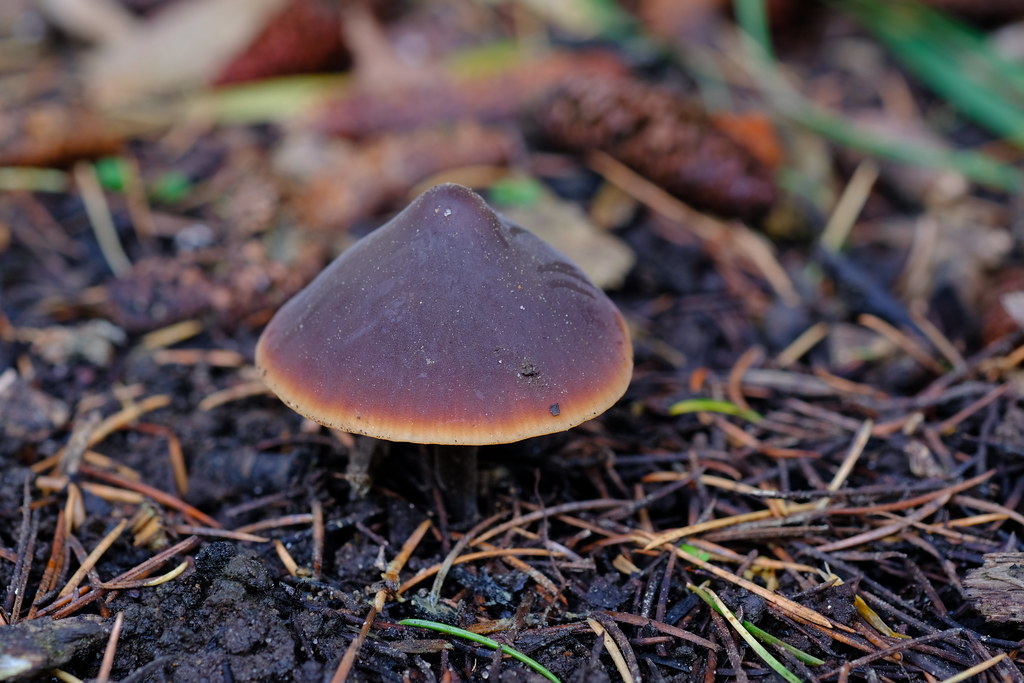
- 1–5 cm wide; hemispherical, bell-shaped, or conical when young, maturing to broadly convex; dark mahogany to blackish brown, fading to pale mahogany buff when dry. The margin is notably paler or nearly white, translucent-striate when wet, and may be wavy in age. The surface texture ranges from smooth to silky, velvety, or finely pruinose.
- Gills
- Close and broad, attached narrowly to the stem or nearly free. Initially white to creamy beige, maturing to cinnamon or pinkish brown as spores develop.
- Stem
- 3–8 cm long and 0.3–0.5 cm thick; straight and equal or slightly narrowing toward the base. The color is dark reddish brown to nearly black at the base, becoming paler pinkish tan toward the top, and darkening from the bottom up. The surface is dry with a velvety or pruinose sheen, sometimes becoming smooth with age.
- Flesh
- Thin, tough, and springy; dark in the stem and paler or tawny in the cap.
- Odor
- Very distinctive, smelling strongly of cucumber, raw fish, or sushi; occasionally described as unpleasant.
- Taste
- Mild to slightly farinaceous.
- Spore print
- Pinkish to dingy salmon tan or pinkish brown.
Sporecast is better in the app
Plan ahead with 10-day forecasts, see what people are finding nearby, get photo IDs, and track your finds.
Edibility
The culinary value of this species is undetermined. Its flavor is described as mild to slightly farinaceous, while its odor is distinctive and varies from cucumber to raw fish or sushi. It can be distinguished from the similar Gymnopus brassicolens by its scent; the latter smells of rotting cabbage. Other lookalikes include the Velvet Foot, which has a white spore print and grows on wood, and the Velvet Pinwheel, which lacks a velvety stem and a prominent odor.
Misidentification can be fatal. Never eat a mushroom unless you're 100% sure. This information may be inaccurate. Always consult multiple sources.
Nutrient Source
SaprotrophicIt obtains nutrients by decomposing dead organic matter from plants or animals.
Common Names
- Danish
- Agurkehat
- Dutch
- Levertraanzwam
- English
- Cucumber Cap
- French
- Macrocystidie à odeur de concombre, Naucorie à odeur de concombre
- German
- Gurkenschnitzling
- Norwegian Bokmål
- agurkhatt
- Norwegian Nynorsk
- agurkhatt
- Swedish
- transkräling
- Welsh
- Cap Cucumer
Synonyms
- Agaricus cucumis
- Agaricus mimicus
- Agaricus nigripes
- Agaricus piceus
- Agaricus pisciodorus
- Collybia mimica
- Derminus cucumis
- Entoloma piceum
- Galera cucumis
- Galeromycena mirabilis
- Gymnopus cucumis
- Hylophila cucumis
- Hyporrhodius nigripes
- Hyporrhodius piceus
- Latzinaea nigripes
- Latzinaea picea
- Latzinaea pisciodora
- Macrocystidia cucumis
- Macrocystis cucumis
- Macrocystis cucumis
- Naucoria cucumis
- Naucoria cucumis
- Nolanea nigripes
- Nolanea nigripes
- Nolanea picea
- Nolanea pisciodora
- Simocybe cucumis