
Habitat
This mushroom grows on soil, typically appearing solitary or in small groups. It is most frequently found in broad-leaved or open woodland, woodland edges, and glades. It also inhabits unimproved grasslands, particularly on chalk hills, as well as heathland, roadsides, and coastal areas.
Photos
Appearance
- Cap
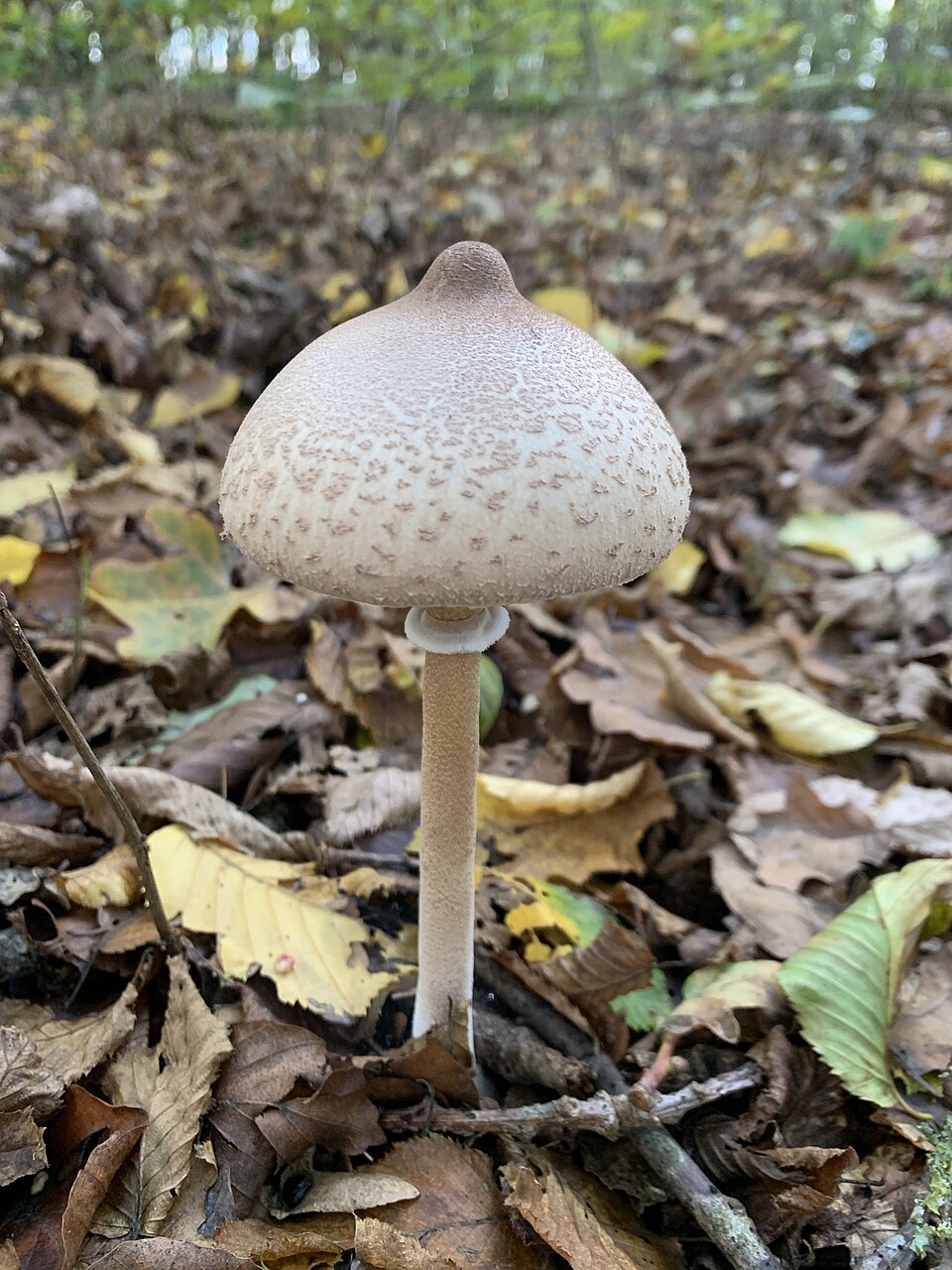
- 5 to 12 cm wide, starting spherical or bell-shaped before expanding to a flattened convex shape with a prominent, nipple-like central bump. The surface is cream to pale ochre with a darker center, covered in fine, granular yellow-brown scales that may form a star-shaped pattern.
- Stem
- 8 to 15 cm long, slender and mostly equal but with a slightly swollen base. It is white to pale brown, covered in fine, dense granular scales and features a thick, movable, double ring positioned toward the top.
- Gills
- White to cream-colored, crowded together, and free from the stem, sometimes forming a collar around it.
- Flesh
- White to cream-colored, soft, and thin with a mild or faintly pleasant taste and smell.
- Spore print
- White.
Sporecast is better in the app
Plan ahead with 10-day forecasts, see what people are finding nearby, get photo IDs, and track your finds.
Edibility
This species has a mild or faintly pleasant taste and can be confused with the smaller, edible Macrolepiota excoriata. Foragers should be careful not to mistake it for larger, dangerous Lepiota species like the orange-girdled parasol (Lepiota ignivolvata), which typically has an unpleasant smell and taste.
Misidentification can be fatal. Never eat a mushroom unless you're 100% sure. This information may be inaccurate. Always consult multiple sources.
Nutrient Source
SaprotrophicIt obtains nutrients by decomposing dead organic matter from other organisms, such as fallen leaves and wood.
Common Names
- Basque
- galanperna puntadun, maluta-puntadun, galanperna puntaduna
- Danish
- Puklet kæmpeparasolhat
- Dutch
- donkere parasolzwam, Tepelparasolzwam, Donkere parasolzwam
- English
- Slender Parasol
- Finnish
- suippu-ukonsieni
- French
- Lépiote mamelonnée, Lépiote grêle
- German
- Zitzen-Schirmpilz, Sternschuppiger Riesenschirmling
- Norwegian Bokmål
- skjoldparasollsopp
- Norwegian Nynorsk
- skjoldparasollsopp
- Spanish
- lepiota amamelonada, lepiota mamelonada
- Swedish
- puckelfjällskivling, vårtfjällskivling, stjärnfjällskivling
- Ukrainian
- Макролепіота Конрада
- Welsh
- Parasol Main
Synonyms
- Agaricus gracilentus
- Agaricus mastoideus
- Agaricus umbonatus
- Lepiota affinis
- Lepiota gracilenta
- Lepiota gracilenta
- Lepiota gracilenta
- Lepiota konradii
- Lepiota konradii
- Lepiota mastoidea
- Lepiota pitereka
- Lepiota rickenii
- Lepiota subsquarrosa
- Lepiota umbonata
- Lepiota umbonata
- Lepiotophyllum mastoideum
- Leucocoprinus affinis
- Leucocoprinus coccineobasalis
- Leucocoprinus gracilentus
- Leucocoprinus gracilentus
- Leucocoprinus mastoideus
- Leucocoprinus mastoideus
- Leucocoprinus subsquarrosus
- Macrolepiota affinis
- Macrolepiota gracilenta
- Macrolepiota konradii
- Macrolepiota psammophila
- Macrolepiota rickenii
- Macrolepiota subsquarrosa
- Macrolepiota umbonata
- Mastocephalus mastoideus