
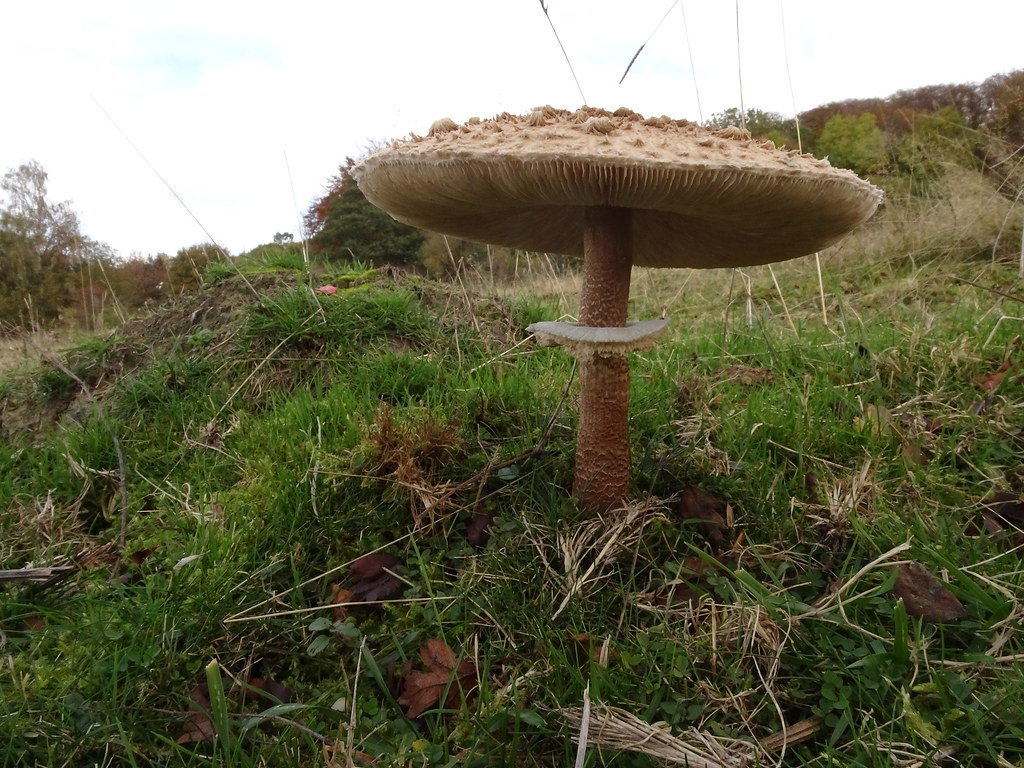
Habitat
Occurs on soil in a variety of open and semi-open environments, including pastures, meadows, parkland, and grassy areas. It is frequently found in open woodland, woodland glades, and under both hardwood and coniferous trees. It also grows along roadsides and footpaths, appearing singly, in clusters, or in large rings.
Photos
Appearance
- Cap
- Large, 7–25 cm across, starting as egg-shaped or spherical before expanding to flattened with a prominent central bump (umbo). The surface is pale buff, grey-brown, or off-white and is covered in darker, shaggy, brown scales that are often arranged in zones.
- Stem
- Tall and slender, 15–30 cm long, with a bulbous base. The surface is covered in a felty brownish coating that splits into a distinct snake-skin pattern as it expands. It features a large, thick, double-edged ring that can be moved up and down the stem.
- Gills
- White, crowded, and free from the stem. They may darken slightly or become dirty white as the mushroom ages.
- Flesh
- White, soft, and thin. It remains white or may discolour slightly brown but does not turn red when cut or bruised.
- Spore print
- White.
Sporecast is better in the app
Plan ahead with 10-day forecasts, see what people are finding nearby, get photo IDs, and track your finds.
Edibility
Possessing a sweet or mild flavor, this species is considered a delicacy, though the fibrous stems should be discarded. It is easily confused with various other Macrolepiota species and the edible Chlorophyllum rhacodes, which differs by having flesh that stains orange or red when cut. Extreme caution must be taken to avoid the toxic lookalike Chlorophyllum molybdites, which is distinguished by its mature green-tinged gills and green spore print.
Misidentification can be fatal. Never eat a mushroom unless you're 100% sure. This information may be inaccurate. Always consult multiple sources.
Nutrient Source
SaprotrophicIt obtains nutrients by breaking down dead organic matter from plants and other organisms in the soil.
Common Names
- Basque
- galanperna jangarri, galanperna jagarri
- Catalan
- Paloma, apagallums
- Danish
- Stor kæmpeparasolhat
- Dutch
- Grote parasolzwam
- English
- Parasol
- Finnish
- ukonsieni
- French
- Grande coulemelle, Lépiote élevée
- Galician
- choupin, zarrota, cogordo
- German
- Parasol
- Norwegian
- knylsopp, langbeen rise, langbeen-sopp
- Norwegian Bokmål
- stor parasollsopp
- Norwegian Nynorsk
- stor parasollsopp
- Spanish
- galipierno, galamperma, parasol, paloma, jangarria, galanperna, cachiporra, Galamperna, Apagador, matacandelas
- Swedish
- stolt fjällskivling
- Welsh
- Ambarelo'r Bwgan
Synonyms
- Agaricus annulatus
- Agaricus antiquatus
- Agaricus colubrinus
- Agaricus concentricus
- Agaricus procerus
- Agaricus squamosus
- Amanita procera
- Lepiota procera
- Lepiotophyllum procerum
- Leucocoprinus procerus
- Mastocephalus procerus
- Mastocephalus procerus