
Habitat
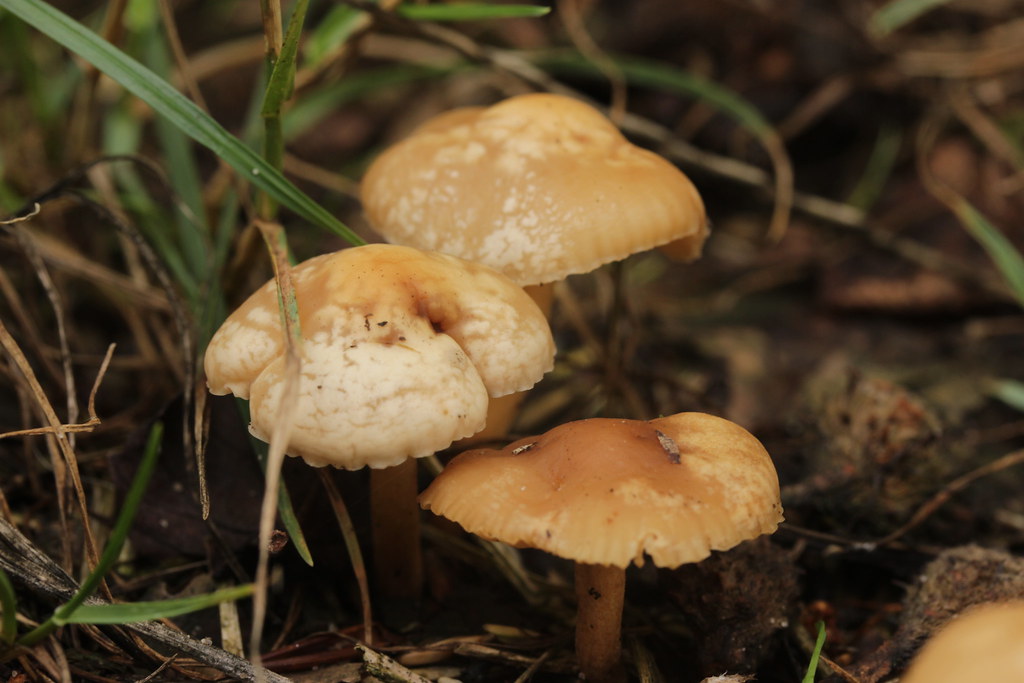
This common species is found almost exclusively in grassy environments, including lawns, pastures, meadows, parks, and playgrounds. It typically grows on soil in clumps, arcs, or complete circles known as fairy rings, sometimes occurring on sand dunes, grassy roundabouts, or in steppe habitats. While primarily associated with low-elevation areas, it can also be found in shortgrass meadows at higher elevations.
Photos
Appearance
- Cap
- 2–6 cm wide, initially rounded, bell-shaped, or conical, becoming convex to flat with a broad central bump (umbo). The surface is smooth and hygrophanous, ranging from pinkish-tan or reddish-brown when moist to pale buff, cream, or nearly white when dry. The margin can be wavy, ruffled, or faintly lined when wet.
- Stem
- 2–10 cm long, 3–5 mm thick; slender, cylindrical, and notably tough, rigid, or rubbery. It is whitish to pale buff at the top and often darker tan or ocher toward the base. The surface may be smooth or finely fuzzy/velvety on the lower half.
- Gills
- Broad and widely spaced (distant); narrowly attached to the stem or nearly free. Color starts white or cream, maturing to a pale tan or ochre-buff, sometimes developing darker blotches with age.
- Flesh
- White to pale buff; thin but flexible and tough in the cap, and fibrously tough in the stem. Known for its ability to revive after drying out.
- Spore print
- White.
- Odor
- Distinctive and pleasant, described as smelling of fresh sawdust, sweet almond, or slightly like apricot pits.
- Taste
- Mild, sweet, or slightly nutty.
Sporecast is better in the app
Plan ahead with 10-day forecasts, see what people are finding nearby, get photo IDs, and track your finds.
Edibility
Great care must be taken to distinguish this species from the deadly Clitocybe rivulosa (also known as Clitocybe dealbata or Fool's Funnel), which grows in the same grassy habitats and sometimes within the same rings. While Marasmius oreades has a distinctive sweet, nutty, or almond-like flavor and a smell compared to fresh sawdust or apricot pits, lookalikes such as Clitocybe species may have a mealy odor and more crowded, decurrent gills. The stems are notably tough and fibrous, leading most to consume only the caps. Due to its preference for lawns, avoid specimens from areas treated with herbicides, pesticides, or those near roadsides where they may absorb pollutants.
Misidentification can be fatal. Never eat a mushroom unless you're 100% sure. This information may be inaccurate. Always consult multiple sources.
Nutrient Source
SaprotrophicIt obtains nutrients by breaking down dead organic matter found in rich soils, such as dead grass and other plant material.
Common Names
- Danish
- Elledans-bruskhat
- Dutch
- Weidekringzwam
- English
- Fairy Ring Champignon, Fairy Ring Marasmius
- Finnish
- nurminahikas
- French
- Faux mousseron
- German
- Nelkenschwindling
- Norwegian Bokmål
- nelliksopp
- Norwegian Nynorsk
- nelliksopp
- Spanish
- champiñón de prado
- Swedish
- nejlikbroskskivling, nejlikbrosking
- Welsh
- Madarch Cylch
Synonyms
- Agaricus caryophyllaceus
- Agaricus caryophylleus
- Agaricus coriaceus
- Agaricus oreades
- Agaricus pratensis
- Agaricus pseudomouceron
- Chamaeceras albidus
- Chamaeceras caryophylleus
- Collybia oreades
- Gymnopus pratensis
- Marasmius caryophyllaceus
- Marasmius caryophylleus
- Marasmius caryophyllus
- Pleurotus caryophylleus
- Scorteus oreades
- Scorteus oreades