
Habitat
This common decomposer is found on or near rotting deciduous wood, particularly stumps, logs, and buried timber. It is frequently associated with broad-leaved trees like beech. While it sometimes appears to grow directly from the soil, it is actually attached to subterranean wood by a network of thick, white, string-like mycelial strands. It typically grows alone or in small, scattered groups.
Photos
Appearance
- Cap
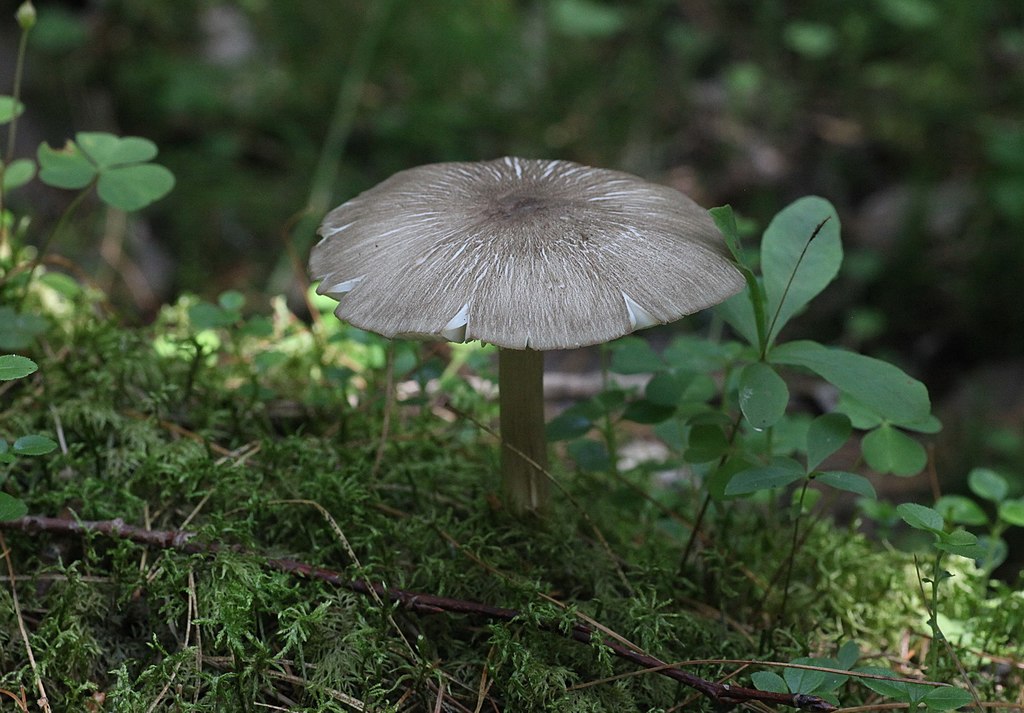
- 4–15 cm wide; initially hemispherical or convex, becoming flat, depressed, or upturned with age. The surface is dark grey-brown to ochraceous with prominent dark, radial streaks or fibrils. The margin is often wavy, inrolled when young, and may develop small scales or splits.
- Stem
- 4–15 cm long and 1–2 cm wide; cylindrical or slightly tapering upwards. It is tough, fibrous, and white to pale greyish. The base is notably characterized by long, thick, white, cord-like mycelial strands (rhizomorphs) that attach to wood.
- Gills
- Very broad and distant to well-spaced. They are white to whitish-cream or pale greyish and are attached (adnate to adnexed) to the stem.
- Flesh
- Thin and white.
- Spore print
- White.
- Smell
- Mild or not distinctive.
- Taste
- Mild to slightly bitter.
Sporecast is better in the app
Plan ahead with 10-day forecasts, see what people are finding nearby, get photo IDs, and track your finds.
Edibility
While considered edible by some, this mushroom is frequently reported to cause gastric upset in certain individuals and must be cooked thoroughly. It is characterized by a bitter taste and should not be confused with the poisonous Deathcap, which differs by having a volva and stem ring. Identification is aided by several prominent, rooting white rhizomorphs at the base of the stem.
Misidentification can be fatal. Never eat a mushroom unless you're 100% sure. This information may be inaccurate. Always consult multiple sources.
Nutrient Source
SaprotrophicIt obtains nutrients by decomposing dead organic matter, such as rotting wood and leaf litter, found on the forest floor.
Common Names
- Danish
- Bredbladet væbnerhat
- Dutch
- Breedplaatstreephoed
- English
- European Platterful Mushroom, Whitelaced Shank
- Finnish
- isojuurekas
- French
- Collybie à lames larges
- German
- Breitblättriger Rübling
- Norwegian Bokmål
- teiesopp, tægesopp, tægersopp
- Norwegian Nynorsk
- teiesopp, tægersopp, tægesopp
- Swedish
- strecknagelskivling
- Welsh
- Hegl Gwyngareog
Synonyms
- Agaricus grammocephalus
- Agaricus platyphyllus
- Agaricus repens
- Agaricus subulatus
- Agaricus tenuiceps
- Clitocybula platyphylla
- Clitocybula platyphylla
- Collybia grammocephala
- Collybia platyphylla
- Collybia repens
- Collybia spuria
- Gymnopus platyphyllus
- Hydropus platyphyllus
- Lyophyllum platyphyllum
- Marasmius platyphyllus
- Oudemansiella platyphylla
- Tricholoma tenuiceps
- Tricholomopsis platyphylla