
Habitat
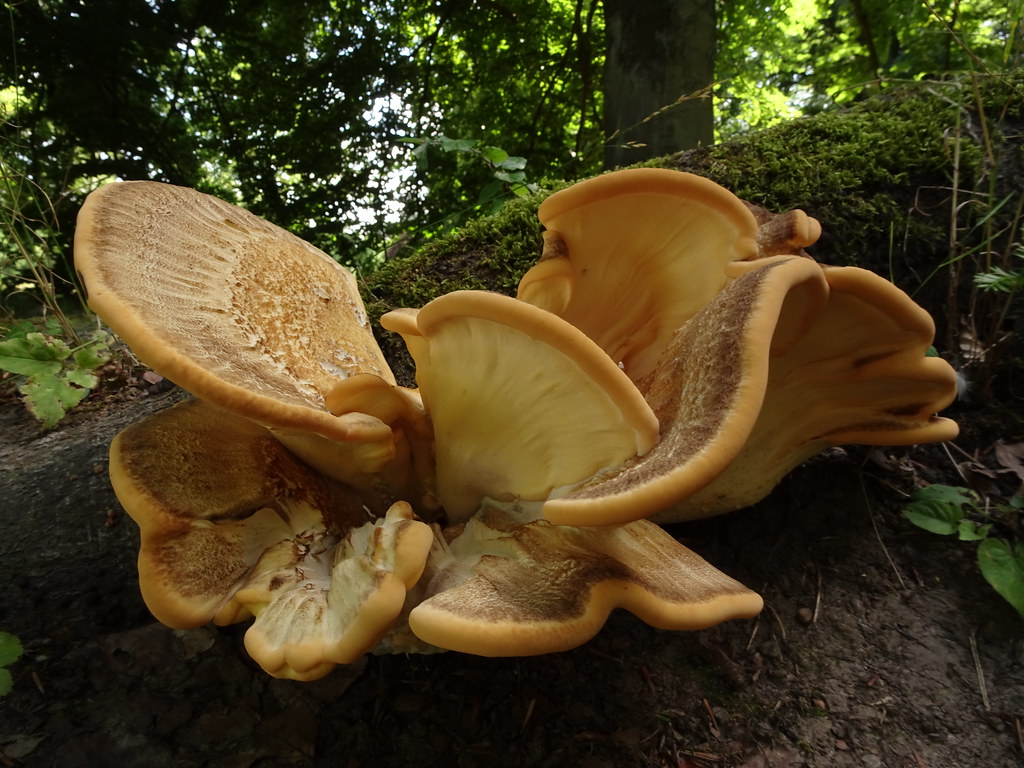
This species grows in dense clusters at the base of living deciduous trees, on stumps, or emerging from buried roots. It is primarily found on old beech and occasionally oak, but it may rarely occur on conifers. It acts as both a pathogen and a decomposer, causing significant rot in the root systems of its host.
Photos
Appearance
- Fruit body
- Forms large, rosette-like masses up to 80-100cm across, consisting of numerous flattened, fan-shaped brackets sharing a common base.
- Cap
- Individual caps are 10-30cm wide and 1-2cm thick. The upper surface is radially grooved or wrinkled and concentrically zoned with shades of brown, yellow, grey, or red, covered in very fine brown scales.
- Stem
- Short, stout, and rudimentary or absent, arising from a central base.
- Tubes
- 4-8mm long, colored white to cream.
- Pores
- Small, rounded openings, 3-5 per mm. The surface is initially whitish to yellow and characteristically bruises blackish when touched.
- Flesh
- White to cream-colored, soft when young but becoming fibrous and tough. It has a pleasant smell and a taste that is initially mild or sour but becomes bitter with age.
- Spore print
- White.
Sporecast is better in the app
Plan ahead with 10-day forecasts, see what people are finding nearby, get photo IDs, and track your finds.
Edibility
This mushroom is edible only when very young, as it quickly becomes tough, fibrous, and bitter with age. The flavor is described as pleasant or mild at first but can turn slightly sour or bitter, and the white pore surface characteristically bruises blackish. It has no dangerous lookalikes, though it may be confused with the rare and poor-quality edible Bondartsev's Polypore.
Misidentification can be fatal. Never eat a mushroom unless you're 100% sure. This information may be inaccurate. Always consult multiple sources.
Nutrient Source
facultativeIt obtains nutrients by decaying dead wood and can also parasitize living trees, especially those that are old or weakened.
Common Names
- Basque
- ardagai erraldoia, ardagai erraldoi
- Catalan
- gírbola de castanyer, girgola de castanyer, gamarús, bolet de garrofera
- Danish
- Kæmpeporesvamp
- Dutch
- Reuzenzwam
- English
- Giant Polypore
- French
- Polypore géant
- German
- Riesen-Porling
- Norwegian Bokmål
- storkjuke
- Norwegian Nynorsk
- storkjuke
- Spanish
- poliporo gigante, políporo frondoso, Políporo gigante, licia
- Swedish
- jätteticka
- Welsh
- Ysgwydd Fawr
Synonyms
- Agaricus aequivocus
- Agaricus multiplex
- Boletus cornutus
- Boletus giganteus
- Boletus giganteus
- Cladomeris giganteus
- Clavaria aequivoca
- Flabellopilus giganteus
- Grifola gigantea
- Grifola lentifrondosa
- Meripilus lentifrondosus
- Merisma giganteum
- Polypilus giganteus
- Polyporus aequivocus
- Polyporus frondosus
- Polyporus giganteus
- Polyporus giganteus
- Polyporus lentifrondosus