
Habitat
This mushroom grows on the ground in soil or duff, appearing solitary, scattered, or in large clusters. It is commonly found in hardwood forests, particularly in bottomland and riparian areas near rivers and streams where cottonwood, white ash, or elms grow. It also frequently inhabits apple orchards, burned areas, steep banks, abandoned railroad beds, and urban settings with fruit trees.
Photos
Appearance
- Fruit body
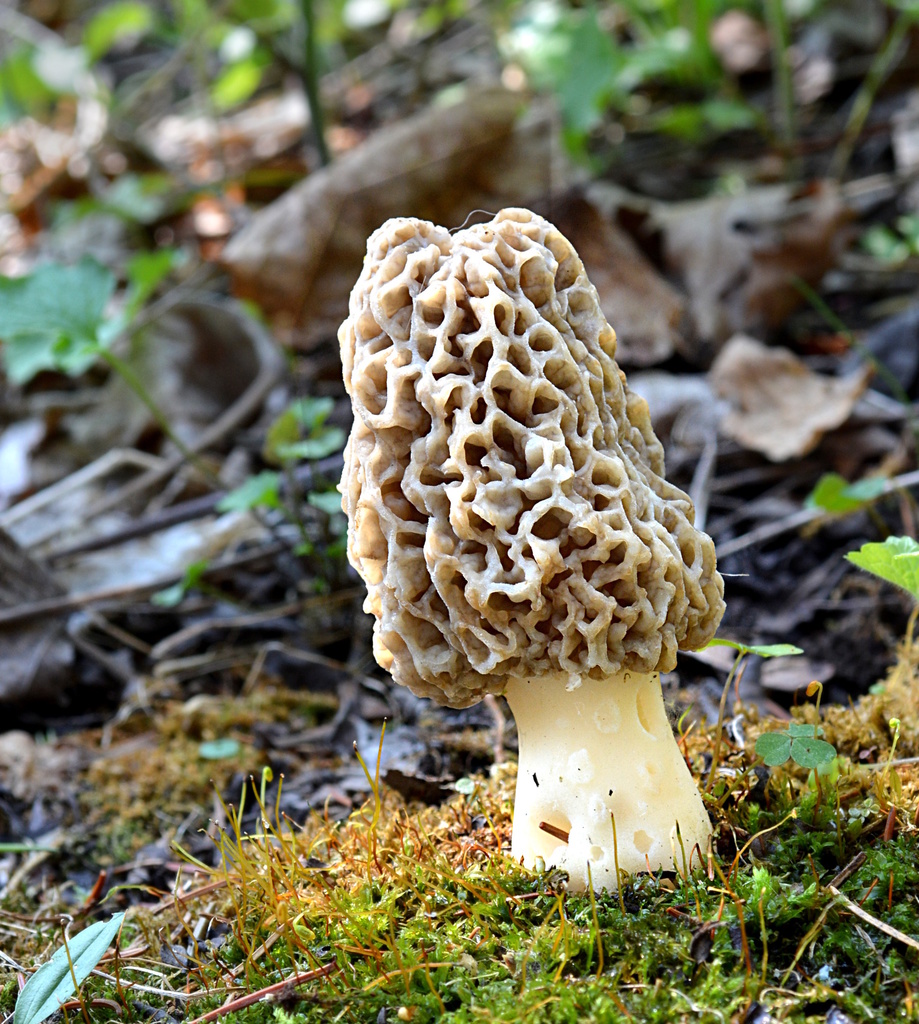
- A medium-sized to large mushroom ranging from 5 to 20 cm in total height with a honeycomb-like structure.
- Cap
- Ovoid, conical, or irregularly rounded, 2.5–15 cm tall and 1.5–8 cm wide. It features a sponge-like surface of randomly arranged, deep pits and irregular cross-ridges. Color varies from gray-tan or pale whitish when young to yellowish-brown, tan, or straw-yellow as it matures, occasionally developing reddish spots. The cap is fused directly to the stem without a depression.
- Stem
- White to creamy or tan, 2–12 cm long and 1.5–6 cm thick. The surface is dry and slightly granular or smooth, with distinct ribs or furrows near the base, which may be slightly enlarged.
- Flesh
- Thin, brittle to slightly rubbery, and whitish to tan. The entire interior of the mushroom is hollow, consisting of a single chamber.
- Spore print
- Buff, orange-buff, or ocher-buff.
Sporecast is better in the app
Plan ahead with 10-day forecasts, see what people are finding nearby, get photo IDs, and track your finds.
Edibility
This species has a delicate or nutty flavor and is a highly prized edible, but it must be cooked thoroughly before consumption. It should never be eaten raw or consumed with alcohol. While easily identified, it can be confused with other blond or yellow morels like M. prava, which is nearly identical, or M. tridentina, which has more vertically arranged ridges and a distinct groove where the cap meets the stem.
Misidentification can be fatal. Never eat a mushroom unless you're 100% sure. This information may be inaccurate. Always consult multiple sources.
Nutrient Source
facultativeIt can obtain nutrients by decomposing dead organic matter, forming symbiotic relationships with trees, or living as an endophyte within plants.
Common Names
- Dutch
- Oevermorielje
- English
- White Morel