
Habitat
This species grows on the ground in sandy or mineral soils within hardwood, coniferous, or mixed forests. It occurs individually or in groups and is frequently associated with dead standing elm trees. In the Appalachian region, it is more prevalent in mountain coves at higher elevations rather than in bottomlands or river valleys. While often considered decomposers of humus and litter, they may also form mycorrhizal relationships with trees.
Photos
Appearance
- Fruit body
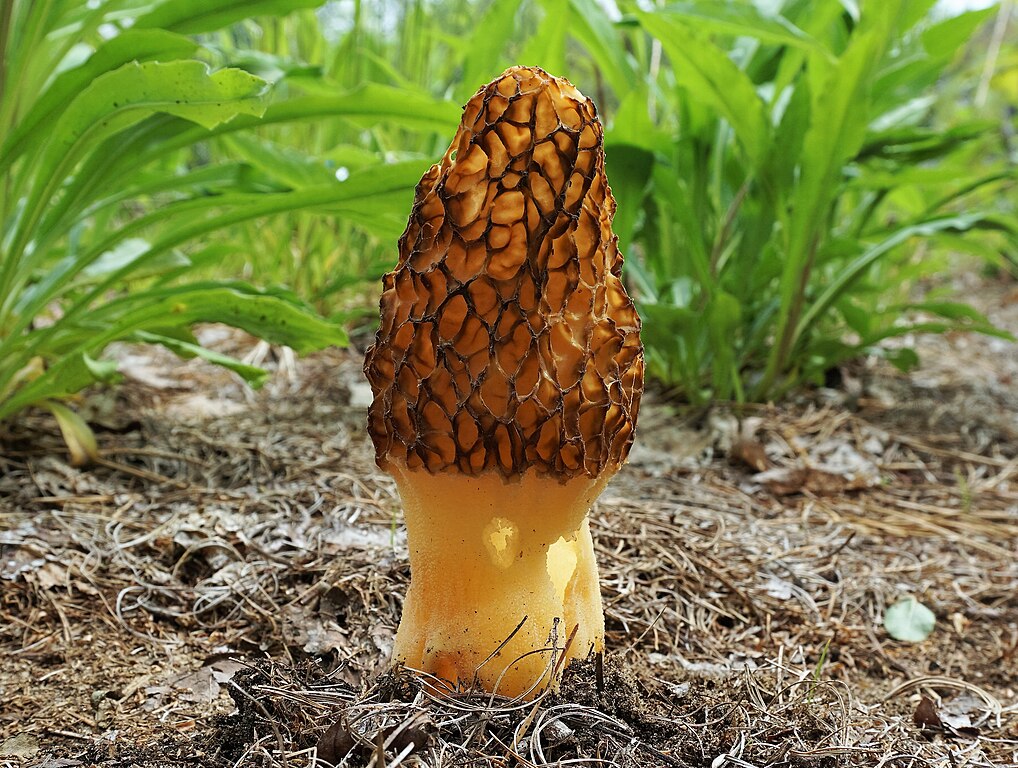
- Total height ranges from 7.5 to 15 cm and consists of a honeycomb-like cap attached to a central stem.
- Cap
- Conical to elongated and sponge-like, measuring 5–10 cm tall. It features dark brown to black longitudinal ridges and yellowish-brown pits. The structure is hollow and fragile.
- Stem
- Whitish to pale yellow, measuring 2.5–7.5 cm long. The surface is granular and may be smooth or slightly furrowed. It is hollow and attached to the base of the cap.
- Flesh
- Thin, fragile, and hollow throughout both the cap and stem.
- Spore print
- Cream to light buff.
Sporecast is better in the app
Plan ahead with 10-day forecasts, see what people are finding nearby, get photo IDs, and track your finds.
Edibility
This species must be cooked thoroughly and should never be consumed raw or with alcohol, as it may cause stomach upset for some people. It is similar in appearance to Morchella punctipes, though that species has a cap that is not attached to the stalk. When trying for the first time, it is recommended to eat only a small amount to check for potential sensitivities.
Misidentification can be fatal. Never eat a mushroom unless you're 100% sure. This information may be inaccurate. Always consult multiple sources.
Nutrient Source
facultativeThis species can obtain nutrients by decomposing dead organic matter in the soil, or it can form associations with tree roots to exchange nutrients.
Common Names
- English
- Black Morel
Synonyms
- Phalloboletus angusticeps