
Habitat
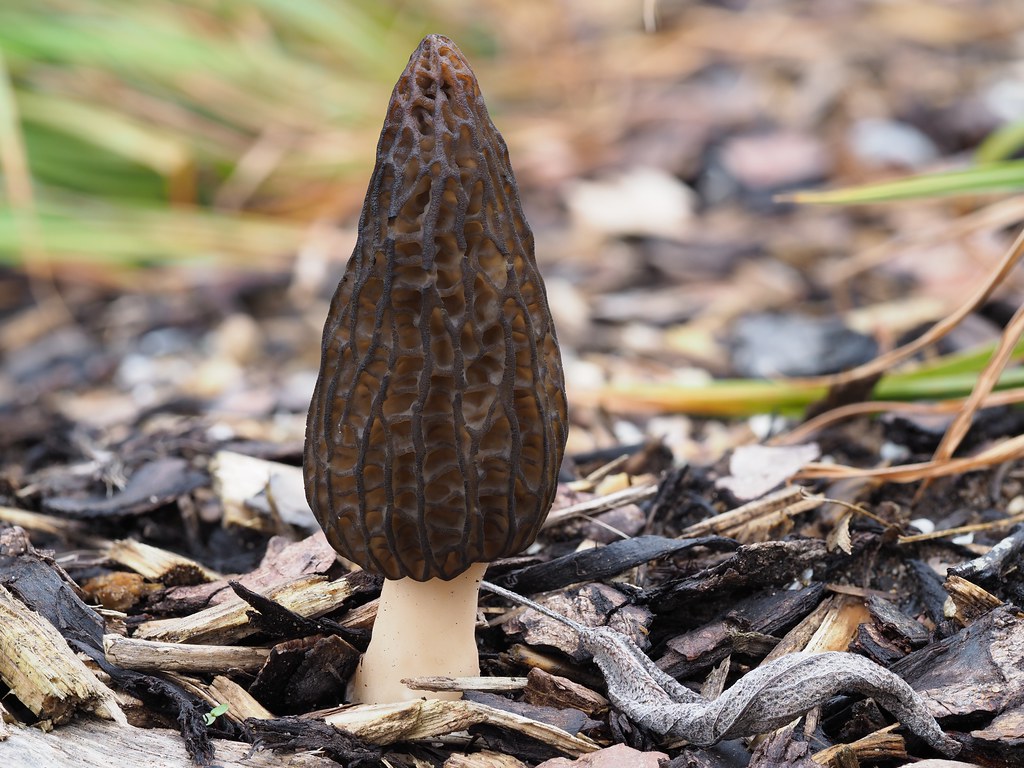
Occurs in coniferous forests, particularly on chalky soil. It is frequently found in man-made environments such as gardens, specifically on woodchip and bark mulch. It also appears on burned ground and may grow individually or in small groups.
Photos
Appearance
- Fruit body
- Stands 5 to 15 cm tall with a distinct honeycomb-like structure; the upper portion consists of a narrow, conical head.
- Cap
- Ridged and pitted with rectangular cavities; ridges are mostly arranged in parallel vertical lines. Colors range from yellow-brown to olive-brown, with the ridges darkening to grey or black with age.
- Stem
- Cylindrical and hollow, often equal in width or slightly furrowed. The surface is coarsely granular and brittle, colored white to cream or pale brown.
- Flesh
- Thin and brittle.
Sporecast is better in the app
Plan ahead with 10-day forecasts, see what people are finding nearby, get photo IDs, and track your finds.
Edibility
This mushroom is highly sought after but must be thoroughly cooked before consumption because it is poisonous if eaten raw. It is similar to the common morel but could also be confused with the smaller semi-free morel, which can cause gastric distress. There is considerable taxonomic uncertainty regarding this species, as it is often considered part of a larger complex of variable forms.
Misidentification can be fatal. Never eat a mushroom unless you're 100% sure. This information may be inaccurate. Always consult multiple sources.
Nutrient Source
facultativeIt is thought that it may obtain nutrients as a decomposer of dead organic matter (saprotrophic), or by forming symbiotic relationships with trees (ectomycorrhizal), and may also have the ability to act as a parasite or endophyte.
Common Names
- Dutch
- Kegelmorielje
- English
- Black Morel
- French
- Morille élevée
- German
- Hohe Morchel
- Welsh
- Morel Du
Synonyms
- Phalloboletus elatus