
Habitat
This mushroom grows on the ground in soil within broadleaf and hardwood forests. It appears in solitary fruiting bodies or in small to large clusters, often inhabiting the same areas as other morel species.
Photos
Appearance
- Fruit body
- An elongated structure consisting of a distinct cap and stipe, reaching a total height of 5 to 18 cm.
- Cap
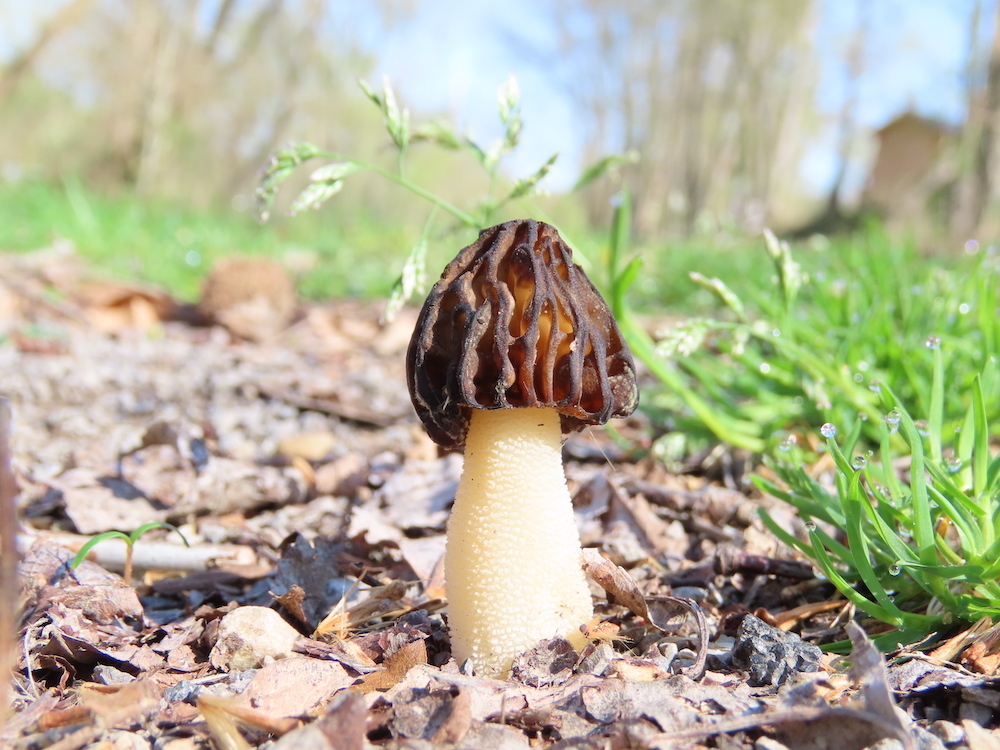
- Short and irregularly conical, 1–4 cm high, with a honeycombed surface. The cap is 'half-free,' meaning it is attached only halfway up the stem, with the lower half flaring out like a skirt. It features 15 to 25 longitudinal ridges that are yellowish-brown to dark brown, eventually turning black.
- Stem
- Whitish and hollow, 2–15 cm long, with a fragile texture and a surface covered in dense, meal-like granules. It may be equal in width or enlarged toward the base, sometimes exhibiting longitudinal wrinkles.
- Flesh
- Not as substantial or thick as that of black or yellow morels.
- Spore print
- Pale orange to yellowish cream.
Sporecast is better in the app
Plan ahead with 10-day forecasts, see what people are finding nearby, get photo IDs, and track your finds.
Edibility
This mushroom must be thoroughly cooked and never consumed raw or in combination with alcohol. While edible, the flesh is less substantial than other morel varieties. It can be confused with Verpa bohemica and Verpa conica, which are attached only at the very top of the stalk rather than halfway up the cap; both Verpa species are toxic to some individuals.
Misidentification can be fatal. Never eat a mushroom unless you're 100% sure. This information may be inaccurate. Always consult multiple sources.
Nutrient Source
facultativeIt is uncertain whether it obtains nutrients primarily as a decomposer of dead organic matter, or if it forms a symbiotic relationship with trees, or possibly both.
Common Names
- English
- Half-free Morel