
Habitat
Grassland or Woodland
Found on soil in a variety of environments, ranging from wet habitats like riverbanks, damp meadows, and woodlands to drier locations such as railway embankments. They grow individually or in small groups.
Photos
Appearance
- Fruit body
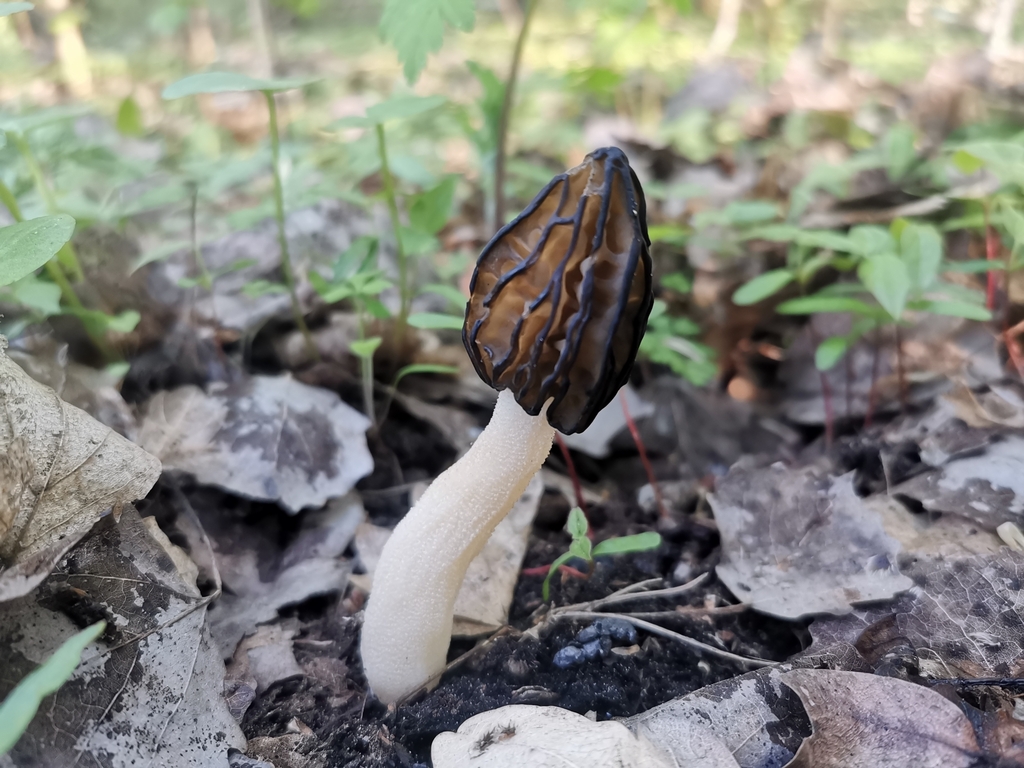
- Composed of a cap and a stem, typically found growing alone or in small groups.
- Cap
- Measures 2.5 to 7.5 cm, shaped like a cone with a honeycomb-like texture. Features vertical and some horizontal ridges forming pits. Color is yellowish-brown with darker ridges; the bottom half of the cap hangs free from the stem.
- Stem
- Measures 10 to 20 cm tall, cylindrical and slightly narrowing toward the top. The surface is white to cream-colored, somewhat irregular and wavy, with fine grooves and a granular texture.
Sporecast is better in the app
Plan ahead with 10-day forecasts, see what people are finding nearby, get photo IDs, and track your finds.
Edibility
EdibleTaste: Very good ★★★★☆
Misidentification can be fatal. Never eat a mushroom unless you're 100% sure. This information may be inaccurate. Always consult multiple sources.
Nutrient Source
facultativeIt can obtain nutrients by decomposing dead organic matter or by forming symbiotic relationships with trees.
Common Names
- Danish
- Hætte-morkel
- Dutch
- Kapjesmorielje, kapjesmorielje
- English
- Semifree Morel
- French
- Morillon
- German
- Halbfreie M., Käppchen-Morchel
- Swedish
- hättmurkla
- Ukrainian
- Мітрофора гібридна
- Welsh
- Morel Lled Rydd
Synonyms
- Helvella hybrida
- Mitrophora hybrida
- Mitrophora rimosipes
- Mitrophora rimosipes
- Mitrophora semilibera — Semifree Morel
- Mitrophora undosa
- Morchella acuta
- Morchella favosa
- Morchella hybrida
- Morchella rimosipes
- Morchella undosa
- Morilla rimosipes
- Morilla semilibera
- Phalloboletus gigas
- Phalloboletus rimosipes
- Phalloboletus undosus
- Phallus undosus