
Habitat
This species typically grows on soil amidst leaf litter in broad-leaved or coniferous forests. It is also frequently found in disturbed environments such as gardens, lawns, flowerpots, and along trail edges. It commonly colonizes wood-based materials, including woodchip mulch, bark, sawdust, and plant debris.
Photos
Appearance
- Fruit body
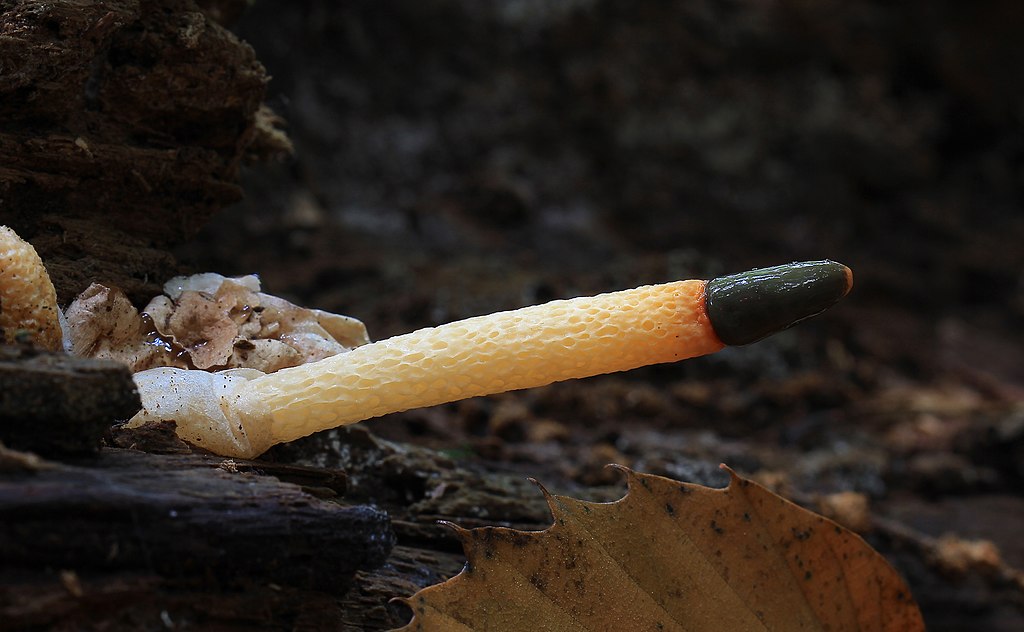
- Begins as a semi-buried, white to cream egg-like structure, up to 4 cm tall, which ruptures to reveal an upright, unbranched, cylindrical column.
- Stem
- Measuring 10–12 cm high, the stem is slender, hollow, and spongy with a styrofoam-like texture. Colors range from pale yellow-buff or pinkish to bright orange, often fading toward the base.
- Head
- A narrow, conical, orange-red apex that is roughened or pitted. It is initially covered in a dark olive-brown, slimy spore mass, though the very tip may remain bare.
- Gleba
- A dark olive-green to olive-brown gelatinous slime covering the head, containing the spores. It possesses a distinct odor often described as sickly-sweet, foul, or resembling animal feces.
- Volva
- The remains of the initial egg-like sac, which persists as a cup-like sheath at the base of the stem, often attached to the ground by white mycelial strands.
- Spore print
- Pale yellow to olive-brown.
Sporecast is better in the app
Plan ahead with 10-day forecasts, see what people are finding nearby, get photo IDs, and track your finds.
Edibility
While mature specimens possess an obnoxious odor described as sickly, sweet, or similar to predator feces, they are reportedly edible in the unexpanded egg stage. Foragers must be extremely careful not to mistake the buttons of poisonous Amanita species for stinkhorn eggs. This species is similar to the larger, more deeply colored Mutinus elegans and Mutinus ravenelii.
Misidentification can be fatal. Never eat a mushroom unless you're 100% sure. This information may be inaccurate. Always consult multiple sources.
Nutrient Source
SaprotrophicIt obtains nutrients by decomposing dead organic matter in the soil, such as decaying wood, leaf litter, and mulch.
Common Names
- Basque
- txakur-zakil
- Catalan
- fallus caní
- Danish
- Hunde-stinksvamp
- Dutch
- Kleine stinkzwam
- English
- Dog Stinkhorn
- Finnish
- koiranpökkösieni
- French
- Phallus de chien, Satyre des chiens
- Galician
- carallete
- German
- Gewöhnliche Hundsrute
- Norwegian Bokmål
- dvergstanksopp
- Norwegian Nynorsk
- dvergstanksopp
- Spanish
- Falo perruno
- Swedish
- liten liksvamp, liten stinksvamp
- Ukrainian
- Мутин собачий
- Welsh
- Y Gingroen Bengoch
Synonyms
- Aedycia canina
- Cynophallus caninus
- Ithyphallus inodorus
- Phallus caninus
- Phallus caninus
- Phallus inodorus