
Habitat
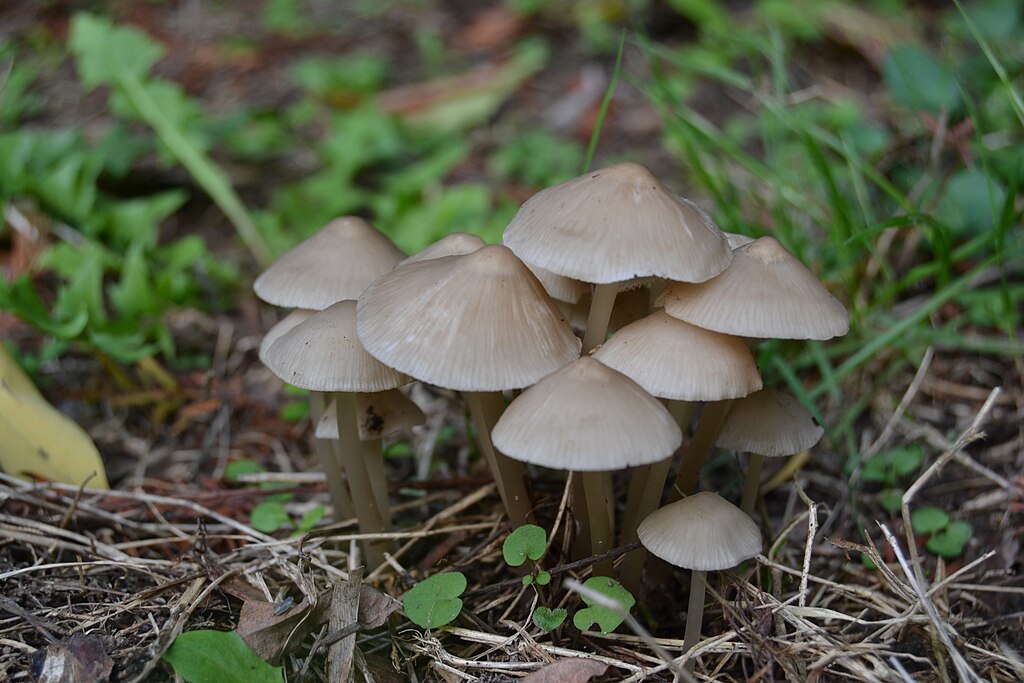
This common and widespread species typically grows in clusters, tufts, or occasionally as solitary specimens on decaying wood. It is most frequently found on the stumps, fallen branches, and logs of broad-leaved or deciduous trees such as oak, alder, and bigleaf maple, though it can also occur on conifers. The stem often has a rooting base that may extend into the wood, well-decayed logs, or buried wood. While almost exclusively associated with coarse woody debris, it is occasionally observed growing on the ground in coniferous or mixedwood forests.
Photos
Appearance
- Cap
- 2–6 cm wide, initially conical or bell-shaped, maturing to broadly convex or plane with a prominent central bump. The surface is smooth to wrinkled, translucent-striate at the margin, and ranges in color from dark grayish brown to pale gray, often fading toward the edges.
- Stem
- 2–15 cm tall and 0.2–0.8 cm thick, tough, hollow, and cartilaginous. It is typically smooth and shiny, matching the cap color or paler toward the top, with a characteristic rooting base covered in white, woolly hairs.
- Gills
- Broadly attached or notched with a short descending tooth, they are fairly distant and often connected by cross-veins. Initially white to pale gray, they typically develop a pinkish tint as they age.
- Flesh
- White to watery grayish-brown, thin, and fragile in the cap but tougher in the stem.
- Odor
- Variable; ranging from mild to distinctly mealy (floury) or radish-like, sometimes becoming rancid when crushed.
- Taste
- Mild to floury or cucumber-like.
- Spore print
- White to pale cream.
Sporecast is better in the app
Plan ahead with 10-day forecasts, see what people are finding nearby, get photo IDs, and track your finds.
Edibility
While documented as edible, this species is often considered not worthwhile for the table due to its thin flesh and variable taste, which ranges from mild or mealy to rancid or earthy. It can be confused with other wood-growing bonnets such as Mycena maculata or Mycena inclinata, and careless foragers could mistake it for the deadly Funeral Bell. Identifying these lookalikes can be difficult when they are young, though Mycena inclinata typically has a distinctive red-brown cap and desarrolla red-spotted gills with age.
Misidentification can be fatal. Never eat a mushroom unless you're 100% sure. This information may be inaccurate. Always consult multiple sources.
Nutrient Source
SaprotrophicIt obtains nutrients by decomposing dead organic matter from trees, such as stumps and decaying wood.
Common Names
- Dutch
- Helmmycena
- English
- Bonnet Mycena, Common Bonnet
- Finnish
- poimuhiippo
- French
- Mycène casquée
- German
- Rosablättriger Helmling
- Norwegian Bokmål
- rynkehette
- Norwegian Nynorsk
- rukkehette
- Swedish
- rynkhätta
- Welsh
- Bonet (y) Coed
Synonyms
- Agaricus conicus
- Agaricus crispus
- Agaricus galericulatus
- Agaricus hiemalis
- Agaricus nubigenus
- Agaricus radicatellus
- Agaricus rugosus
- Collybia rugulosiceps
- Mycena berkeleyi
- Mycena nubigena
- Mycena radicatella
- Mycena rugosa
- Mycena rugulosiceps
- Prunulus galericulatus
- Prunulus radicatellus