
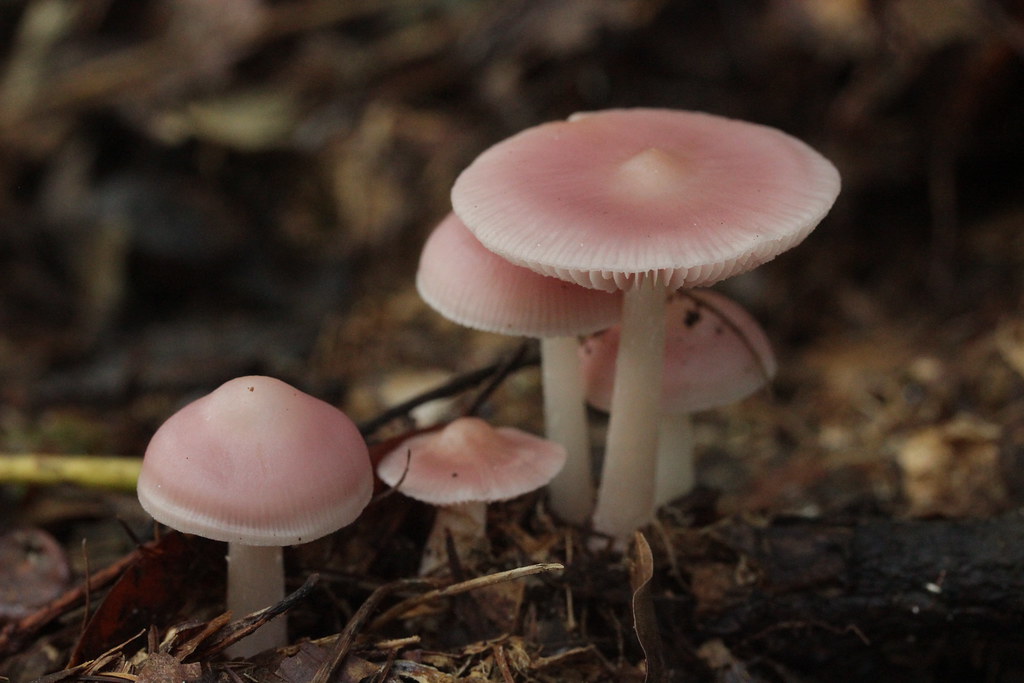
Habitat
Found among leaf litter primarily in beech forests, though it also occurs in mixed broad-leaved woodlands containing oak and hazel. It grows individually or in small clusters and tufts, anchored to the substrate by a mass of white mycelium.
Photos
Appearance
- Cap
- Measures 1.5 to 4 cm across, starting convex and becoming flattened with a small central bump; surface features radial lines nearly to the center and a unique concentric pattern near the edge.
- Stem
- Ranges from 5 to 10 cm long, slender and of equal thickness, frequently marked with vertical grooves; the base is typically curved and attached to the substrate by a dense cluster of white mycelium.
- Gills
- Grey-violet in color, spaced far apart, and slightly running down the stem.
- Flesh
- Thin and lilac-brown in color.
- Spore print
- White.
- Odour and Taste
- Smell is sweet and incense-like; taste is faint and reminiscent of radishes.
Sporecast is better in the app
Plan ahead with 10-day forecasts, see what people are finding nearby, get photo IDs, and track your finds.
Edibility
The mushroom possesses a faint taste reminiscent of radishes. There is a sweet, incense-like smell, though it is sometimes described as indefinite.
Misidentification can be fatal. Never eat a mushroom unless you're 100% sure. This information may be inaccurate. Always consult multiple sources.
Nutrient Source
SaprotrophicIt obtains nutrients by decomposing dead organic matter found in leaf litter, often beneath deciduous trees or in coniferous forests.
Common Names
- Danish
- Rosa huesvamp
- Dutch
- Heksenschermpje
- English
- Rosy Bonnet
- Finnish
- rusohiippo
- French
- Mycène pure forme rose
- German
- Rosa Rettich-Helmling
- Norwegian Bokmål
- blekrosa reddikhette
- Norwegian Nynorsk
- bleikrosa reddikhette
- Swedish
- rosa rättikhätta
- Welsh
- Bonet Wridog
Synonyms
- Agaricus roseus
- Agaricus roseus
- Prunulus roseus