
Habitat
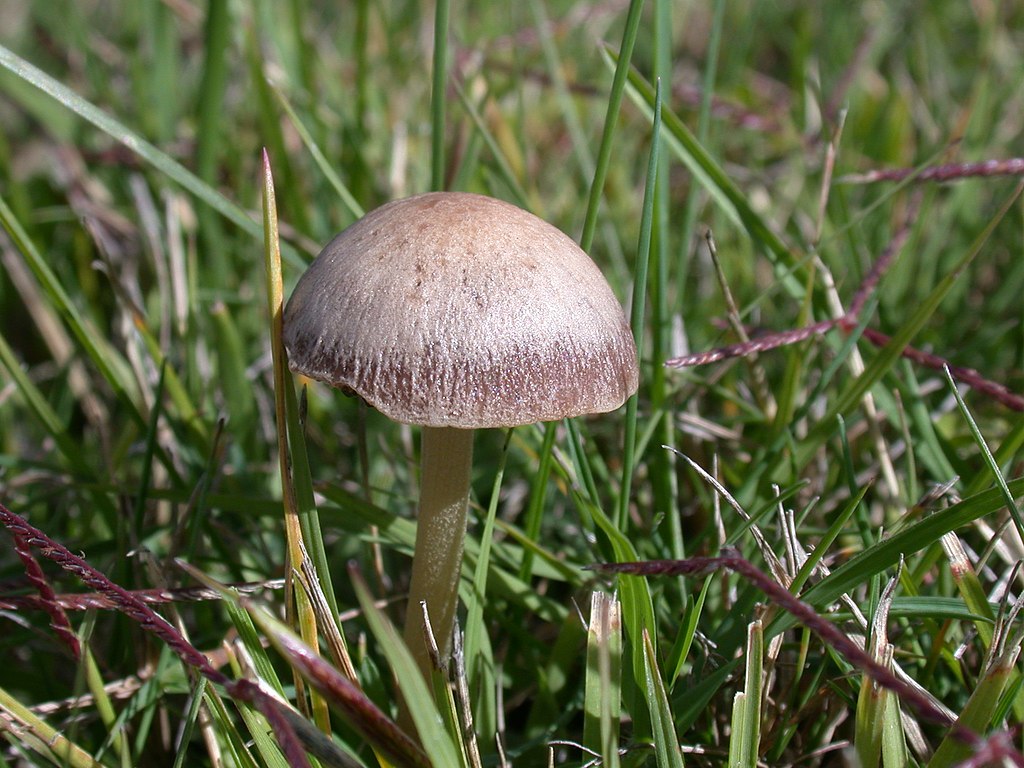
This common and widespread mushroom is primarily found growing on the ground in lawns and grassy areas. It is frequently associated with manicured or short grass, path edges, roadsides, and meadows. Unlike many related species, it grows directly in the soil or grass rather than on dung, though it can thrive in areas that are not heavily fertilized. It often appears in small groups or larger scattered troops, particularly when warm weather coincides with humidity, rainfall, or lawn watering.
Photos
Appearance
- Cap
- 1–3 cm wide; bell-shaped, conical, or hemispheric when young, maturing to convex or flat. Surface is smooth but may develop fine cracks in dry weather. It is hygrophanous, changing color dramatically from dark brown, smoky brown, or reddish brown when moist to tan, gray-beige, or buff as it dries. A distinct darker band often remains near the margin during drying.
- Stem
- 3–9 cm tall by 2–4 mm wide; slender, fragile, and equal in width throughout. The surface is dry and smooth to finely hairy or powdery. Color is whitish to buff-brown, typically darkening from the base upwards as it ages or where handled.
- Gills
- Broadly to narrowly attached to the stem and moderately crowded. Initially pale brown or whitish, they become dark brown and develop a mottled or spotted appearance as the spores mature. The edges are often distinctly paler or finely fringed with white.
- Flesh
- Thin and fragile; buff to pale brown when moist, becoming whitish when dry. No distinctive smell or taste, though some notes describe it as occasionally musty or sour.
- Spore print
- Dark brown to brownish-black.
Sporecast is better in the app
Plan ahead with 10-day forecasts, see what people are finding nearby, get photo IDs, and track your finds.
Edibility
Frequently considered inedible or of uncertain status, this species has been reported to contain psilocybin and psilocin, though these findings are often unsubstantiated. It is sometimes described as having a sour or musty flavor. It is easily confused with the mildly hallucinogenic Panaeolus cinctulus, which is differentiated by its jet-black spore print and stockier growth, and species in the Psathyrella gracilis group, which typically grow on wood chips rather than grass.
Misidentification can be fatal. Never eat a mushroom unless you're 100% sure. This information may be inaccurate. Always consult multiple sources.
Nutrient Source
SaprotrophicIt obtains nutrients by breaking down dead organic matter, such as grass clippings and other plant debris.
Common Names
- Basque
- larre-orribeltz
- Danish
- Høslætsvamp
- Dutch
- Gazonvlekplaat
- English
- Brown Hay Cap, Brown Mottlegill, Mower's Mushroom
- Finnish
- nurmikirjoheltta
- German
- Heu-Düngerling
- Norwegian Bokmål
- slåttesopp
- Norwegian Nynorsk
- slåttesopp
- Swedish
- slåtterbroking, slåtterbrokskivling, slåtterslätskivling
- Welsh
- Medelwr
Synonyms
- Agaricus foenisecii
- Coprinarius foenisecii
- Coprinus foenisecii
- Drosophila foenisecii
- Panaeolus foenisecii — Brown Mottlegill
- Prunulus foenisecii
- Psathyra foenisecii
- Psathyrella foenisecii
- Psilocybe foenisecii