
Habitat
This species is found in nutrient-rich environments, including manured soil, compost heaps, gardens, and dung hills. It frequently grows on rotting hay bales, in areas frequented by horses, or on dung mixed with straw. It also inhabits grassy lawns (especially those that have been fertilized or watered), wood chip mulches, and other rich soils. It typically grows in clusters, tufts, or scattered groups.
Photos
Appearance
- Cap
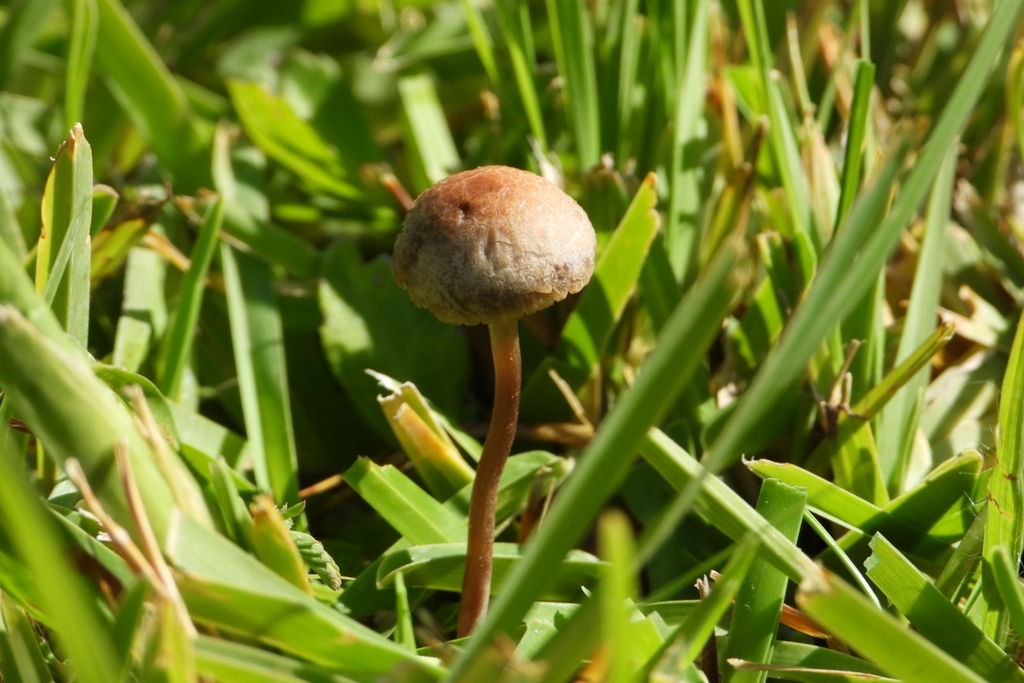
- 2–6 cm wide, ranging from bell-shaped or convex to nearly flat with a broad central bump. The surface is smooth, sometimes developing fine cracks in dry weather. Reddish-brown to cinnamon-brown when moist, it fades to tan or grayish-beige from the center outward as it dries, frequently leaving a distinct dark band around the margin.
- Stem
- 3–10 cm long and 2–8 mm thick, hollow and relatively equal in width or slightly tapering upward from a sometimes swollen base. It is buff to reddish-brown, often covered in a fine white powder when young and eventually becoming smooth. The base may stain pale blue when handled or with age.
- Gills
- Attached to the stem and closely spaced. Initially pale tan, pink-buff, or grayish-brown, they develop a mottled appearance before turning solid black. The edges are typically paler or white.
- Flesh
- Moderately thin and buff-brown to cream-colored; fragile in the cap and more fibrous in the stem.
- Spore print
- Jet black.
Sporecast is better in the app
Plan ahead with 10-day forecasts, see what people are finding nearby, get photo IDs, and track your finds.
Edibility
Contains psychoactive compounds. Possession is illegal in some jurisdictions. Follow all local laws.
Misidentification can be fatal. Never eat a mushroom unless you're 100% sure. This information may be inaccurate. Always consult multiple sources.
Nutrient Source
SaprotrophicIt obtains nutrients by decomposing dead organic matter, such as dead plants and animal waste. It is commonly found in fertilized lawns and compost piles.
Common Names
- Dutch
- Gezoneerde vlekplaat
- English
- Banded Mottlegill
- Finnish
- reunuskirjoheltta
- German
- Dunkelrandiger Düngerling
- Norwegian Bokmål
- belteflekkskivesopp
- Norwegian Nynorsk
- belteflekkskivesopp
- Swedish
- kantbroking
- Welsh
- Brithdegyll Cylchog
Synonyms
- Agaricus cinctulus
- Campanularius pumilus
- Coprinus cinctulus
- Panaeolus dunensis
- Panaeolus pumilus
- Panaeolus subbalteatus