
Habitat
Grassland
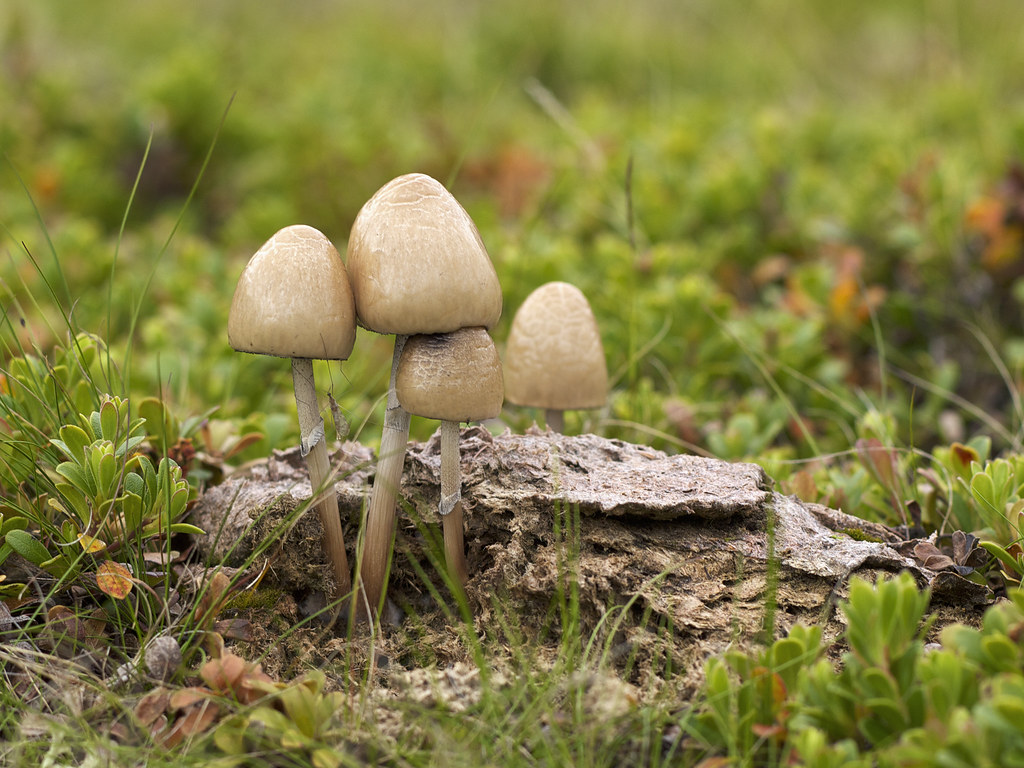
This mushroom is commonly found growing on dung, particularly cow pies and horse manure.
Photos
Appearance
- Cap
- 2 to 6 centimeters wide, egg-shaped or bell-shaped, rarely expanding; surface is white to clay-colored, turning yellowish at the center; texture is slimy or greasy when moist, becoming shiny when dry; edge may have remaining fragments of the veil.
- Stem
- 50 to 100 millimeters long and 4 to 8 millimeters thick, slightly wider at the base; color is whitish; features a persistent, white, skin-like ring that may be blackened by spores.
- Gills
- Broadly attached; initially whitish, later turning dark brown to black through development, often with edges that remain white.
- Flesh
- Whitish color throughout the cap and yellowish within the stem.
- Spore print
- Black.
Sporecast is better in the app
Plan ahead with 10-day forecasts, see what people are finding nearby, get photo IDs, and track your finds.
Edibility
Not edible
While considered non-edible by some, others note it may be edible despite its substrate. It is characterized by an egg-shaped cap and a persistent ring on the stem, though it can be confused with the smaller Panaeolus papilionaceus which features a darker cap and shaggy veil remnants.
Misidentification can be fatal. Never eat a mushroom unless you're 100% sure. This information may be inaccurate. Always consult multiple sources.
Nutrient Source
SaprotrophicThis mushroom obtains nutrients by decomposing dead organic matter, typically found in its environment.
Common Names
- Basque
- orribeltz arrautzerdi, orribeltz arraultzerdi
- Danish
- Ring-glanshat
- Dutch
- Geringde vlekplaat, geringde vlekplaat
- English
- Egghead Mottlegill, Shiny Mottlegill
- Finnish
- kauluskirjoheltta
- German
- Ring-Düngerling
- Norwegian Bokmål
- gjødselringsopp
- Norwegian Nynorsk
- gjødselringsopp
- Spanish
- paneolo anillado, Paneolo anillado
- Swedish
- ringbroking, ringbrokskivling
- Welsh
- Brithdegyll Wyffurf
Synonyms
- Agaricus ciliaris
- Agaricus egregius
- Agaricus fimiputris
- Agaricus nutans
- Agaricus phalenarum
- Agaricus semiovatus
- Agaricus separatus
- Amanita separata
- Anellaria fimiputris
- Anellaria fimiputris
- Anellaria phalenarum
- Anellaria semiovata
- Anellaria separata
- Chalymmota phalenarum
- Coprinarius phalenarum
- Coprinarius separatus
- Coprinus ciliaris
- Coprinus ciliatus
- Coprinus semiovatus
- Panaeolus egregius
- Panaeolus fimiputris
- Panaeolus phalenarum
- Panaeolus separatus
- Panaeolus separatus
- Pholiota separata
- Stropharia separata