
Habitat
This species grows on soil and leaf litter within both deciduous and coniferous woodlands. It often forms large troops, rings, or clustered, tufted groups, and shows a preference for nutrient-rich soils.
Photos
Appearance
- Cap
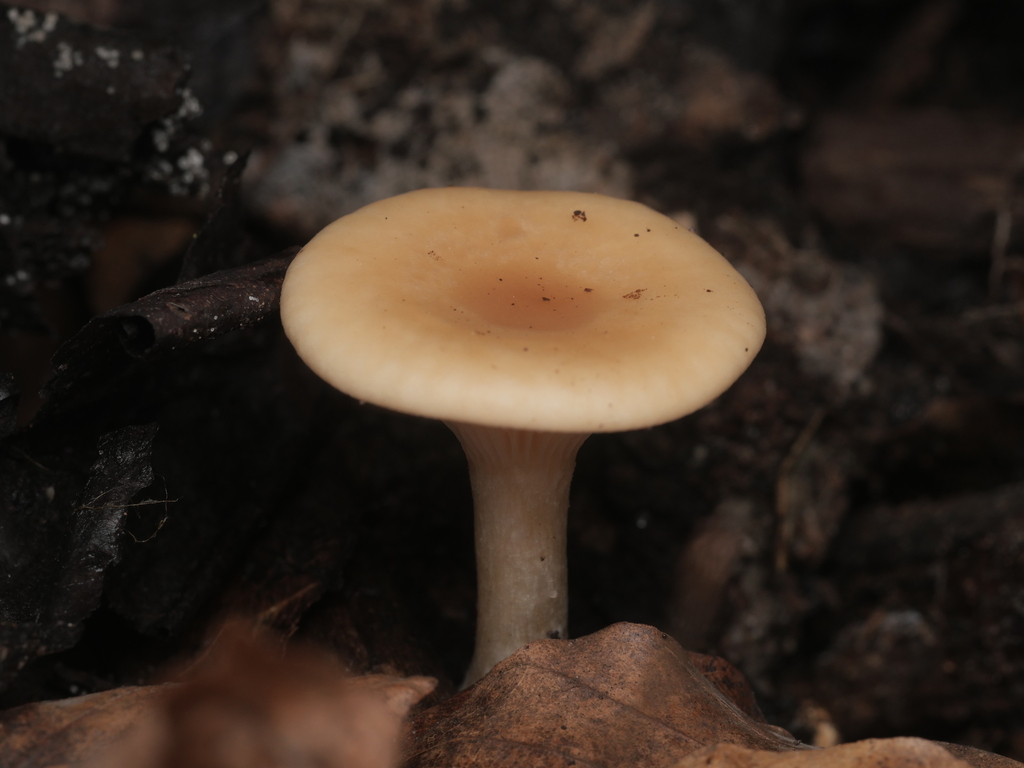
- 5 to 9 cm wide, starting convex and becoming funnel-shaped with age. The surface is ochraceous-buff to orange-brown or tawny, often spotted, and has an irregular, inrolled margin.
- Stem
- 2.5 to 5.5 cm long, cylindrical to club-shaped and often stout. It is paler than the cap, smooth at the top, and woolly or tufted at the base, becoming hollow with maturity.
- Gills
- Crowded and deeply decurrent, ranging in color from whitish-yellow to orange or reddish-buff.
- Flesh
- Thin to thick, pale cream, yellow, or red-brown, sometimes drying to a whitish color.
- Spore print
- White to very pale cream.
Sporecast is better in the app
Plan ahead with 10-day forecasts, see what people are finding nearby, get photo IDs, and track your finds.
Edibility
This mushroom is edible but often considered poor or mediocre due to its chewy texture and an unpleasant, oily, or spicy taste. It can be confused with several Clitocybe species, including the dangerous Paralysis Funnel. Additionally, this species is known to absorb and accumulate environmental toxins.
Misidentification can be fatal. Never eat a mushroom unless you're 100% sure. This information may be inaccurate. Always consult multiple sources.
Nutrient Source
SaprotrophicIt obtains nutrients by decomposing dead organic matter found on the ground under trees or in compost.
Common Names
- Danish
- Brunstænket hekseringshat, Brunstænket heksetragthat
- Dutch
- Roodbruine schijnridderzwam
- English
- Tawny Funnel, Tawny Funnel Cap
- Finnish
- ruskomalikka
- French
- Clitocybe inverse des feuillus, Clitocybe inversé
- German
- Fuchsiger Röteltrichterling
- Norwegian Bokmål
- gulbrun ridderhatt
- Norwegian Nynorsk
- gulbrun riddarhatt
- Swedish
- rödbrun trattskivling
- Welsh
- Twmffat/Twndish Melyngoch
Synonyms
- Agaricus extenuatus
- Agaricus flaccidus
- Agaricus infundibuliformis
- Agaricus inversus
- Agaricus lobatus
- Agaricus obconicus
- Clitocybe flaccida
- Clitocybe gilva
- Clitocybe guttatomarmorata
- Clitocybe inversa
- Clitocybe inversa
- Clitocybe inversa
- Craterellus infundibuliformis
- Lepista flaccida — Tawny Funnel
- Lepista inversa
- Omphalia flaccida
- Omphalia inversa
- Omphalia lobata
- Paralepista inversa