
Habitat
This species grows on the ground in variety of settings including broad-leaved and mixed woodlands, heaths, gardens, and along roadsides. It is frequently associated with birch trees but also occurs with other deciduous trees and conifers. While often found on acidic soil, it has also been noted on downland with common rock-rose and near bogs or seepage areas. Though it primary fruits from soil—sometimes in low-light environments—it can also appear on well-decayed wood, stumps, or more rarely on stone walls.
Photos
Appearance
- Cap
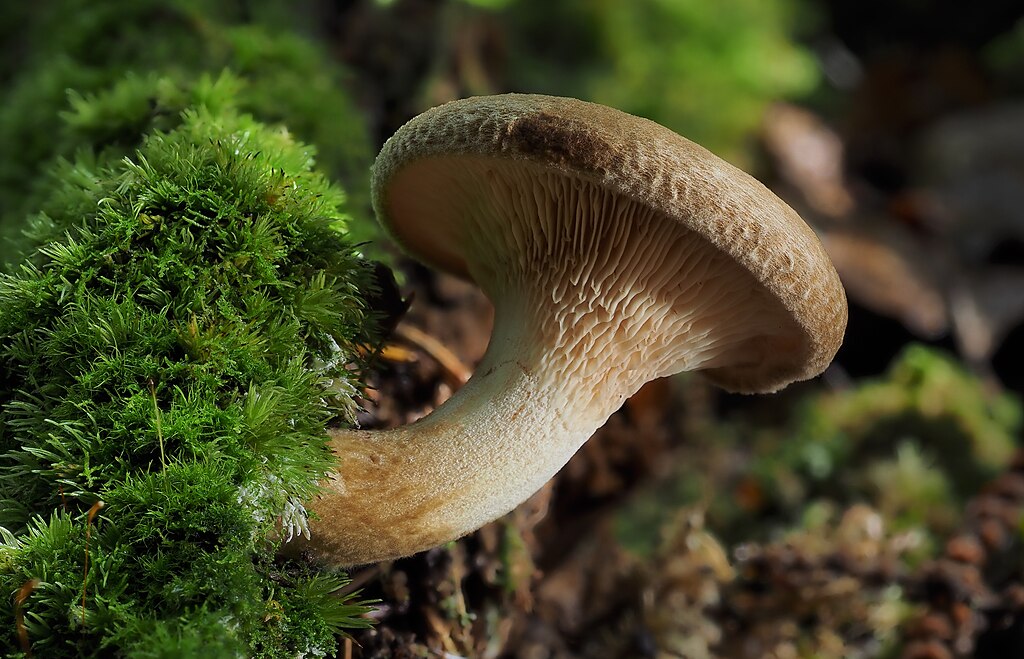
- 4–14 cm across, convex but soon flattening and becoming depressed in the center, sometimes with a blunt central bump. The surface is orange-brown, gray-brown, or yellow-brown, and is finely downy or velvety when young but becomes smoother with age. It is sticky or slimy when wet, and the margin is distinctly grooved and stays strongly inrolled.
- Gills
- Pale yellow, cream, or ochraceous-yellow, bruising red-brown. They are crowded, run down the stem (decurrent), and are often forked or connected by cross-veins near the point of attachment. The gills can be easily peeled or rubbed off the flesh of the cap.
- Stem
- 3–8 cm long and up to 2 cm wide, stout, and sometimes tapering toward the base or slightly off-center. It is similar in color to the cap, smooth to finely downy, and bruises reddish-brown when handled or cut.
- Flesh
- Thick and pale yellow to ochraceous-buff. It slowly darkens or bruises reddish-brown when exposed to air, particularly at the base of the stem.
- Spore print
- Red-brown, sienna, or yellowish-brown, sometimes with a slight olive or reddish tint.
Sporecast is better in the app
Plan ahead with 10-day forecasts, see what people are finding nearby, get photo IDs, and track your finds.
Edibility
This species contains a toxin that triggers a severe autoimmune response in which the body attacks its own red blood cells. While once eaten and considered safe by some if cooked, repeated consumption can cause this response to suddenly manifest as kidney failure, hemolysis, or death. Raw specimens cause immediate stomach upset, and even well-cooked mushrooms involve significant risk of hepatorenal problems and gastrointestinal illness. It has a sour, fruity, or acidic flavor and can be confused with Chanterelles or Copper Spikes, though it is distinguished by gills that turn brown when bruised and easily detach from the cap.
Misidentification can be fatal. Never eat a mushroom unless you're 100% sure. This information may be inaccurate. Always consult multiple sources.
Nutrient Source
EctomycorrhizalIt forms a symbiotic relationship with trees, exchanging nutrients with them.
Common Names
- Basque
- orri-onddo hiltzaile, orri-onto hiltzailea
- Danish
- Almindelig netbladhat
- Dutch
- Gewone krulzoom
- English
- Brown Rollrim, Brown Roll Rim, Brown Roll-Rim
- Finnish
- pulkkosieni
- French
- Paxille enroulé, Paxille involuté, Chanterelle brune, Bolet à lamelles, Paxille à bords enroulés
- German
- Kahler Krempling
- Northern Sami
- bunceguoppar
- Norwegian Bokmål
- pluggsopp
- Norwegian Nynorsk
- pluggsopp
- Scottish Gaelic
- oir chruinn dhonn, oirean cruinne donna
- Spanish
- paxilo en forma dena, Seta enrrollada, Paxilo enrollado, seta enrollada
- Welsh
- Cantel Mewndro Brown
Synonyms
- Agaricus adscendibus
- Agaricus contiguus
- Agaricus involutus
- Omphalia involuta
- Paxillus leptopus
- Rhymovis involuta
- Tapinia involuta
- Tapinia involuta