
Habitat
This species grows on rich, compost-heavy soil. It is frequently found in disturbed areas such as old country roadsides, trails, meadow edges, gardens, and parklands. It also occurs in mixed woods, at forest edges, and under deciduous regrowth like alder or poplar. It is specifically associated with environments that support stinging nettles, which also favor highly nutrient-rich conditions.
Photos
Appearance
- Cap
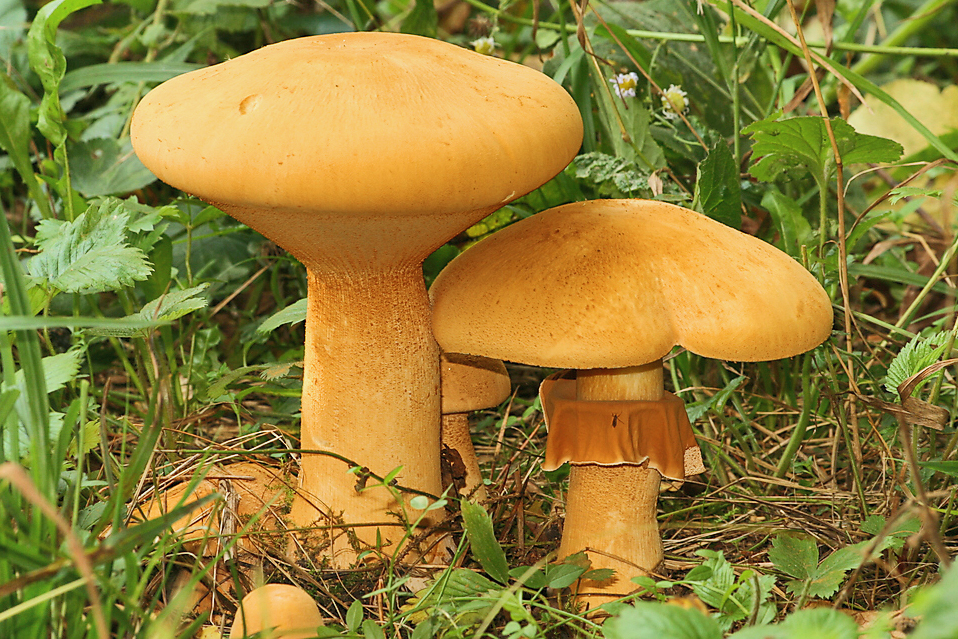
- Large, 5 to 25 cm across; ranging from obtusely conical or convex to flat, often with a central hump. The surface is dry and covered in distinctive golden-orange to tawny-brown granules or powder that may wash off with age. The margin often has hanging veil remnants and may remain inrolled for some time.
- Stem
- Robust, 4 to 30 cm long and up to 5 cm thick, often widening toward the base. Features a texture that is smooth above the ring and granular or powdery like the cap below the ring. Colors range from orangish-buff to golden-brown, sometimes maturing to a darker orange-brown.
- Ring
- A persistent, membranous, and flaring ring that is smooth on the upper surface and granular underneath. It is colored like the cap and stem.
- Gills
- Attached (adnate) to nearly free, sometimes with a descending tooth. They are closely spaced and broad, starting pale yellow or whitish-cream and maturing to a tawny or orange-brown color.
- Flesh
- Thick and firm, colored white to pale yellowish or cream, sometimes developing orange streaks as it ages.
- Spore print
- Yellowish-brown, orange-buff, or ochraceous.
Sporecast is better in the app
Plan ahead with 10-day forecasts, see what people are finding nearby, get photo IDs, and track your finds.
Edibility
This mushroom is potentially mildly poisonous, as a significant number of consumers experience gastrointestinal distress. The caps can contain high levels of cadmium and cyanide compounds which are only partially removed by cooking. The flavour is described as mild or indistinct to bitter and astringent. It can be confused with Gymnopilus species (Jumbo Gym), which grow on wood rather than soil, and Phaeolepiota aurea should be distinguished from Granny's Nightcap, which has a striate stem and lacks granules when young.
Misidentification can be fatal. Never eat a mushroom unless you're 100% sure. This information may be inaccurate. Always consult multiple sources.
Nutrient Source
SaprotrophicIt obtains nutrients by feeding on dead organic matter in the soil, such as decaying leaves and wood, to fuel its growth.
Common Names
- Danish
- Gyldenhat
- English
- Golden Bootleg
- Ukrainian
- Феолепіота золотиста
- Welsh
- Capan Aur
Synonyms
- Agaricus aureus
- Agaricus spectabilis
- Agaricus vahlii
- Cystoderma aureum
- Dryophila aurea
- Lepiota aurea
- Lepiota pyrenaea
- Phaeolepiota vahlii
- Pholiota aurea
- Pholiota aurea
- Pholiota aurea
- Pholiota vahlii
- Pholiota vahlii
- Togaria aurea