
Habitat
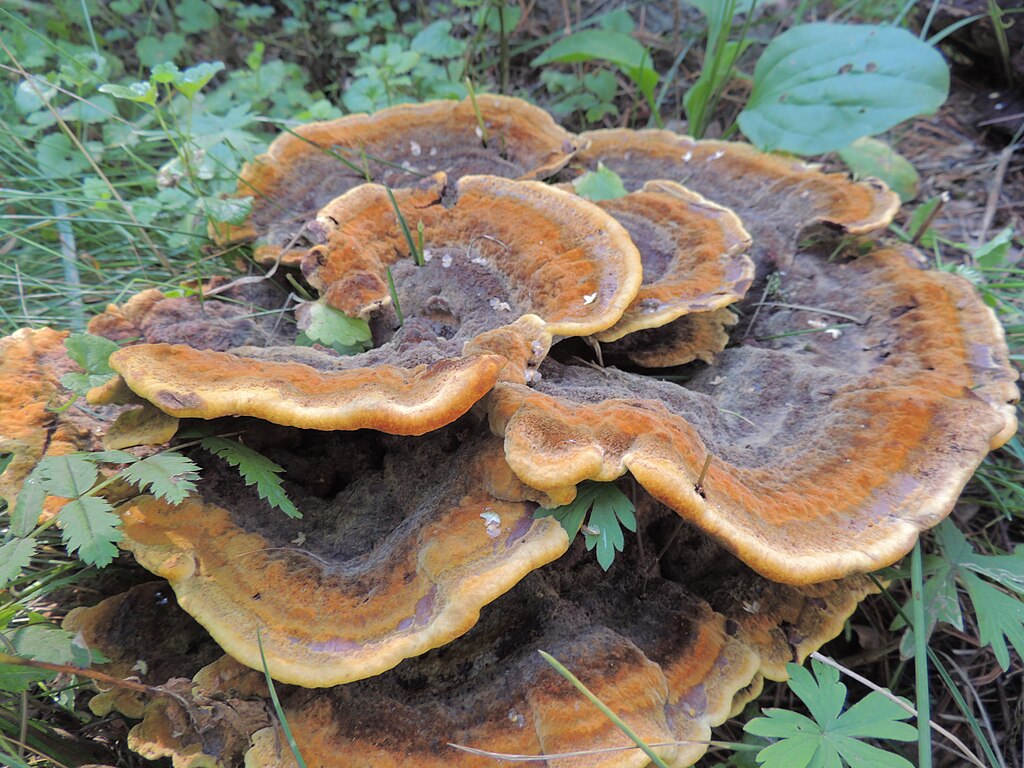
This parasitic fungus is a significant pathogen that causes brown cubical butt rot in conifers, particularly in old-growth trees. It typically grows at the base of living trees, dead stumps, or from buried roots, where it frequently appears to be growing on the ground. While it most often fruits around the tree base or from root systems, it can also fruit as shelving brackets directly on trunks, snags, or large downed logs. It is common in areas with temperate conifers, specifically associated with species such as Scots pine and white pine.
Photos
Appearance
- Fruit body
- Large and varying in shape from amorphous cushion-like blobs to circular discs, multi-shelved rosettes, or overlapping fan-shaped brackets. Typically measures 6–30 cm across, occasionally reaching 45 cm; surfaces are initially velvety or hairy and soft, becoming dry, brittle, lumpy, and corky with age.
- Cap surface
- Exhibits concentric color zones including shades of golden-yellow, orange-brown, rusty-red, and dark olive-brown, often with a paler yellow or whitish margin. It turns dark brown to blackish in old age.
- Pores
- Small and irregular in shape, appearing angular, maze-like, or labyrinthine. Colors range from greenish-yellow and pale olive to mustard-yellow or gray; they characteristically stain dark brown to blackish when bruised or scratched.
- Tubes
- Measuring 3–15 mm deep, they are typically the same color as the cap surface or yellowish-brown and run down the stem.
- Stem
- Short, thick, and stout; it may be central, off-center, or absent. Often tapers downward, possesses a velvety texture, and may have a rooting base or be fused with other stems.
- Flesh
- Initially soft and watery but becomes tough, fibrous, or leathery. Color ranges from yellow-brown to rusty-red or dark brown.
- Spore print
- White to yellowish-white.
Sporecast is better in the app
Plan ahead with 10-day forecasts, see what people are finding nearby, get photo IDs, and track your finds.
Edibility
This mushroom is generally considered inedible and its specific toxicity is unknown, though some sources suggest it may be poisonous. The taste is described as unpleasant, rancid, or somwhat sour, and the flesh develops a tough, fibrous, or corky texture as it matures. It can be confused with Onnia tomentosa, which is typically smaller with a more velvety cap and paler pores that do not stain dark brown when bruised.
Misidentification can be fatal. Never eat a mushroom unless you're 100% sure. This information may be inaccurate. Always consult multiple sources.
Nutrient Source
facultativeThis fungus primarily acts as a parasite, decaying the roots and heartwood of living coniferous trees, causing a brown rot. It can also grow on dead wood, breaking down decaying organic matter.
Common Names
- Danish
- Brunporesvamp
- Dutch
- Dennenvoetzwam, Dennevoetzwam
- English
- Dyer's Polypore, Pine Dye Polypore, Dyer's Mazegill, Velvet-top Fungus
- Finnish
- karhunkääpä
- French
- Polypore éponge, Phéole de schweinitz
- German
- Kiefern-Braunporling
- Norwegian Bokmål
- gulrandkjuke
- Norwegian Nynorsk
- gulrandkjuke
- Spanish
- poliporo esponjoso del pino
- Swedish
- grovticka
- Welsh
- Tegyll Rhwyllog y Lliwydd
Synonyms
- Boletus maximus
- Boletus schweinitzii
- Boletus sistotremoides
- Calodon spadiceus
- Cladomeris schweinitzii
- Cladomeris spongia
- Coltricia schweinitzii
- Daedalea epigaea
- Daedalea fusca
- Daedalea maxima
- Daedalea spadicea
- Daedalea suberosa
- Deadeala spadicea
- Hapalopilus schweinitzii
- Hydnellum spadiceum
- Hydnum spadiceum
- Inodermus schweinitzii
- Inodermus spongia
- Inonotus herbergii
- Inonotus spongia
- Inonotus sulphureopulverulentus
- Merisma spongia
- Mucronoporus spongia
- Ochroporus sistotremoides
- Phaeodon spadiceus
- Phaeolus schweinizii
- Phaeolus sistotremoides
- Phaeolus sistotremoides
- Phaeolus spadiceus
- Phaeolus spadiceus
- Phaeolus spongia
- Polyporus herbergii
- Polyporus hispidoides
- Polyporus holophaeus
- Polyporus schumacheri
- Polyporus schweinitzii
- Polyporus schweinizii
- Polyporus scweinitzii
- Polyporus sistotremoides
- Polyporus sistotremoides
- Polyporus spongia
- Polyporus sulphureopulverulentus
- Polystictus herbergii
- Polystictus holophaeus
- Polystictus holophaeus
- Polystictus holopleus
- Polystictus schweinitzii
- Romellia sistotremoides
- Sistotrema ferrugineum
- Sistotrema lusitanicum
- Sistotrema spadiceum
- Spongiosus schweinitzii
- Trametes schweinitzii
- Xanthochrous waterlotii