
Habitat
This common species is found in woodlands, gardens, and broadleaf forests, frequently growing in areas with rich humus, thick leaf litter, or organic matter. It often occurs near old stumps and is associated with rotting wood, which may be buried beneath the soil surface. It is also found in disturbed habitats like trail edges and occasionally on sand dunes. The fruiting bodies are solitary or grow in small groups, with the initial egg-like stage often buried or partially buried and attached to the substrate by cord-like mycelial strands.
Photos
Appearance
- Fruit body
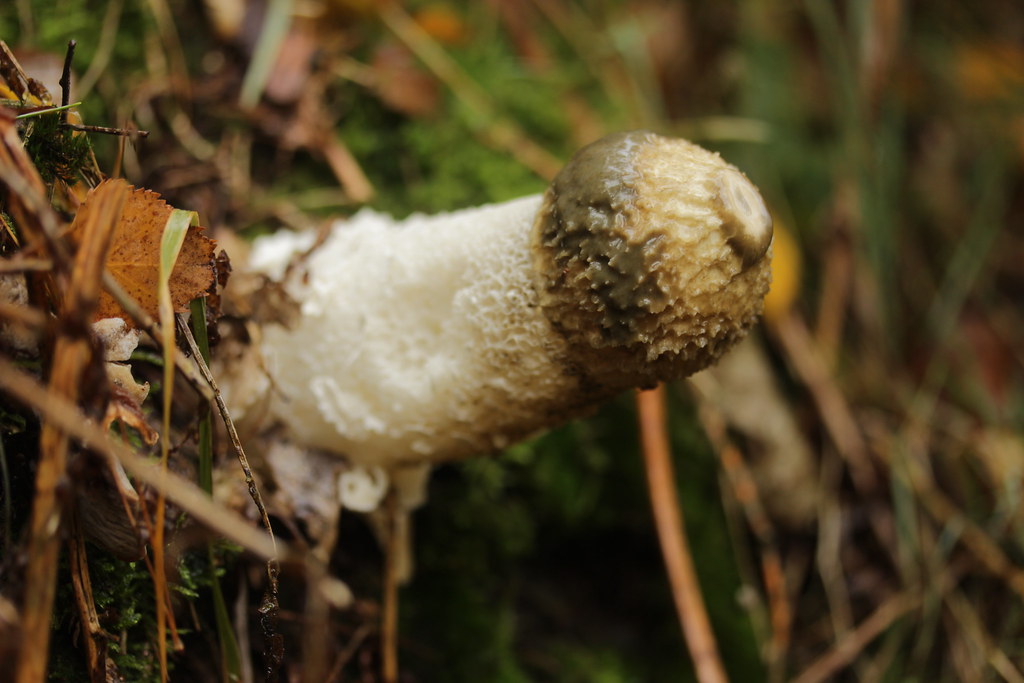
- Begins as a partially buried, egg-shaped or spherical structure, 3–6cm in diameter, with a leathery white to pinkish outer skin and a thick gelatinous inner layer. Upon maturing, it ruptures into lobes to release an upright, phallic stalk.
- Cap
- Bell-shaped or conical, 2–4cm tall, featuring a deeply pitted, honeycomb-like surface reminiscent of a morel. It is initially covered in a thick, foul-smelling, olive to dark-green slime.
- Stem
- Standing 10–25cm tall and 2–4cm wide, it is white, hollow, and has a fragile, spongy texture similar to expanded polystyrene. It is often narrowed at the ends.
- Gleba
- A dark olive-green to greenish-black slime covering the cap that contains the spores; it emits a powerful, repulsive odor of rotting meat or sewage to attract flies.
- Volva
- A membranous, cup-like structure at the base of the stem, representing the remains of the initial egg stage.
- Veil
- Occasionally present as a white, lacy, skirt-like net hanging from the base of the cap.
- Spore print
- Olive-brown to yellow-brown, though individual spores may appear pale yellow or colorless.
- Flesh
- White and spongy in the stem; the egg stage features a distinct gelatinous layer surrounding an embryonic interior.
Sporecast is better in the app
Plan ahead with 10-day forecasts, see what people are finding nearby, get photo IDs, and track your finds.
Edibility
The mushroom is edible only in its immature egg stage when the foul, sewage-like odor is absent and the embryonic interior is visible. The central portion of the egg has an earthy, radish-like taste and can be eaten raw or fried after the gelatinous layer is removed, though many foragers find it unpalatable. Once mature, the mushroom is generally considered inedible due to its repulsive smell, and its honeycomb-shaped head may be confused with a morel. In the egg stage, care must be taken not to confuse it with puffballs or the buttons of poisonous Amanita species.
Misidentification can be fatal. Never eat a mushroom unless you're 100% sure. This information may be inaccurate. Always consult multiple sources.
Nutrient Source
SaprotrophicIt obtains nutrients by decomposing dead organic matter, such as wood.
Common Names
- Basque
- etsai-ezten, etzai-ezten
- Catalan
- ou del diable, falus impúdic
- Danish
- Almindelig stinksvamp
- Dutch
- Grote stinkzwam
- English
- Common Stinkhorn, Stinkhorn
- Finnish
- haisusieni
- French
- Satyre puant, Morille du diable, Phallus impudique
- Galician
- carallá
- German
- Gemeine Stinkmorchel
- Norwegian
- falske morkler
- Norwegian Bokmål
- stanksopp
- Norwegian Nynorsk
- stanksopp
- Spanish
- falo impúdico, falo hediondo
- Swedish
- liksvamp, stinksvamp
- Welsh
- Cingroen
Synonyms
- Hymenophallus togatus
- Ithyphallus impudicus
- Ithyphallus impudicus
- Ithyphallus mauritianus
- Ityphallus impudicus
- Kirchbaumia imperialis
- Morellus impudicus
- Phallus foetidus
- Phallus impudicus
- Phallus mauritianus
- Phallus volvatus
- Phallus vulgaris