
Habitat
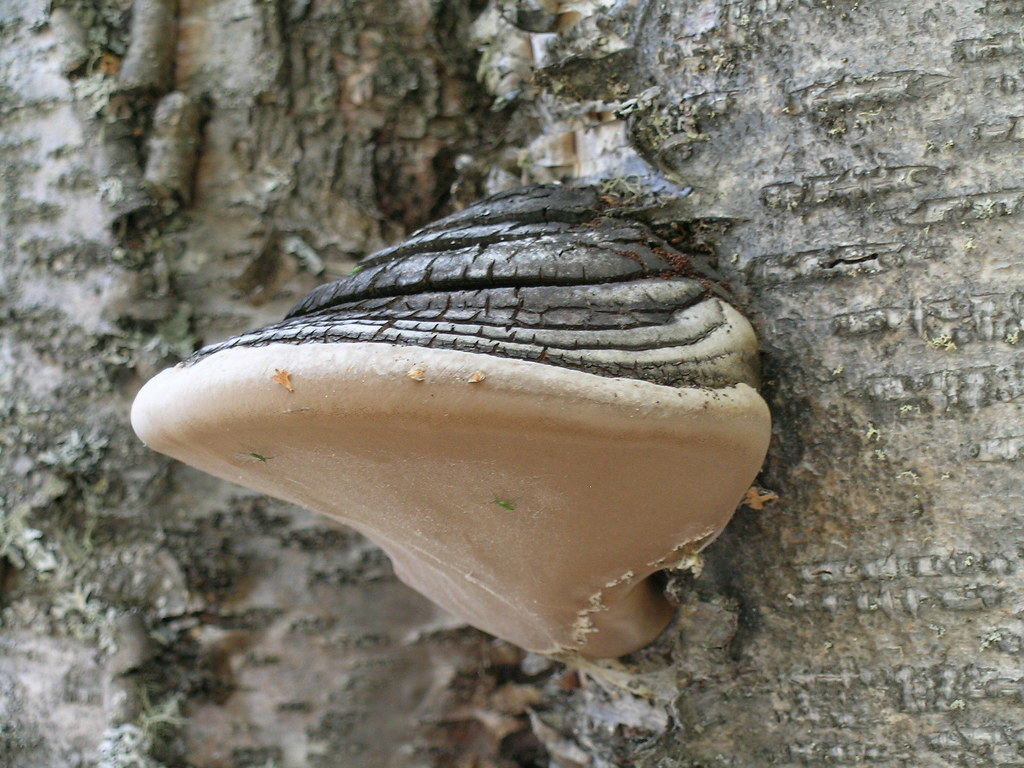
This parasitic bracket fungus grows on broad-leaved trees, most frequently occurring on the living trunks of willow and birch. It causes intensive white or yellowish soft rot and can be found on various living or dead hardwoods, typically situated on the lower trunk near the ground or on downed logs.
Photos
Appearance
- Bracket
- A very large, hard, and woody perennial growth that is typically hoof-shaped or cushion-like. The surface is concentrically ridged or grooved, starting out finely velvety and rusty brown before turning gray and finally black. As it ages, the surface becomes smooth but deeply cracked or crazed, and it often supports the growth of moss and algae.
- Pores
- Small and circular, numbering about 4 to 6 per millimeter. The color ranges from rusty cinnamon and maroon to reddish-brown or gray-brown as they weather.
- Tubes
- Arranged in layers, typically 2 to 5 millimeters deep per year; colored cinnamon to reddish-brown, sometimes becoming filled with white mycelium in older sections.
- Flesh
- Dense, brittle, and very hard; reddish-brown in color. The taste is reported as sour or bitter, and the smell is described as fungus-like.
- Spore print
- White.
Sporecast is better in the app
Plan ahead with 10-day forecasts, see what people are finding nearby, get photo IDs, and track your finds.
Edibility
The flesh of this mushroom is extremely hard and woody or brittle with a sour or bitter taste and a fungus-like smell.
Misidentification can be fatal. Never eat a mushroom unless you're 100% sure. This information may be inaccurate. Always consult multiple sources.
Nutrient Source
SaprotrophicIt obtains nutrients by breaking down and consuming dead organic matter, such as the lignin and cellulose found in trees.
Common Names
- Basque
- ardagai beltza, supizteko zume-ardagai
- Catalan
- bolet d´esca
- Danish
- Almindelig ildporesvamp, Elle-ildporesvamp
- Dutch
- Echte vuurzwam
- English
- Black Bristle Bracket, Willow Bracket
- Finnish
- arinakääpä, lepänarinakääpä
- French
- Polypore noircissant, Faux amadouvier
- German
- Schwarzer Birken-Feuerschwamm, Grauer Feuerschwamm
- Norwegian Bokmål
- oreildkjuke, bjørkeildkjuke, svart ildkjuke, ildkjuke, seljeildkjuke
- Norwegian Nynorsk
- eldkjuke, seljeeldkjuke, svart eldkjuke, bjørkeeldkjuke, oreeldkjuke
- Spanish
- yesquero negro, Yesquero, yesca, hongo yesquero, Clem., hongo del negral
- Swedish
- svart eldticka, eldticka
- Welsh
- Ysgwydd Helyg
Synonyms
- Agaricus igniarius
- Boletus igniarius
- Boletus nigricans
- Fomes igniarius
- Fomes igniarius
- Fomes igniarius
- Fomes nigricans
- Fomes nigricans
- Fomes roburneus
- Fomes roburneus
- Fomes trivialis
- Ganoderma triviale
- Ganoderma trivialis
- Mucronoporus igniarius
- Mucronoporus nigricans
- Ochroporus alni
- Ochroporus igniarius
- Ochroporus nigricans
- Phellinus alni
- Phellinus nigricans — Black Bristle Bracket
- Phellinus trivialis
- Placodes igniarius
- Placodes nigricans
- Polyporites igniarius
- Polyporites nigricans
- Polyporus igniarius
- Polyporus nigricans
- Polyporus roburneus
- Polyporus ungulatus
- Poria plicata
- Pseudofomes nigricans
- Pyropolyporus igniarius
- Pyropolyporus igniarius
- Scindalma igniarium
- Scindalma nigricans
- Scindalma roburneum
- Ungulina roburnea