
Habitat
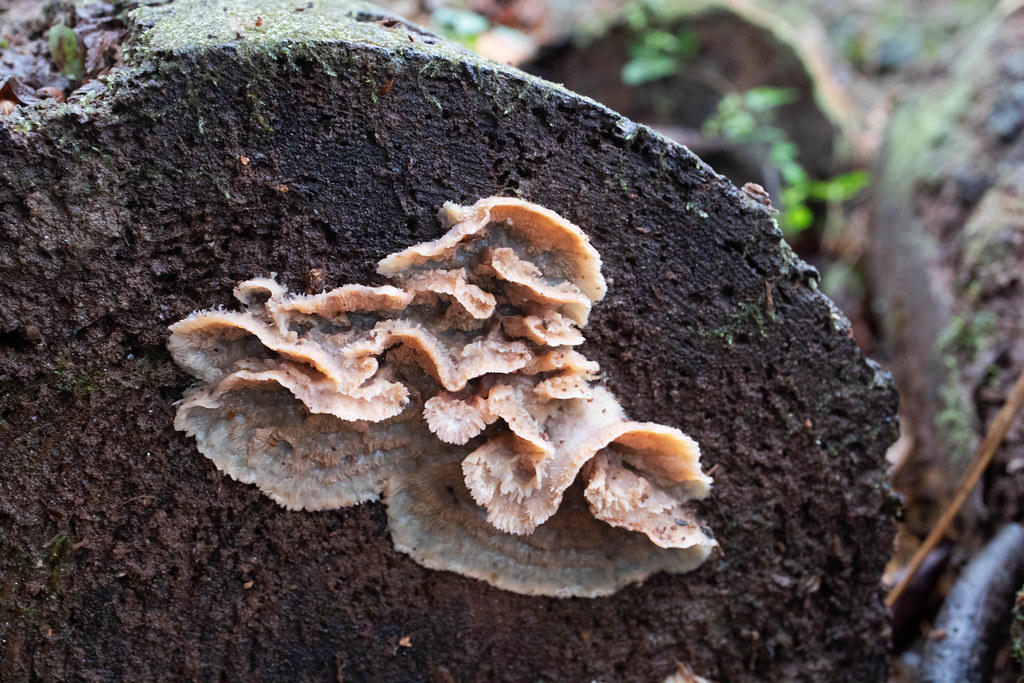
Phlebia tremellosa is a widespread white-rot fungus that acts as a decomposer on rotting wood. It is most commonly found on the stumps, fallen logs, and downed branches of deciduous trees, particularly birch, beech, ash, maple, and alder. It also occurs less frequently on coniferous wood. It typically grows on the sides or undersides of logs and debris, often colonizing barkless wood in large, overlapping clusters or contiguous rows.
Photos
Appearance
- Fruit body
- Forms spreading, irregular patches or crusts that often bend away from the wood to create shelf-like brackets. These caps are typically 1–5 cm across, thin, flexible, and frequently fuse together in tiered, overlapping clusters or long rows.
- Cap
- Upper surface is white to pale yellowish or pinkish-white, with a densely hairy or woolly texture. The margin is often wavy, translucent, and covered in silky radiating fibers.
- Fertile surface
- Located on the underside, the color ranges from orange-buff and salmon-pink to dull pinkish-orange, sometimes aging to blood red. It is gelatinous and characterized by a network of wrinkles, folds, and radiating ridges that create a net-like or pore-like appearance.
- Flesh
- White to translucent; thin and watery with a gelatinous, rubbery, or cartilaginous consistency. It becomes hard and tough when dry.
- Spore print
- White.
Sporecast is better in the app
Plan ahead with 10-day forecasts, see what people are finding nearby, get photo IDs, and track your finds.
Edibility
Generally considered inedible, this species has flesh that is gelatinous, rubbery, and thin, becoming hard when dried. It has an indistinct taste and a whitish to sausage-shaped pinkish-orange appearance that may be confused with Phlebia radiata, which typically lacks caps and is more brightly orange. Other lookalikes include Gelatoporia dichroa, which has distinct round pores and a drier texture, and Byssomerulius incarnatus, which features a pink upper surface.
Misidentification can be fatal. Never eat a mushroom unless you're 100% sure. This information may be inaccurate. Always consult multiple sources.
Nutrient Source
SaprotrophicIt obtains nutrients by breaking down dead organic matter, primarily wood from deciduous hardwoods and sometimes conifers.
Common Names
- Basque
- mukiazal laranja
- Danish
- Bævrende åresvamp
- Dutch
- spekzwoerdzwam, Spekzwoerdzwam
- English
- Trembling Crust, Jelly Rot
- Finnish
- hytyrypykkä
- French
- Mérule tremblante
- German
- Gallertfleischiger Fältling
- Norwegian Bokmål
- gelénettsopp
- Norwegian Nynorsk
- gelénettsopp
- Spanish
- corteza gelatinosa naranja
- Swedish
- dallergröppa
- Welsh
- Jeli Gwrychog
Synonyms
- Merulius imbricatus
- Merulius tremellosus
- Merulius tremellosus — Trembling Crust
- Sesia tremellosa
- Xylomyzon tremellosum