
Habitat
This species typically appears in dense, tufted clusters on the trunks and logs of both hardwoods and conifers. It is frequently found on living trees, often high up on the branches, as well as on dead or decaying wood. Common hosts include beech, maple, and elm.
Photos
Appearance
- Cap
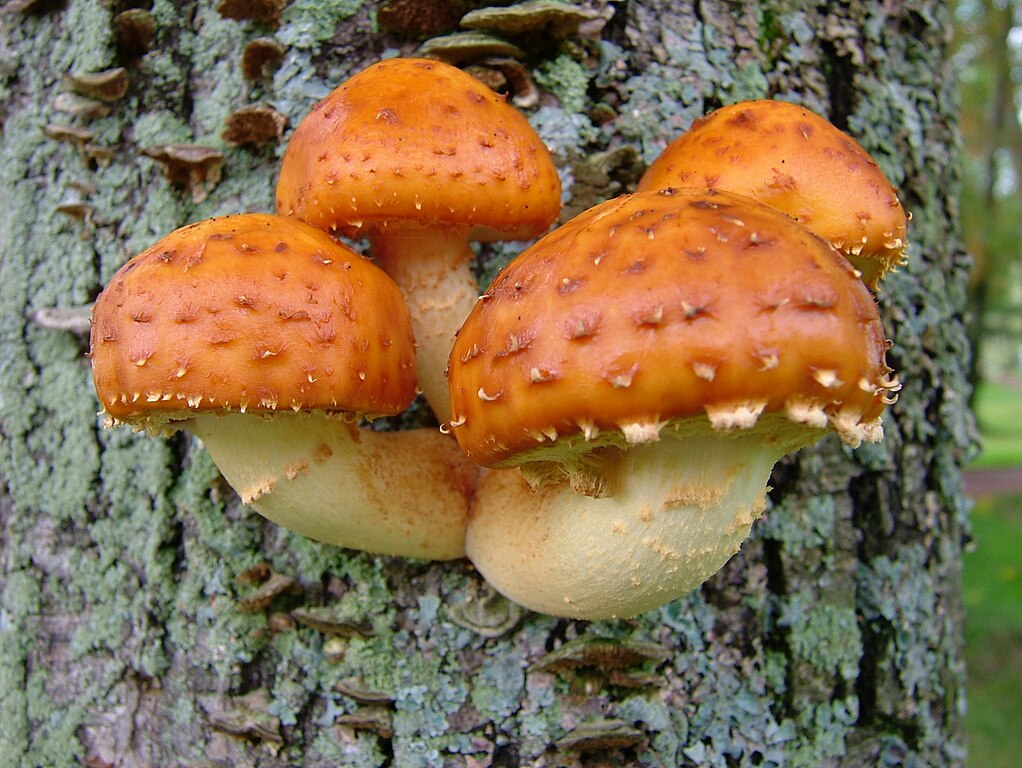
- Measuring 4 to 15 cm across, starting bell-shaped or convex and flattening over time, sometimes with a broad central bump. The surface is highly sticky or slimy, colored ochre-yellow to tawny-orange, and covered in large, flattened, brown, spot-like scales that are often arranged in concentric circles.
- Stem
- Measuring 5 to 9 cm long and up to 15 mm thick, often curved or tapering slightly. The surface is yellowish to yellow-brown, dry and smooth or cottony above the ring, but covered in small, upturned, slightly sticky scales toward the base.
- Gills
- Crowded and broadly attached to the stem, sometimes slightly notched. They transition in color from pale yellowish or cream to a tawny or dark reddish-brown as they mature.
- Flesh
- Firm and yellowish in color, possessing a faint sweet or mushroom-like scent and a slight or somewhat unpleasant taste.
- Spore print
- Rusty brown to dark red-brown.
- Partial veil
- White and filamentous, leaving a short-lived, thin ring or zone on the upper portion of the stem.
Sporecast is better in the app
Plan ahead with 10-day forecasts, see what people are finding nearby, get photo IDs, and track your finds.
Edibility
The flavor of this mushroom is variously described as slight, sweet, or faint and unpleasant. While some resources list this species as edible, others identify it as not edible. It is closely related to Pholiota squarrosa, which is known to cause gastrointestinal upset in some people, and it can be difficult to distinguish from Pholiota limonella and Pholiota squarrosoides without microscopically examining the spores.
Misidentification can be fatal. Never eat a mushroom unless you're 100% sure. This information may be inaccurate. Always consult multiple sources.
Nutrient Source
SaprotrophicIt obtains nutrients by decomposing dead organic matter, such as wood.
Common Names
- Basque
- urrezko egur-ziza
- Danish
- Pilemose-skælhat
- Dutch
- Wilgenbundelzwam, Goudvliesbundelzwam
- English
- Golden Scalycap, Golden Pholiota
- German
- Goldfell- Schüppling
- Norwegian Bokmål
- pileskjellsopp
- Norwegian Nynorsk
- pileskjelsopp
- Spanish
- foliota dorada, foliotauesa
- Welsh
- Cap Cennog Euraidd
Synonyms
- Agaricus aurivellus
- Agaricus ceriferus
- Agaricus filamentosus
- Dryophila aurivella
- Hypodendrum aurivellum
- Pholiota cerifera
- Pholiota lilacifolia
- Pholiota lilacifolia
- Pholiota serifera