
Habitat
Found on decaying wood, specifically dead or living deciduous trees, including large fallen trunks and branches. It shows a strong preference for hardwoods such as beech, but also occasionally occurs on conifer wood. Often found on well-decayed, barkless logs, it can also appear to be growing from the ground when emerging from buried wood. It may grow solitary, in small groups, or in tufted clusters.
Photos
Appearance
- Cap
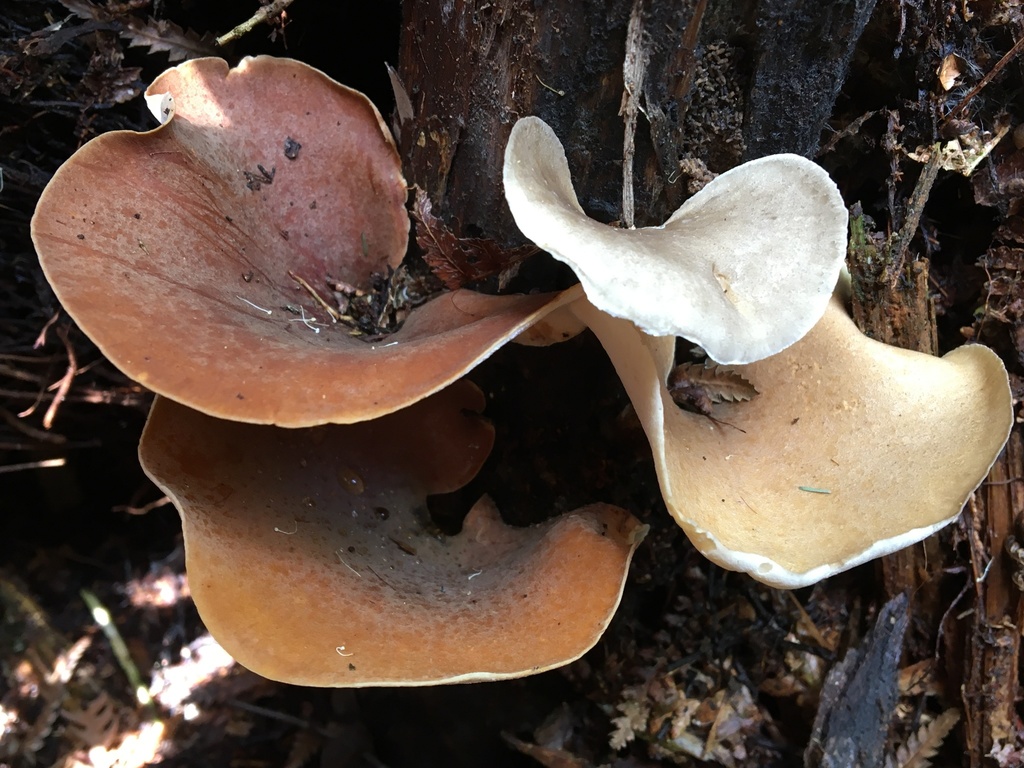
- 2 to 20 cm wide, ranging from circular to funnel-shaped, often with a sunken center and wavy or lobed margins. The surface is smooth and shiny when dry, slightly sticky when fresh, and colored chestnut, reddish-brown, or dark brown, often becoming darker toward the center.
- Stem
- 1 to 8 cm long, typically eccentric or off-center and fairly slender. It is distinctively black and velvety or fuzzy at the base, with the blackening often extending toward the apex as it matures; the upper portion is initially pale brown or cream.
- Pores
- Extremely small and dense (usually 6 to 10 per mm), making them difficult to see. They are white to cream when young, aging to pale buff or light tan.
- Tubes
- Very short and shallow, reaching up to 3 mm in depth, and decurrent where they meet the stem.
- Flesh
- Thin, white to cream-colored, and very tough, leathery, or corky in texture. It may turn brownish as it ages.
- Spore print
- White.
Sporecast is better in the app
Plan ahead with 10-day forecasts, see what people are finding nearby, get photo IDs, and track your finds.
Edibility
This species is considered inedible due to its very thin, corky, or leathery flesh that is too tough to eat. While some descriptions report a mild or indistinct flavor, others note a bitter taste. It is commonly confused with other closely related polypores with brownish caps and black-based stems, such as P. leptocephalus, P. melanopus, and P. varius.
Misidentification can be fatal. Never eat a mushroom unless you're 100% sure. This information may be inaccurate. Always consult multiple sources.
Nutrient Source
SaprotrophicIt obtains nutrients by breaking down dead organic matter, primarily from hardwood and conifer trees, causing white rot.
Common Names
- Danish
- Kastaniebrun stilkporesvamp
- Dutch
- Peksteel
- English
- Bay Polypore
- Finnish
- kastanjakääpä
- German
- Kastanienbrauner Schwarzfußporling
- Norwegian Bokmål
- kastanjestilkkjuke
- Norwegian Nynorsk
- kastanjestilkkjuke
- Spanish
- políporo bayo, poliporo bayo
- Swedish
- stor tratt-ticka, stor tratticka
- Welsh
- Cyfrwy Caled
Synonyms
- Boletus badius
- Boletus batschii
- Boletus durus
- Grifola badia
- Polyporellus badius
- Polyporus badius — Bay Polypore
- Polyporus durus
- Polyporus nigripes
- Royoporus badius
- Royoporus durus