
Habitat
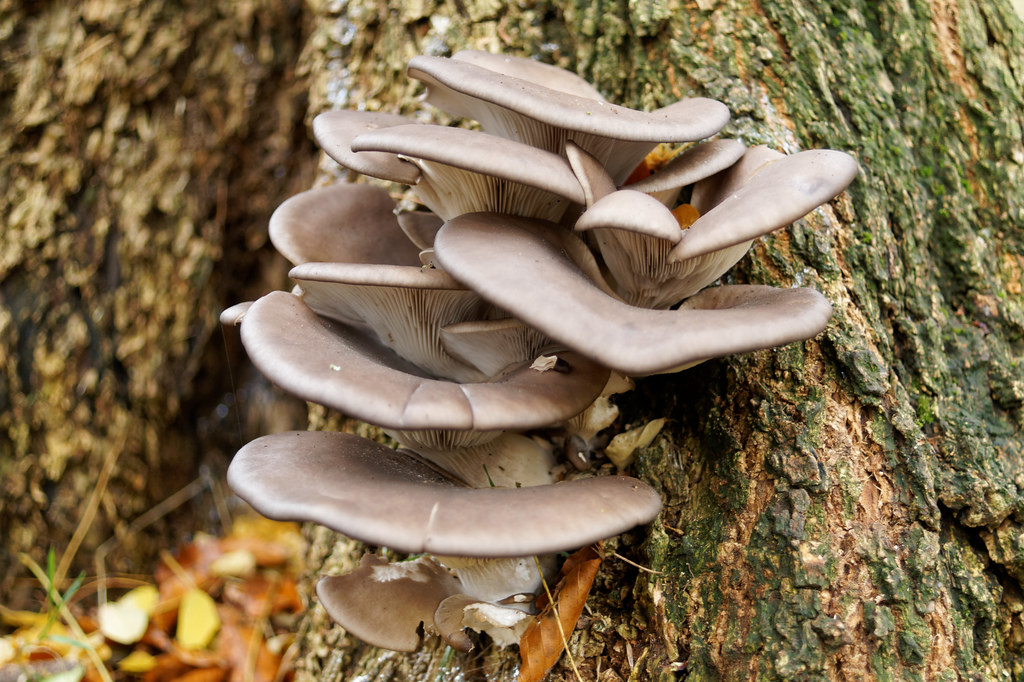
This species grows in small to large overlapping clusters or shelving groups on the wood of both broad-leaved and coniferous trees. It is found on trunks, stumps, and logs of dead or dying trees, such as poplar, willow, hickory, maple, magnolia, tanoak, oak, and alder. It also occasionally occurs on wood chips and worked timber. While primarily a decomposer, it can act as a weak parasite on living trees.
Photos
Appearance
- Cap
- 4–20 cm or more across; initially convex, becoming flattened, fan-shaped, or oyster-shell shaped. The surface is smooth and silky-shiny or slightly greasy when wet, with colors ranging from white and cream to shades of gray, brown, steel blue, or violet. The margin is initially inrolled but becomes wavy, lobed, or uplifted with age, and the color often pales or yellows as it dries.
- Gills
- Crowded to semi-distant, broad, and deeply decurrent, running down the stem or to the point of attachment. Color is white to cream, often becoming yellowish, pinkish-buff, or pale yellow in maturity.
- Stem
- Sometimes absent; when present, it is short (1–3 cm), stout, and positioned off-center or laterally. It is white to creamy, often curved, and typically features a woolly or hairy base.
- Flesh
- White, thick, and firm, but becoming tough, rubbery, or fibrous, especially near the point of attachment.
- Spore print
- White to buff, often with a distinct lilac or gray-lilac tint.
Sporecast is better in the app
Plan ahead with 10-day forecasts, see what people are finding nearby, get photo IDs, and track your finds.
Edibility
Pleurotus ostreatus must be cooked before consumption as it contains compounds that can damage red blood cells, which are neutralized by heat. While generally mild and mushroomy, its flavor can include sweet anise or almond notes, and the flesh is notably tough, rubbery, or stringy, especially in the stem. Foragers should inspect mature specimens for beetles in the gills and larvae in the flesh. It is part of a complex of similar-looking edible species, but it must be distinguished from the potentially deadly Angel’s Wings (Pleurocybella porrigens), which are smaller, thinner, and grow specifically on conifers. Other lookalikes include the toxic or dubious Crepidotus genus, which is distinguished by brown spore prints, and the rare Tapinella panuoides, which has drab brown colors and yellow-brown spores.
Misidentification can be fatal. Never eat a mushroom unless you're 100% sure. This information may be inaccurate. Always consult multiple sources.
Nutrient Source
facultativeIt obtains nutrients by decomposing dead organic matter, such as wood, but can also act as a parasite on living trees or prey on nematodes.
Common Names
- Basque
- belarri landua, ostra-belarri landua, belarri landu
- Catalan
- gírbola, clopisons, gírgola, orellas de poll, orellanas de polls, orellana, Orellanas
- Dutch
- Gewone oesterzwam
- English
- Oyster Mushroom
- Finnish
- osterivinokas
- French
- Pleurote en huître
- German
- Austernseitling
- Norwegian Bokmål
- blågrå østerssopp
- Norwegian Nynorsk
- blågrå østerssopp
- Spanish
- cabeza de fraile, parásito facultativo, pleuroto en forma de concha, pleuroto en forma de ostra, Orellana, seta de mano, oreja blanca, pleurotoncoideo, pleuroto ostreado, pleuroto de madera, pleuroto de tocones, falsa seta de cardo de la madera, seta de tocones
- Swedish
- ostronmussling
- Welsh
- Wystrysen y Coed
Synonyms
- Agaricus convivarum
- Agaricus fuligineus
- Agaricus glandulosus
- Agaricus limpidus
- Agaricus macropus
- Agaricus ochraceus
- Agaricus ostreatus
- Agaricus reticulatus
- Agaricus revolutus
- Agaricus salignus
- Agaricus salignus
- Agaricus spodoleucus
- Clitocybe ostreata
- Clitocybe saligna
- Crepidopus ostreatus
- Dendrosarcus ostreatus
- Dendrosarcus revolutus
- Panus carpathicus
- Panus carpathicus
- Pleuropus atroalbus
- Pleuropus ostreatus
- Pleurotus columbrinus
- Pleurotus glandulosus
- Pleurotus limpidus
- Pleurotus limpidus
- Pleurotus revolutus
- Pleurotus salignus
- Pleurotus spodoleucus
- Pleurotus suberis