
Habitat
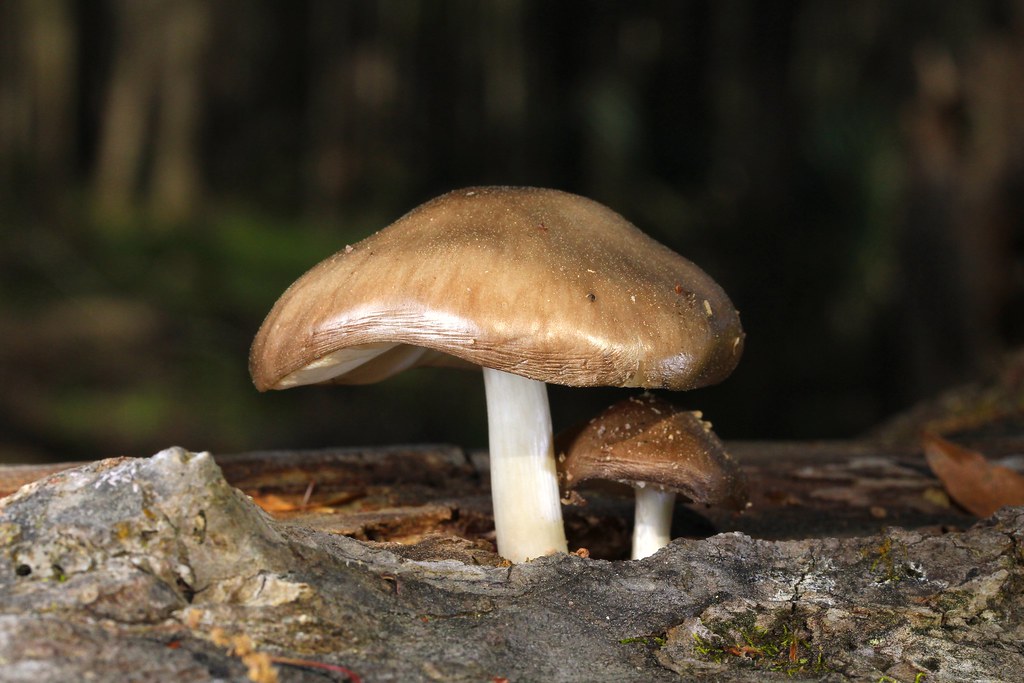
Pluteus cervinus is found on the rotting stumps, trunks, and logs of deciduous trees and, less frequently, conifers. It is common on sawdust, wood chips, and other woody debris, and may appear in urban habitats on landscaped areas or rising from buried wood. While it is often solitary or scattered, it can also grow in small, tufted groups.
Photos
Appearance
- Cap
- 3–15 cm wide; initially bell-shaped or convex, maturing to flat; typically brown, sepia, or gray-brown, often darkest at the center; surface is smooth, satiny, or subtly wrinkled, frequently featuring radiating dark streaks or fine fibers.
- Stem
- 4–15 cm long, 0.5–2 cm thick; cylindrical and often slightly swollen at the base; white to cream base color, typically decorated with gray or dark brown vertical fibers or fine scales.
- Gills
- Crowded and distinctly free from the stem; initially white, turning dull pink to salmon as the spores mature; edges may appear finely fringed or white.
- Flesh
- White, thick, and relatively firm when young, becoming softer with age; possesses a distinctive odor and taste reminiscent of radishes or raw potatoes.
- Spore print
- Pink, salmon-buff, or brownish-pink.
Sporecast is better in the app
Plan ahead with 10-day forecasts, see what people are finding nearby, get photo IDs, and track your finds.
Edibility
The deer mushroom is edible with soft flesh, though its taste and odor are frequently described as radish-like. While generally safe, foragers should avoid confusion with poisonous Entoloma species and be aware that it may contain psilocybin or psilocin. Identification is complicated by several morphologically identical or similar species, such as Pluteus exilis, P. pouzarianus, P. rangifer, and P. petasatus, which often require microscopic analysis or DNA sequencing to differentiate.
Misidentification can be fatal. Never eat a mushroom unless you're 100% sure. This information may be inaccurate. Always consult multiple sources.
Nutrient Source
SaprotrophicIt obtains nutrients by breaking down dead organic matter, such as decaying wood.
Common Names
- Basque
- pluteo marroia, izokin marroia
- Catalan
- bolet de soca rosat
- Danish
- Sodfarvet skærmhat
- Dutch
- Gewone hertenzwam
- English
- Deer Mushroom, Fawn Pluteus, Deer Shield
- Finnish
- koivulahorusokas
- French
- Plutée couleur de cerf
- German
- Rehbrauner Dachpilz, Braunfaseriger Dachpilz
- Norwegian Bokmål
- vanlig skjermsopp, skjermsopp
- Norwegian Nynorsk
- vanleg skjermsopp, skjermsopp
- Spanish
- Plúteo cervino, plúteo blanco, pluteo marroi
- Swedish
- hjortskölding, skölding
- Welsh
- Tarian Carw
Synonyms
- Agaricus atricapillus
- Agaricus cervinus
- Agaricus curtisii
- Agaricus pluteus
- Agaricus pluteus
- Gymnopus pluteus
- Hyporrhodius cervinus
- Pluteus atricapillus
- Pluteus atricapillus
- Pluteus atricapillus
- Pluteus brunneoradiatus
- Pluteus bullii
- Pluteus bullii
- Pluteus curtisii
- Pluteus curtisii
- Pluteus curtsii
- Pluteus eximius
- Rhodosporus cervinus