
Habitat
Woodland
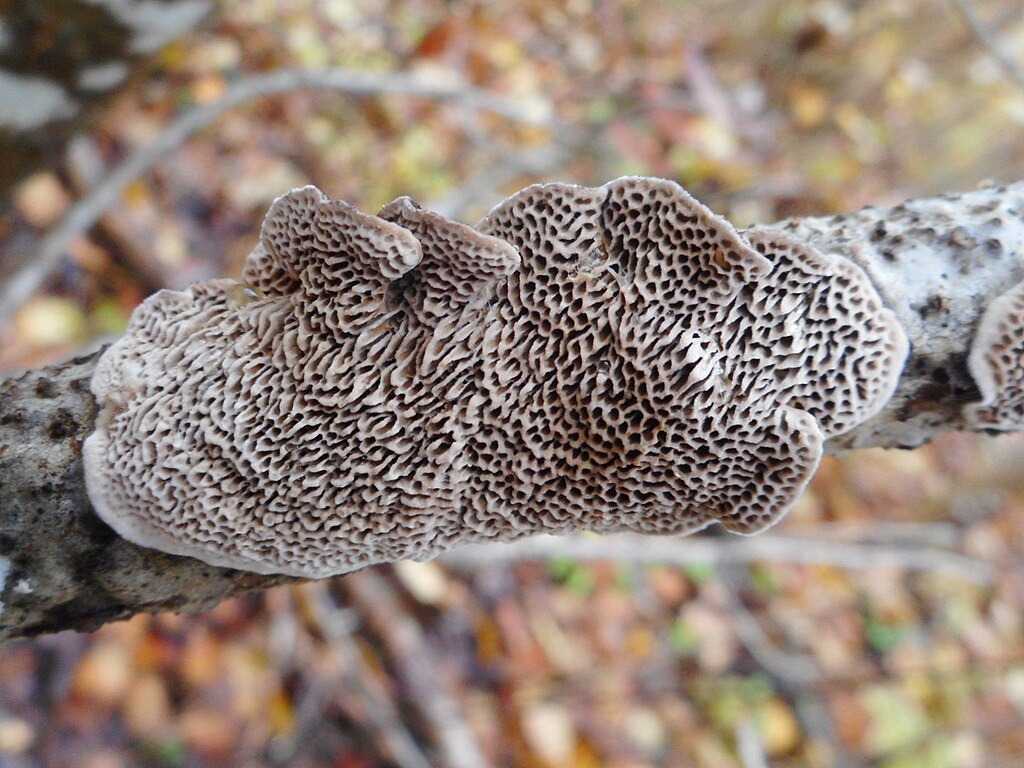
This species grows on the dead wood of deciduous or broad-leaved trees. It typically forms irregular, spreading patches or overlapping tiers of narrow, shelf-like brackets that are loosely attached to the substrate.
Photos
Appearance
- Fruit body
- Forms spreading, irregular patches or narrow, undulating, shelf-like brackets that often overlap in tiers; loosely attached to the wood surface with a wavy-lobed margin.
- Bracket
- Upper surface is umber-brown and finely velvety when fresh, later smooth and turning dark brown or black; surfaces may bruise darker.
- Flesh
- Pale brown, cream, or buff in color, often featuring a black line just beneath the upper surface; texture is tough and leathery, becoming brittle when dry.
- Tubes
- Ranging from 0.5 to 5 millimeters in depth and ochre-colored.
- Pores
- Large and angular to irregular or slot-like; initially grayish due to a white bloom, but maturing to yellowish-brown or umber where handled.
- Spore print
- White.
Sporecast is better in the app
Plan ahead with 10-day forecasts, see what people are finding nearby, get photo IDs, and track your finds.
Edibility
Not edible
This species is considered inedible. The flesh has a tough, leathery texture that becomes hard and brittle when it is dry.
Misidentification can be fatal. Never eat a mushroom unless you're 100% sure. This information may be inaccurate. Always consult multiple sources.
Nutrient Source
SaprotrophicThis fungus obtains nutrients by decomposing dead organic matter, primarily wood.
Common Names
- Danish
- Blød begporesvamp
- Dutch
- Wijdporiekurkzwam
- English
- Common Mazegill
- Finnish
- kennokääpä
- French
- Tramète à odeur d'abricot
- German
- Großporige Tramete
- Norwegian Bokmål
- skorpekjuke
- Norwegian Nynorsk
- skorpekjuke
- Swedish
- stor hjortticka
- Welsh
- Tagell Ddryslyd Gyffredin
Synonyms
- Antrodia mollis
- Boletus substrigosus
- Cerioporus mollis
- Cerrena mollis
- Daedalea lassbergii
- Daedalea mollis
- Daedaleopsis mollis
- Datronia mollis — Common Mazegill
- Polyporus mollis
- Polyporus sommerfeldtii
- Polyporus sommerfeltii
- Trametes mollis
- Trametes serpens