
Habitat
Woodland
Occurs on the ground in deciduous woodlands, specifically growing from the living roots of broad-leaved trees. It has a particular association with oak trees and is most frequently found in old-growth woodland environments.
Photos
Appearance
- Fruit body
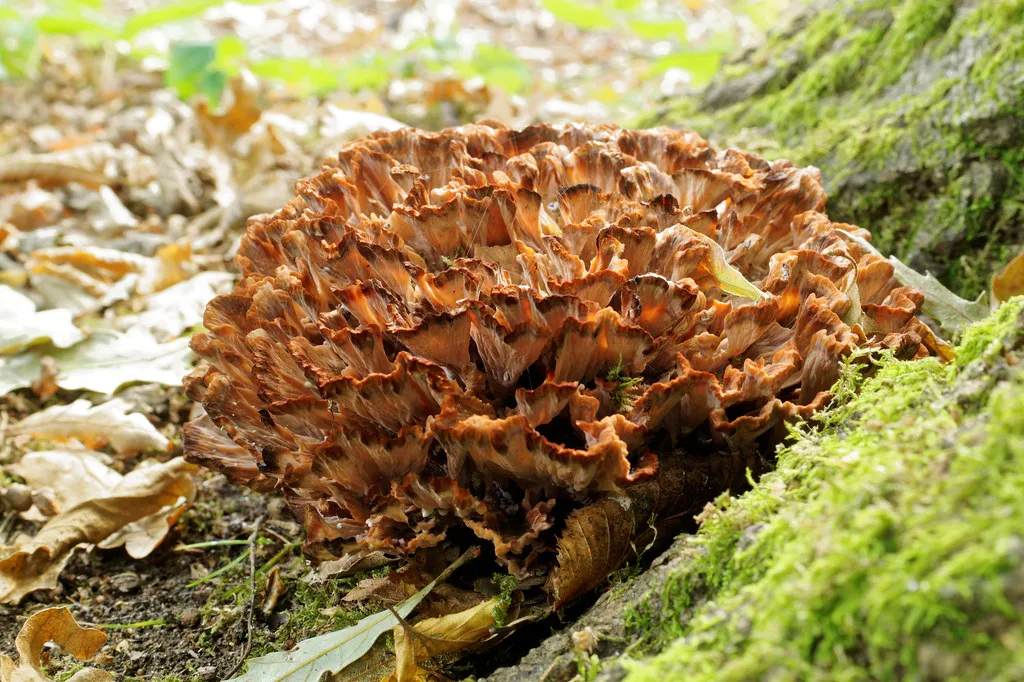
- Forms a large, rosette-shaped mass measuring up to 20 cm across. It consists of numerous thin, leathery, fan-shaped or spoon-shaped lobes that grow upward from a thick, central base. In some cases, the lobes fuse together to resemble a cauliflower-like growth.
- Caps
- The individual lobes are colored flesh-pink to rich brown and are marked with distinct, darker concentric bands.
- Spore-bearing surface
- The underside of the lobes is pale brown to grayish.
- Flesh
- Whitish-pink and very tough or leathery in texture.
- Stem
- A stout, common base from which the various lobes arise.
- Spore print
- White.
Sporecast is better in the app
Plan ahead with 10-day forecasts, see what people are finding nearby, get photo IDs, and track your finds.
Edibility
Not edible
The flesh of this species is described as whitish pink and very tough or leathery.
Misidentification can be fatal. Never eat a mushroom unless you're 100% sure. This information may be inaccurate. Always consult multiple sources.
Nutrient Source
ParasiticIt gains nutrients by being a parasite on the roots of deciduous trees, particularly oaks and beeches.
Common Names
- English
- Zoned Rosette
- Welsh
- Roséd Cylchog
Synonyms
- Stereum multizonatum
- Thelephora multizonata