
Habitat
This species grows on the fallen twigs and dead branches of deciduous trees, specifically hardwood species like beech, hazel, and gorse. It can also be found in mixed conifer and oak forests. While often seen on dead wood, it frequently fruits from a large, rubbery, underground mass called a sclerotium that can range in size from a golf ball to a soccer ball. It typically appears as solitary specimens or in small clusters or tufted groups.
Photos
Appearance
- Cap
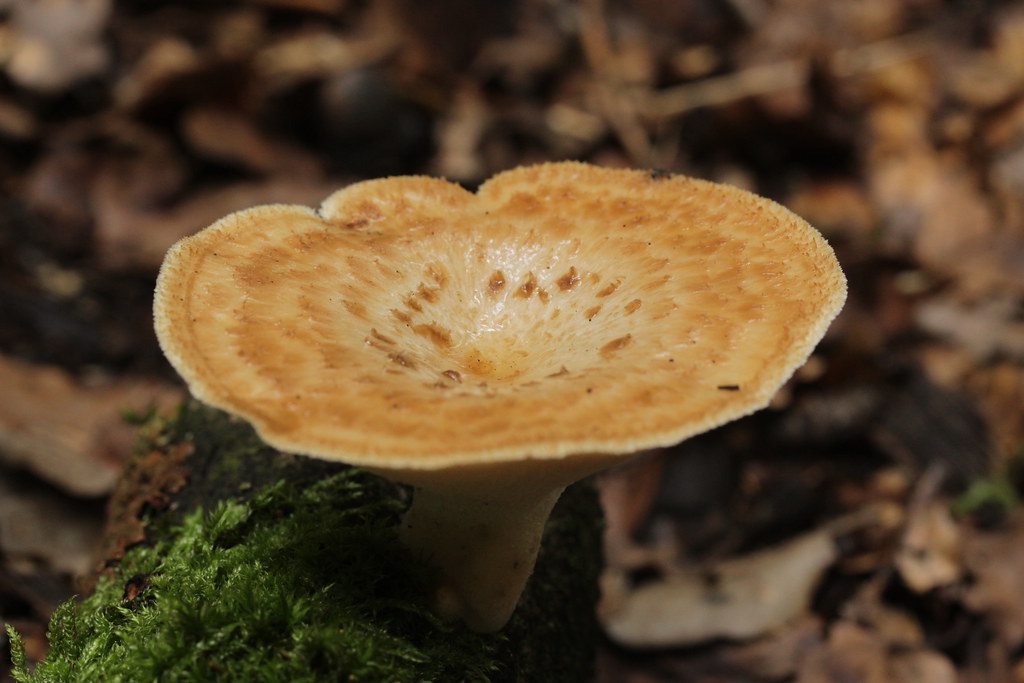
- Measuring 2–12 cm across, it varies from semicircular to circular or funnel-shaped. The surface is yellow-cream, light brown, or grayish and is covered in concentrically arranged, dark, pointed scales or tufts of hair.
- Stem
- 1–10 cm long and 0.5–4 cm thick, it can be central, off-center, or lateral. It is pale cream to light brown, often featuring a hairy or roughened base and sometimes forking or branching.
- Pores
- The surface is white to ochraceous-cream with angular, polygonal, or elongated pores that typically have a toothed appearance.
- Tubes
- Shallow and pale-colored, the tube layer runs significantly down the stem.
- Flesh
- White, thick, and firm with a texture ranging from elastic to tough or leathery.
- Sclerotium
- A notable underground mass of hard, rubbery tissue, ranging from the size of a golf ball to a soccer ball, with a dark wrinkled exterior and marbled interior.
- Spore print
- White.
Sporecast is better in the app
Plan ahead with 10-day forecasts, see what people are finding nearby, get photo IDs, and track your finds.
Edibility
Known for its elastic, tough, rubbery, or leathery flesh, this species is generally considered inedible. It has a mild to indistinct taste and a mushroomy to indistinct odor. It may be confused with the larger Dryad’s Saddle, which forms tiers of overlapping shelves on hardwoods, or Polyporus decurrens, which has a shorter, off-center stem and grows directly from wood.
Misidentification can be fatal. Never eat a mushroom unless you're 100% sure. This information may be inaccurate. Always consult multiple sources.
Nutrient Source
SaprotrophicIt obtains nutrients by decomposing dead or decaying hardwood, often growing from buried branches or a tuber-like structure.
Common Names
- Danish
- Knoldet stilkporesvamp
- Dutch
- Franjeporiezwam
- English
- Tuberous Polypore
- French
- Polypore moucheté
- Norwegian Bokmål
- knollstilkkjuke
- Norwegian Nynorsk
- knollstilkkjuke
- Spanish
- licia, políporo blando, poliporo de forquignon
- Swedish
- stenticka
- Ukrainian
- Трутовик бульбастий
- Welsh
- Cyfrwy Cnapwreiddiog
Synonyms
- Boletus tuberaster
- Boletus tuberaster
- Ceriomyces tuberaster
- Cerioporus boucheanus
- Cerioporus forquignonii
- Favolus boucheanus
- Favolus ciliaris
- Fungus tuberaster
- Leucoporus forquignonii
- Leucoporus lentus
- Melanopus coronatus
- Melanopus forquignonii
- Melanopus forquignonii
- Melanopus lentus
- Mycelithe fungifera
- Polyporellus boucheanus
- Polyporellus tuberaster
- Polyporus boucheanus
- Polyporus boucheanus
- Polyporus coronatus
- Polyporus floccipes
- Polyporus forquignonii
- Polyporus forquignonii
- Polyporus lentus
- Polyporus tiliae
- Polyporus tiliae
- Rhodophyllus forquignonii