
Habitat
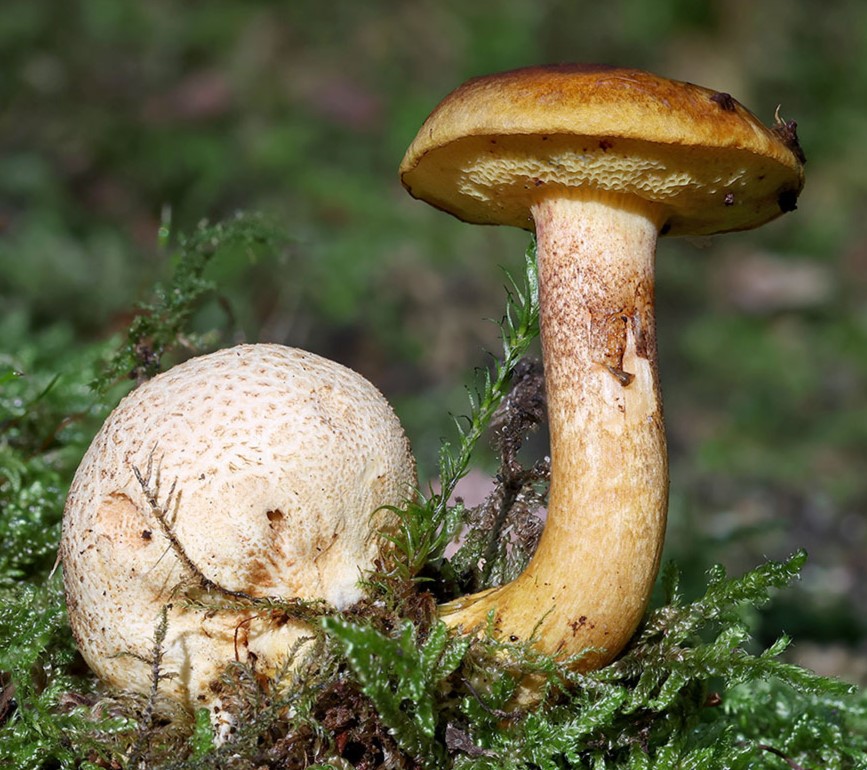
This bolete has a highly specialized habitat, growing exclusively in a symbiotic or parasitic relationship on the fruit bodies of earthballs, specifically Scleroderma citrinum. It can be found solitary or in small clusters on the decaying tissue of its host. The species occurs in diverse forest types, including hardwood, mixed coniferous, and Appalachian forests, often appearing where hemlock is present.
Photos
Appearance
- Cap
- 2 to 6.5 cm wide, starting hemispherical and becoming convex. The surface is dry, finely velvety or downy, and may crack with age. Color ranges from yellowish-brown and ochre to tarnish-brass or olive-brown.
- Stem
- 2 to 7 cm long, often curved around the host fungus and tapering toward the base. Color is similar to the cap, sometimes featuring fine reddish dots, with white mycelium visible at the base.
- Tubes
- Attached to slightly running down the stem. They begin lemon-yellow and mature to ochre, rust, or reddish-brown.
- Pores
- Small and round, initially lemon-yellow, aging to a rusty or olive-tinted color; they do not turn blue when bruised.
- Flesh
- Firm and pale lemon-yellow, typically unchanging when cut, though it may show a rust-colored flush at the base of the stem.
- Spore print
- Olive-brown to olive-walnut brown.
- Fruit body
- Found growing directly out of the fruit bodies of earthballs (Scleroderma citrinum), either solitary or in small clusters.
Sporecast is better in the app
Plan ahead with 10-day forecasts, see what people are finding nearby, get photo IDs, and track your finds.
Edibility
Identified by its growth on Scleroderma citrinum earthballs, this species has been reported as edible with caution, though it is often considered flavorless. While the mushroom itself is edible, never consume the host earthball, as it is poisonous. It is largely unmistakable due to its unique habitat, though some specimens in the southern United States have been observed with slimy caps, potentially indicating a different species.
Misidentification can be fatal. Never eat a mushroom unless you're 100% sure. This information may be inaccurate. Always consult multiple sources.
Nutrient Source
ParasiticIt obtains nutrients by parasitizing other fungi, specifically earthballs.
Common Names
- Basque
- astaputz ontoa, astaputz-onddo
- Danish
- Snyltende rørhat
- Dutch
- Kostgangerboleet
- English
- Parasitic Bolete
- French
- Bolet parasite
- German
- Schmarotzerröhrling
- Norwegian Bokmål
- snylterørsopp
- Norwegian Nynorsk
- snylterøyrsopp
- Spanish
- boleto parasitario, Boleto parásito, hongo de Escleroderma, hongo de Scleroderma
- Swedish
- parasitsopp
- Ukrainian
- Псевдомоховик паразитний
- Welsh
- Cap Tyllog Parasitaidd
Synonyms
- Boletus parasiticus
- Boletus parasiticus
- Boletus parasitus
- Ceriomyces parasiticus
- Suillus parasiticus
- Versipellis parasitica
- Xerocomus parasiticus