
Habitat
This species grows on soil, amongst leaf litter, or in grassy areas, particularly those near trees. It is frequently found on or around highly decomposed logs, stumps, bark, and other woody debris in both coniferous and broad-leaved mixed woodlands. It may appear solo, in clusters, or in small groups.
Photos
Appearance
- Cap
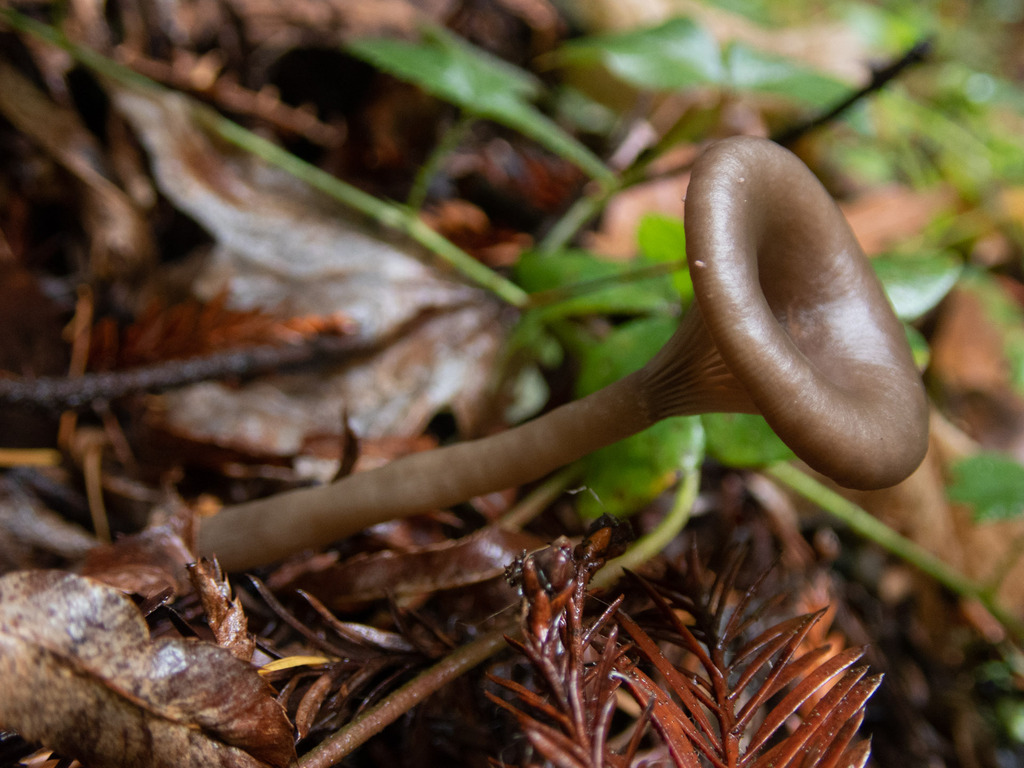
- 2–8 cm across, funnel or goblet-shaped with a strongly inrolled margin. The smooth surface is dark grey-brown to umber when moist, fading to a pale grey or buff as it dries. Young specimens may feature a low central bump or a fine pale bloom.
- Stem
- 4–10 cm long and 5–10 mm thick, usually cylindrical with a swollen or bulbous base. The color is greyish-brown but paler than the cap, covered in silvery-white silky fibers that may appear net-like or striate like woven rope.
- Gills
- Crowded and ranging from adnate to more typically decurrent. Initially pale grey or greyish-white, becoming greyish-brown or tan with age. They are sometimes forked.
- Flesh
- Thin and watery; pallid or greyish in color. The texture is soft or slightly rubbery in the cap and more fibrous in the stem.
- Spore print
- White to off-white.
- Odor and taste
- Taste is mild and faint; odor is indistinct or slightly mushroomy.
Sporecast is better in the app
Plan ahead with 10-day forecasts, see what people are finding nearby, get photo IDs, and track your finds.
Edibility
This mushroom has a mild taste and indistinct or mushroomy odor. Its flesh can be watery, thin, or slightly rubbery and flabby in the cap. It is recommended for experienced collectors as it is easily confused with many similar small mushrooms of uncertain edibility, such as Omphaliaster asterosporus. Other similar species include the deeply vase-shaped Pseudoarmillariella ectypoides, which features prominent cap scales, and the umbonate Cantharellula umbonata.
Misidentification can be fatal. Never eat a mushroom unless you're 100% sure. This information may be inaccurate. Always consult multiple sources.
Nutrient Source
SaprotrophicIt obtains nutrients by decomposing dead organic matter, such as dead wood, logs, soil, and leaf litter.
Common Names
- Danish
- Almindelig bægertragthat
- Dutch
- Bruine schijntrechterzwam
- English
- Goblet
- Finnish
- valemalikka
- French
- Clitocybe en coupe
- German
- Kaffeebrauner Gabeltrichterling
- Norwegian Bokmål
- kaffebrun traktsopp
- Norwegian Nynorsk
- kaffibrun trektsopp
- Swedish
- trattnavling
- Ukrainian
- Псевдоклітоцибе келиховидний
- Welsh
- Gobled/Ffiol y Coed
Synonyms
- Agaricus aithopus
- Agaricus cinerascens
- Agaricus cyathiformis
- Agaricus rufolamellatus
- Agaricus sordidus
- Agaricus tardus
- Cantharellula cyathiformis
- Clitocybe cinerascens
- Clitocybe cinerascens
- Clitocybe cinerescens
- Clitocybe cyathiformis
- Clitocybe cyathiformis
- Omphalia cyathiformis
- Omphalia cyathiformis
- Omphalia tarda
- Omphalina cyathiformis