
Habitat
Grassland or Woodland
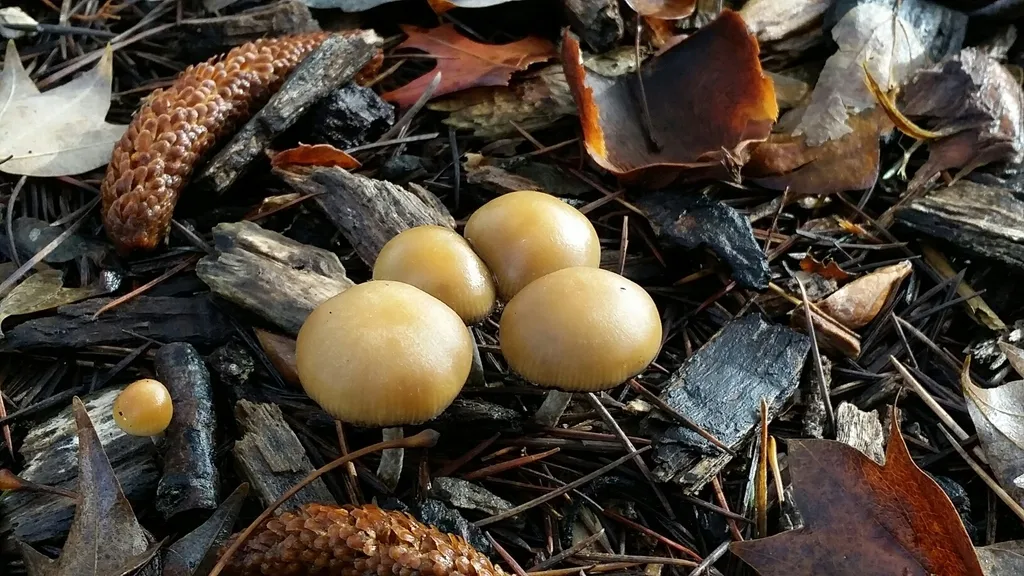
This species is primarily found in urban landscapes growing on wood chips, hardwood mulch, and general woody debris. It also occurs in coastal environments, specifically on grassy sand dunes and in other disturbed habitats. It typically grows in small groups, clusters, or larger troops.
Photos
Appearance
- Cap
- 1.5–9 cm wide; initially hemispheric to convex, maturing to broadly convex or flat. The surface is smooth and can be sticky or dry. It is strongly hygrophanous, colored orange-brown to caramel when moist and fading to yellowish-brown or beige as it dries. The margin is often translucent-striate when wet and lacks the wavy edges typical of similar species. It frequently develops blue-green stains.
- Gills
- Close and narrow; broadly attached, notched, or with a slight downward tooth. Initially creamy beige to pale cinnamon brown, eventually becoming mottled with dark purple-brown or purple-gray as spores mature.
- Stem
- 3–9 cm long and 2–7 mm thick; cylindrical or slightly wider at the base. The surface is dry and silky-fibrillose, with the top sometimes appearing powdery. Primarily white but discolors to dingy brown with age and bruises blue. The base often features white, root-like rhizomorphs.
- Flesh
- Firm and fibrous, ranging from rubbery in the cap to tough in the stem. Color is whitish to dingy tan, slowly bruising blue-green to dark blue when damaged.
- Partial veil
- A thin, white, cobweb-like cortina that may leave temporary faint hairs on the stem before disappearing.
- Spore print
- Dark purple-brown to purple-black or purple-gray.
- Odor
- Mild and earthy or starchy.
- Taste
- Starchy (farinaceous).
Sporecast is better in the app
Plan ahead with 10-day forecasts, see what people are finding nearby, get photo IDs, and track your finds.
Edibility
No
Contains psychoactive compounds. Possession is illegal in some jurisdictions. Follow all local laws.
Misidentification can be fatal. Never eat a mushroom unless you're 100% sure. This information may be inaccurate. Always consult multiple sources.
Nutrient Source
SaprotrophicIt obtains nutrients by breaking down dead organic material, such as wood chips and other woody debris.