
Habitat
Woodland
Psilocybe caerulipes typically grows alone or in small clusters on decaying hardwood logs and debris. It has a specific affinity for birch, beech, and maple wood, particularly when located near river systems.
Photos
Appearance
- Cap
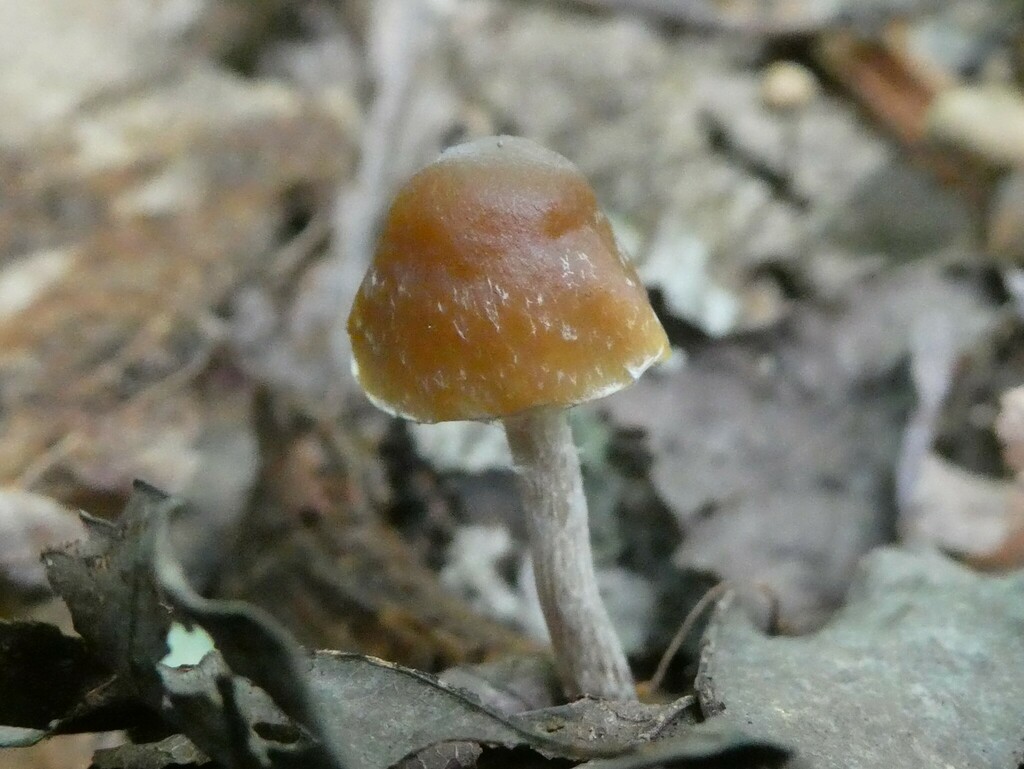
- Small, measuring 1 to 3.5 cm in diameter; shape progresses from obtusely conic to broadly convex or bell-shaped with age. The surface is slippery, cinnamon-brown to dingy brown, often featuring white flecks, and slowly bruises greenish-blue when handled.
- Gills
- Attached to the stem (adnate to sinuate) and narrow; the color is cinnamon-brown to rusty brown, often with white edges.
- Stem
- Measuring 30 to 60 mm long and 2 to 3 mm thick; the surface is white near the top with white dots and becomes dingy cinnamon-brown or fibrillose toward the base. It slowly turns greenish-blue where bruised or handled.
- Spore print
- Purple-brown.
Sporecast is better in the app
Plan ahead with 10-day forecasts, see what people are finding nearby, get photo IDs, and track your finds.
Edibility
No
Contains psychoactive compounds. Possession is illegal in some jurisdictions. Follow all local laws.
Misidentification can be fatal. Never eat a mushroom unless you're 100% sure. This information may be inaccurate. Always consult multiple sources.
Nutrient Source
SaprotrophicIt obtains nutrients by decomposing dead organic matter, such as decaying wood and leaf litter.
Common Names
- English
- Blue-foot
Synonyms
- Agaricus caerulipes