
Habitat
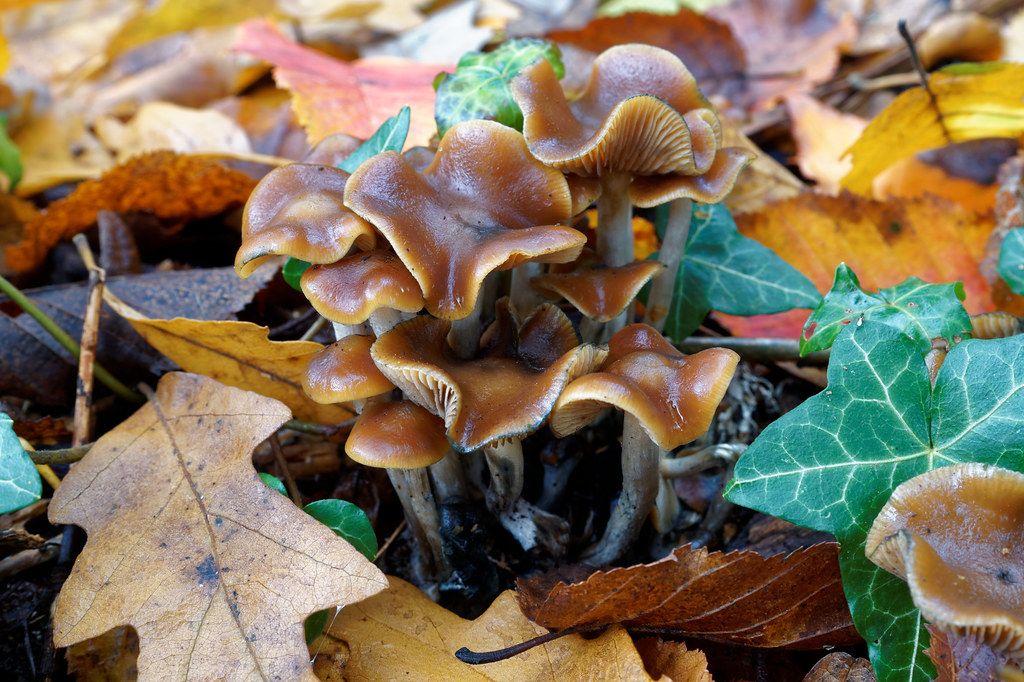
Psilocybe cyanescens thrives on wood-based substrates, particularly wood-chip mulch, rotting sawdust, and woody debris. It is frequently found in urban environments such as gardens, paths, and landscaped areas, as well as the edges of mixedwood forests. It typically grows in large groups, clusters, or troops. While primarily associated with broad-leaved trees and deciduous wood, it also occasionally occurs in disturbed grassy areas and among dune grasses along coastal regions.
Photos
Appearance
- Cap
- 2–8 cm wide; starting conical or convex, expanding to flat or broadly convex, often with a low, round central bump. The margin is notably wavy or undulating when mature, translucent-striate when wet, and often extends beyond the gills. Color is chestnut-brown to caramel when moist, drying to ochre-cream or beige; it quickly develops blue-green stains where handled. Surface is smooth and becomes sticky or slimy when wet.
- Stem
- 2.5–10 cm long, 0.25–0.8 cm thick; cylindrical and equal or with a swollen, club-shaped base. Surface is silky-fibrous, dry, and bright white to pale tan. It bruises strongly blue to blue-green when touched and often has white fungal threads at the base.
- Gills
- Attached (adnate) to slightly descending (decurrent); pale ochre, clay, or cinnamon-brown when young, becoming dark purplish-brown to purplish-black as they mature. The edges are often white or paler and may appear eroded.
- Flesh
- White to pale tan; thin and somewhat rubbery in the cap, but tough and fibrous in the stem. It slowly bruises dark blue to blue-green.
- Partial veil
- A thin, white, cobweb-like membrane (cortina) that disappears or leaves an indistinct, hairy ring-zone on the upper stem.
- Spore print
- Dark purple-brown to purplish-black.
- Odor
- Faintly to strongly mealy (farinaceous) or earthy.
Sporecast is better in the app
Plan ahead with 10-day forecasts, see what people are finding nearby, get photo IDs, and track your finds.
Edibility
Contains psychoactive compounds. Possession is illegal in some jurisdictions. Follow all local laws.
Misidentification can be fatal. Never eat a mushroom unless you're 100% sure. This information may be inaccurate. Always consult multiple sources.
Nutrient Source
SaprotrophicThis species obtains nutrients by breaking down dead organic matter, such as wood chips and plant debris. It is a decomposer in its ecosystem.
Common Names
- Danish
- Blånende nøgenhat
- Dutch
- Blauwwordend kaalkopje
- English
- Blueleg Brownie
- German
- Blaufärbender Kahlkopf
- Norwegian Bokmål
- blånende fleinsopp
- Norwegian Nynorsk
- blånande fleinsopp
- Welsh
- Cap Tonnog
Synonyms
- Psilocybe cyanascens