
Habitat
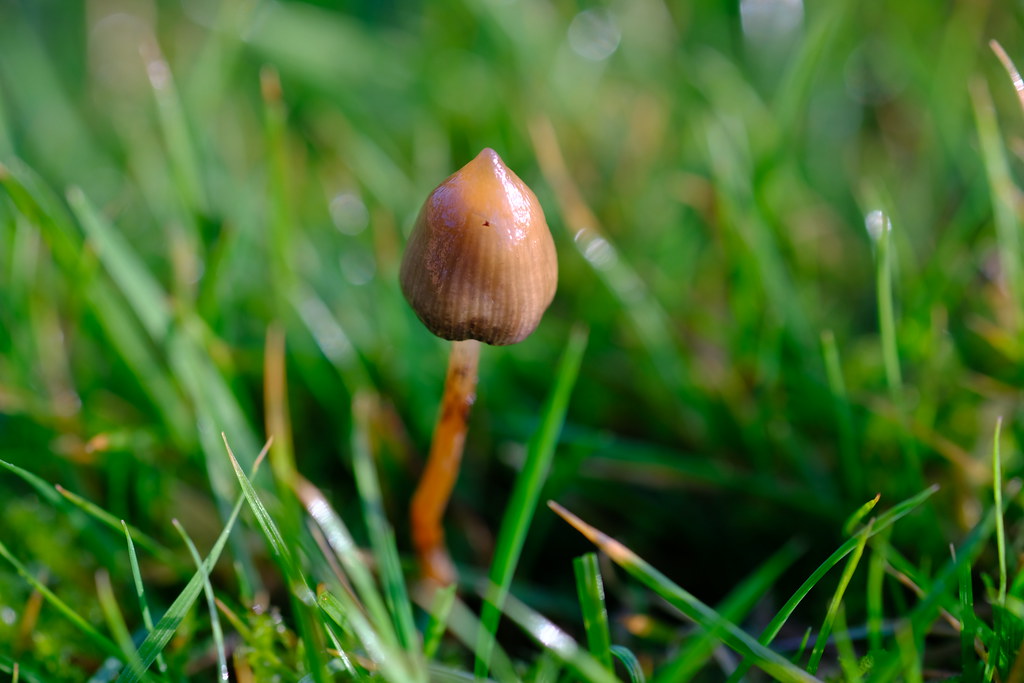
This species is found on soil in grassy environments, including pastures, lawns, playing fields, meadows, and along roadsides or path edges. It frequently inhabits acidic sites and montane grasslands. While often associated with sheep or cow pastures and well-manured fields, it typically grows among clumps of taller grass near dung rather than directly on it. It may grow solitary, in groups, or in trooping formations.
Photos
Appearance
- Cap
- 0.5–2.5 cm across; conical or bell-shaped with a notably sharp, nipple-like point (umbo). The surface is smooth and covered with a thin, sticky, gelatinous skin that can be peeled. Highly hygrophanous, it is dark chestnut-brown to olive-brown when wet and fades to a pale yellowish-tan or buff when dry. The margin is often puckered, translucent-striate when moist, and sometimes stained blue or purple-brown from spores.
- Stem
- 3–10 cm long and 1–3 mm thick; slender, often wavy or distorted, and equal in width. Color ranges from white to pale cream or clay, darkening toward the base in age. It is dry, smooth, or slightly silky, and typically bruises blue when handled or damaged. A faint, cobwebby veil is sometimes present but does not form a persistent ring.
- Gills
- Closely spaced and narrowly attached (adnexed to adnate); initially pale clay, buff, or grayish, eventually becoming dark purple-brown as spores mature. The edges often remain conspicuously whitish.
- Flesh
- Very thin and fragile in the cap, more fibrous in the stem. Color is whitish, cream, or concolorous with the outer surfaces, staining blue when damaged.
- Spore print
- Dark purplish-brown.
- Odor and Taste
- Smell and taste are faint, ranging from indistinct to slightly mealy (farinaceous) or muddy.
Sporecast is better in the app
Plan ahead with 10-day forecasts, see what people are finding nearby, get photo IDs, and track your finds.
Edibility
Contains psychoactive compounds. Possession is illegal in some jurisdictions. Follow all local laws.
Misidentification can be fatal. Never eat a mushroom unless you're 100% sure. This information may be inaccurate. Always consult multiple sources.
Nutrient Source
SaprotrophicIt obtains nutrients by breaking down dead organic matter, such as decaying grass roots.
Common Names
- Basque
- sorgin zorrotz
- Danish
- Spids nøgenhat
- Dutch
- Puntig kaalkopje
- English
- Liberty Cap, Magic Mushroom
- Finnish
- suippumadonlakki
- German
- Spitzkegeliger Kahlkopf
- Norwegian Bokmål
- spiss fleinsopp
- Norwegian Nynorsk
- spiss fleinsopp
- Swedish
- toppslätskivling
- Welsh
- Cap Hud
Synonyms
- Agaricus semilanceatus
- Coprinarius semilanceatus
- Geophila semilanceata
- Panaeolus semilanceatus
- Panaeolus semilanceatus
- Stropharia semilanceata