
Habitat
This common species is primarily found in both deciduous and coniferous forests, with a notable affinity for conifer plantations. It typically grows on the ground, emerging from leaf litter, forest duff, and needles. It can be found solitary, in small clusters, or in scattered troops. While usually associated with woodland settings, it occasionally appears in non-forested environments such as cemeteries or disturbed grassy areas where organic debris is present.
Photos
Appearance
- Cap
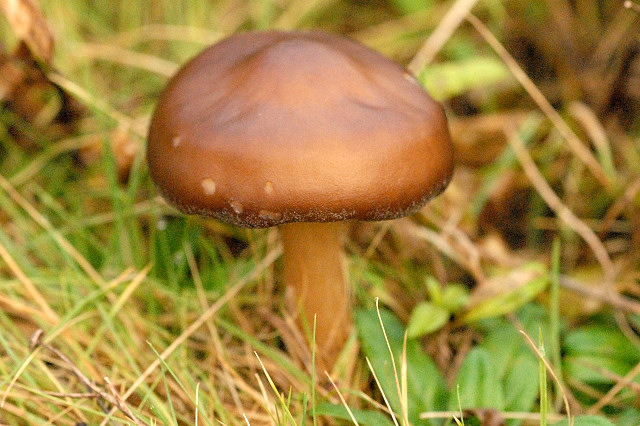
- 2–8 cm wide, convex to flattened, typically featuring a distinct broad umbo. Colors range from dark reddish-brown or dark cinnamon to grey-brown, fading to beige or ivory when dry. Surface is smooth, hygrophanous, and notably greasy or buttery to the touch.
- Stem
- 2–9 cm long, 0.4–1 cm thick, equal or tapering upward with a swollen, bulbous base. Tough and cartilaginous, becoming hollow over time. Color matches the cap or is slightly paler, often with longitudinal grooves. The base is typically covered in white, woolly hairs.
- Gills
- Narrowly attached to free from the stem and closely spaced. White to off-white, sometimes developing a pale pink tint with age. The edges are finely serrated or ragged.
- Flesh
- Thin and whitish to light brown, roughly the same color as the cap or paler. It is fibrous in the stem.
- Spore print
- Ranges from white to pale pinkish-buff or creamy-buff.
Sporecast is better in the app
Plan ahead with 10-day forecasts, see what people are finding nearby, get photo IDs, and track your finds.
Edibility
This mushroom has a greasy, buttery-feeling cap but the flavor and odor are generally described as mild, faint, or slightly rancid. While edible, it is often considered poor in quality and is mostly noted for its abundance rather than its culinary value. It can be confused with many similar species, including Gymnopus dryophilus, Rhodocollybia badiialba (which has a bitter taste), and Rhodocybe nitellina, though there are no known seriously toxic lookalikes.
Misidentification can be fatal. Never eat a mushroom unless you're 100% sure. This information may be inaccurate. Always consult multiple sources.
Nutrient Source
SaprotrophicIt obtains nutrients by breaking down dead organic matter, such as conifer needles and leaf litter.
Common Names
- Danish
- Keglestokket fladhat
- Dutch
- Botercollybia
- English
- Buttery Collybia, Butter Cap, Greasy Toughshank
- Finnish
- valkoviirujuurekas
- French
- Collybie beurrée
- Norwegian Bokmål
- rødbrun flathatt
- Norwegian Nynorsk
- raudbrun flathatt
- Swedish
- mörk nagelskivling
- Welsh
- Cap Menyn
Synonyms
- Agaricus bibulosus
- Agaricus butyraceus
- Agaricus leiopus
- Agaricus spongiosus
- Collybia aurorea
- Collybia bibulosa
- Collybia butyracea — Butter Cap
- Collybia butyracea
- Marasmius butyraceus
- Rhodocollybia butyracea