
Habitat
This common species is found in deciduous, mixed, and coniferous forests, showing a strong preference for mature conifer woods containing spruce, pine, or hemlock. It grows solitarily, in clusters, or in small groups on needle litter, humus, or well-decayed, crumbly wood. The stipe often roots deeply into the substrate or buried woody debris. It is also found under bracken on heaths.
Photos
Appearance
- Cap
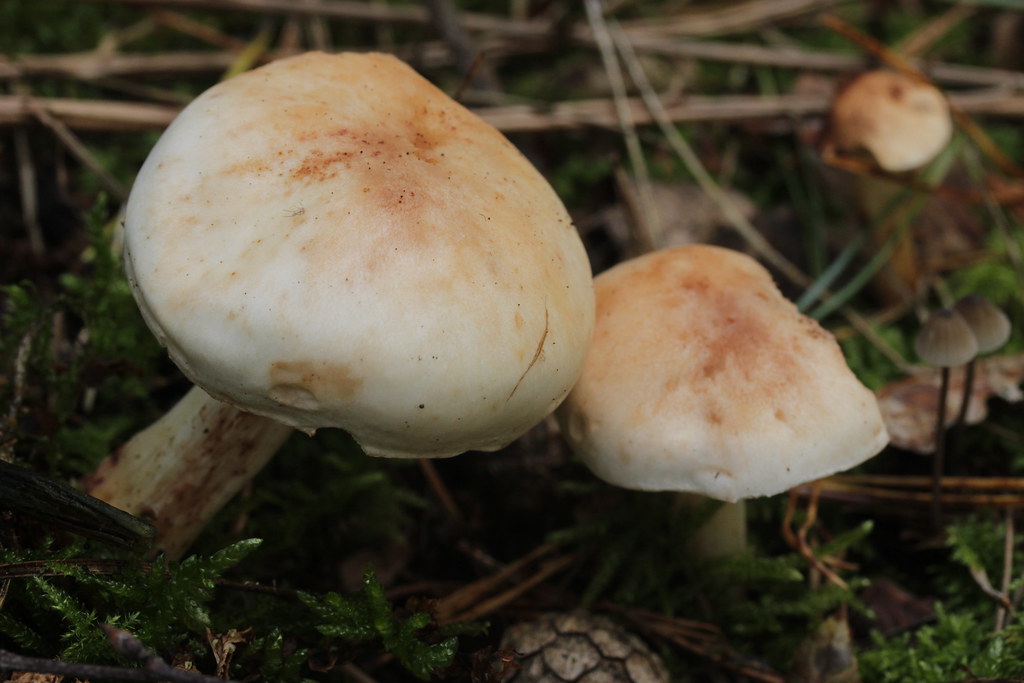
- 3–12 cm wide, convex with an inrolled margin, flattening or becoming wavy with age. The surface is smooth and white to cream, but characteristically develops rusty-brown or reddish-tan spots and blotches.
- Stem
- 5–12 cm long and 0.5–1.5 cm thick, firm and fibrous. It is white, often rooting deeply into the substrate, and develops reddish-brown stains similar to the cap; the interior may be hollow.
- Gills
- Crowded and narrow, with a notched or free attachment. Initially white to cream, becoming spotted with rusty-red or brown as they age; edges may appear finely serrated.
- Flesh
- White, thick in the cap but tough and cartilaginous in the stem.
- Spore print
- Ranges from white or cream to pale buff or pinkish.
- Taste
- Strongly bitter.
- Odor
- Generally mild or indistinct.
Sporecast is better in the app
Plan ahead with 10-day forecasts, see what people are finding nearby, get photo IDs, and track your finds.
Edibility
This mushroom is generally considered inedible due to its tough, fibrous texture and a strong, bitter taste. While it has been recorded as a food source in China during periods of famine, it is not recommended for consumption. It can be confused with certain Hygrophorus species that also develop pinkish blotches, though those lookalikes have more widely spaced gills and a mild flavor.
Misidentification can be fatal. Never eat a mushroom unless you're 100% sure. This information may be inaccurate. Always consult multiple sources.
Nutrient Source
SaprotrophicIt obtains nutrients by breaking down dead organic matter, such as leaf litter and wood, often found near pine trees.
Common Names
- Danish
- Plettet fladhat
- Dutch
- roestvlekkenzwam, Roestvlekkenzwam
- English
- Spotted Tough-Shank, Spotted Collybia, Spotted Toughshank
- Finnish
- rusotäpläjuurekas
- French
- Collybie maculée
- German
- Gefleckter Rübling
- Norwegian Bokmål
- flekket flathatt, flekkrotsopp
- Norwegian Nynorsk
- flekkrotsopp, flekket flathatt
- Swedish
- fläcknagelskivling
- Welsh
- Coes Wydn Fannog
Synonyms
- Agaricus maculatus
- Collybia maculata — Spotted Toughshank
- Collybia maculata
- Collybia maculata
- Collybia scorzonerea
- Marasmius maculatus