
Habitat
This mushroom grows on calcareous or alkaline soil in broad-leaved woodlands. It is primarily associated with beech and oak trees, often favoring open areas. It typically occurs in solitary fashion or in small grouped clusters.
Photos
Appearance
- Cap
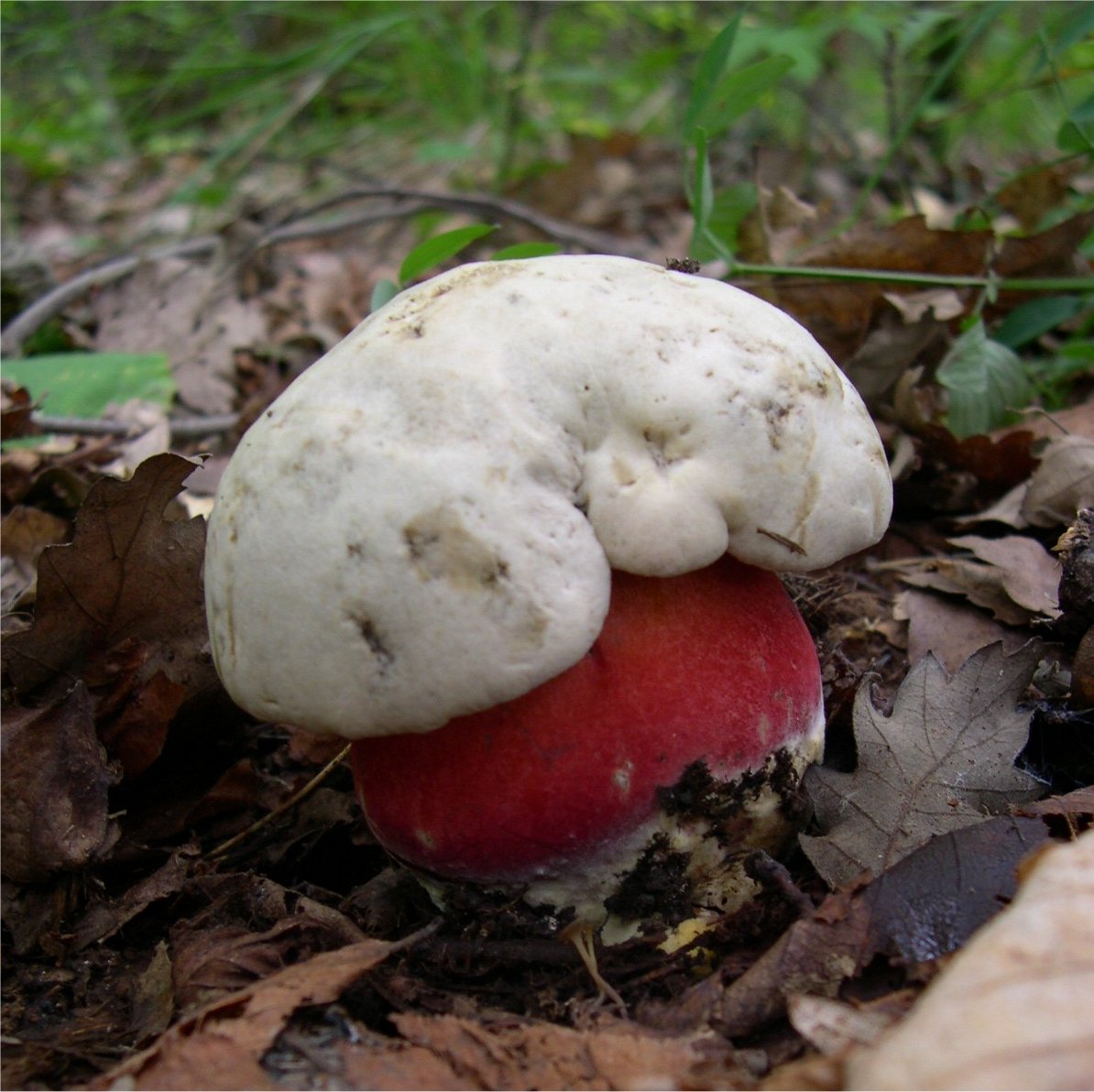
- Large, measuring 8–25 cm across; initially hemispherical and later convex. Color ranges from nearly white to buff or sepia, often with a faint red flush at the edge, aging to ochre or parchment-like. Surface is finely downy when young, becoming smooth and sometimes cracked at the center, and bruises brown when handled.
- Stem
- Very stout and often swollen, sometimes nearly spherical at the base. It features a yellow to orange top and a red or ochre base, decorated with a red net-like pattern that may become finely dotted towards the bottom. The mycelium at the base is white.
- Pores
- Small and round; colored blood-red or orange near the margin, turning orange with age and bruising blue-green.
- Tubes
- Yellowish-green to dark olive, turning blue when cut; they are free from the stem.
- Flesh
- Firm and pale straw or white in color, turning a light sky-blue when cut; may show rusty patches or red blotches at the stem base. The taste is unpleasant and the smell progresses from sweet to foul and fetid.
- Spore print
- Olive-green to walnut-brown.
Sporecast is better in the app
Plan ahead with 10-day forecasts, see what people are finding nearby, get photo IDs, and track your finds.
Edibility
This species is dangerously poisonous and potentially deadly. It has a revolting, foetid odor and an unpleasant taste. Every forager should learn to recognize this fungus as it is the only bolete in Britain considered highly dangerous.
Misidentification can be fatal. Never eat a mushroom unless you're 100% sure. This information may be inaccurate. Always consult multiple sources.
Nutrient Source
EctomycorrhizalIt forms a symbiotic relationship with trees, exchanging nutrients like sugars for minerals absorbed from the soil by the fungal network.
Common Names
- Basque
- etsai-onto, errementi-perreicuak, etsaiontoa, etsai-ontoa, satan onddo, satan ontoa, satan-onto
- Catalan
- matagent, mataparents, Mataparent
- Danish
- Satans rørhat
- Dutch
- Satansboleet
- English
- Devil's Bolete, Satan's Bolete
- French
- Bolet satan, Bolet diabolique, Cèpe du diable
- German
- Satansröhrling
- Norwegian Bokmål
- satansopp
- Norwegian Nynorsk
- satansopp
- Spanish
- mataparientes, Hongo del diablo, boleto de Satanás, Satán
- Swedish
- djävulssopp
- Ukrainian
- Червоноборовик чортів
- Welsh
- Cap Tyllog y Cythraul
Synonyms
- Boletus crataegi
- Boletus crataegi
- Boletus foetidus
- Boletus foetidus
- Boletus marmoreus
- Boletus satanas
- Boletus satanas — Devil's Bolete
- Boletus satanus
- Suillellus satanas
- Suillus satanas
- Tubiporus satanas
- Tubiporus satanas