
Habitat
Found on soil or among leaf litter in deciduous and coniferous forests. While it appears under hardwoods such as aspen and tanoak, it is most frequently associated with beech and oak. It prefers nutrient-rich, acidic locations and may grow singly, in clusters, or in trooping groups.
Photos
Appearance
- Cap
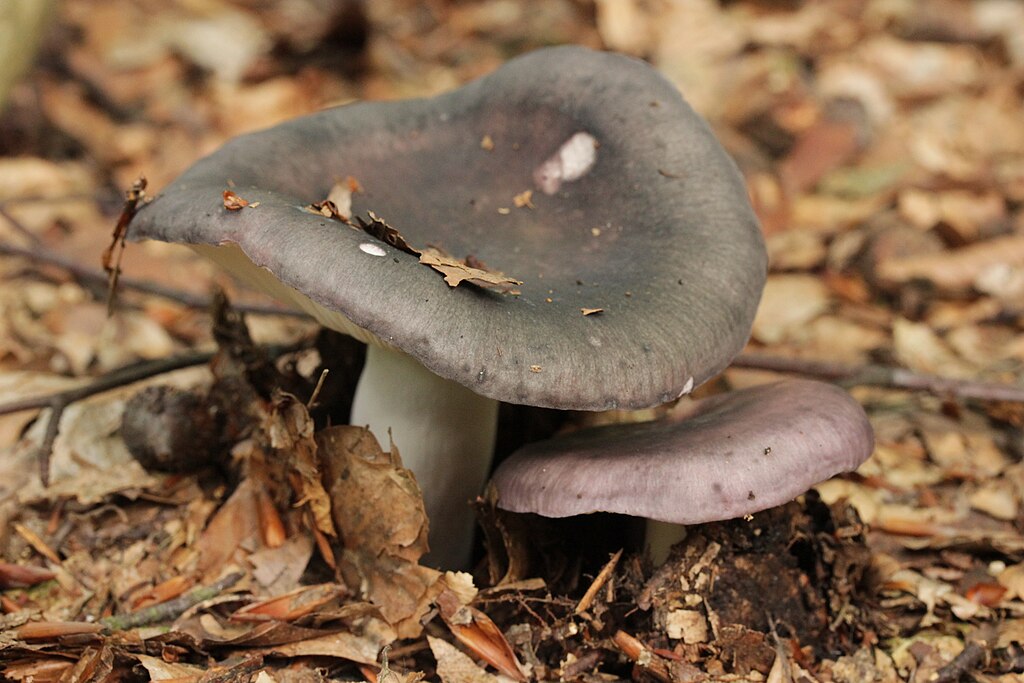
- 5–15 cm wide; initially globose or convex, later flattening or developing a central depression. Color is highly variable, often a mottled mixture of lilac, purple, olive, green, and brown, though sometimes entirely green; surface is greasy when wet, occasionally showing fine radiating veins or a subtle cracked pattern with age.
- Gills
- White to pale cream and crowded; attached to slightly decurrent. Distinctly flexible and oily or greasy to the touch rather than brittle; frequently branching or forking.
- Stem
- 5–12 cm long and 1.5–5 cm thick; sturdy and white, sometimes with a purple or rosy flush. The surface is smooth and the base may be slightly tapered or enlarged.
- Flesh
- White, firm, and thick; lacks a distinctive smell and has a mild, pleasant taste.
- Spore print
- White to whitish.
Sporecast is better in the app
Plan ahead with 10-day forecasts, see what people are finding nearby, get photo IDs, and track your finds.
Edibility
The mild-to-sweet tasting flesh is exceptionally firm when young, though it can become mealy and insect-infested as it ages. Unlike most other Russula species, the gills are flexible and oily to the touch rather than brittle. It can be confused with various brittlegills, including the rare Russula langei, the oilslick brittlegill, and the false charcoal burner. Russula variata is a similar species with significantly more forking in the gills and a taste that can be slightly acrid when young.
Misidentification can be fatal. Never eat a mushroom unless you're 100% sure. This information may be inaccurate. Always consult multiple sources.
Nutrient Source
EctomycorrhizalThis species forms a symbiotic relationship with trees, exchanging nutrients with the tree's roots in exchange for sugars.
Common Names
- Basque
- urritxa, urritza, urretxa, urrecha, urritx
- Catalan
- puagra llora, cualbra blanca, blavet
- Danish
- Broget skørhat, Sprukken skørhat
- Dutch
- Regenboogrussula, craquelérussula
- English
- Charcoal Burner, Variable Russula
- Finnish
- kyyhkyhapero
- French
- Russule charbonnière, Russule crevassée
- German
- Frauentäubling
- Norwegian Bokmål
- broket kremle
- Norwegian Nynorsk
- broket kremle
- Spanish
- rúsula de láminas bifurcadas, gibelurdin, santiaguero, cualbra, rúsula de los cerdos, Carbonera
- Swedish
- brokkremla, mellankremla
- Welsh
- Tegyll Brau Dulas
Synonyms
- Agaricus cyanoxanthus
- Hypophyllum virens
- Russula angustata
- Russula cutefracta
- Russula cutifracta
- Russula flavoviridis
- Russula furcata
- Russula lilacina
- Russula lilacina
- Russula peltereaui
- Russula subacerba
- Russula variata — Variable Russula