
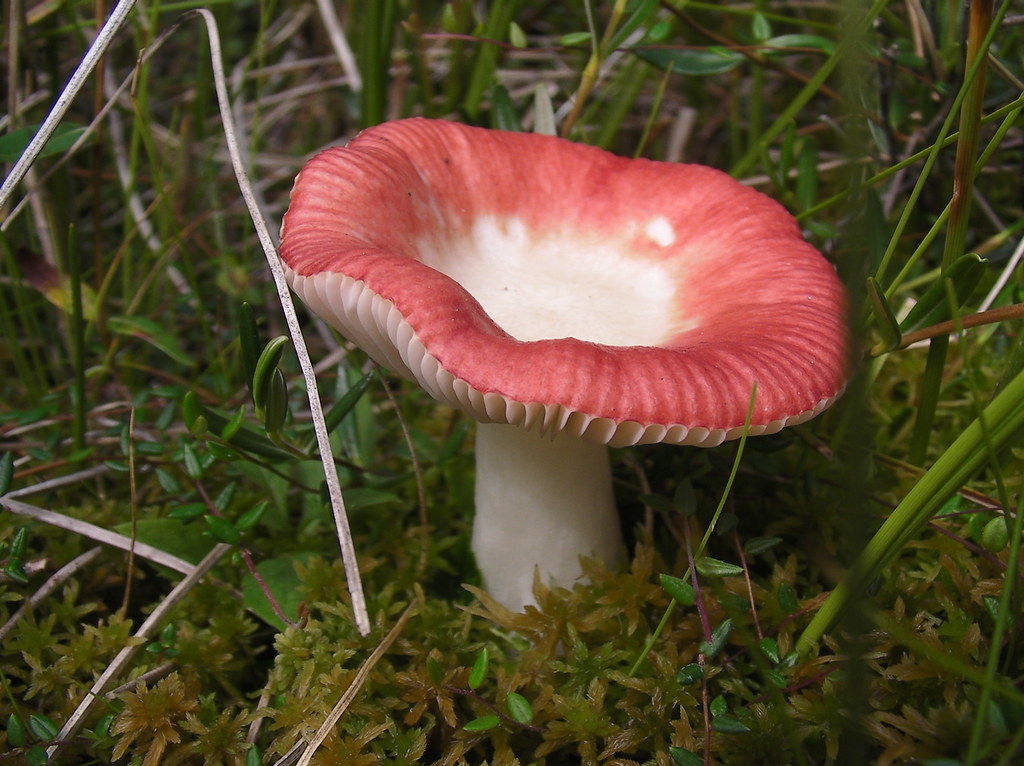
Habitat
Frequently found in damp or swampy coniferous, mixed, and broad-leaved woodlands, primarily associating with pine and spruce. It often grows in acidic environments, commonly appearing among Sphagnum moss, haircap moss, or on well-decayed wood such as moss-covered stumps and logs. The species is also found in heathlands and montane habitats, where it may associate with birch and dwarf willow.
Photos
Appearance
- Cap
- 3–10 cm wide; starts convex or hemispherical, becoming flat or with a shallow central depression. The surface is smooth, shiny, and sticky or greasy when moist. Colors range from bright scarlet or cherry-red to deep pink, sometimes fading or showing yellowish-ochre tones. The margin becomes grooved or furrowed with age, and the skin peels easily (from one-third to entirely) to reveal pinkish-red flesh underneath.
- Stem
- 4–9 cm tall and 0.7–2 cm thick; white, though sometimes turning slightly yellow or grayish-yellow with age. It is cylindrical, often slightly swollen toward the base, and has a fragile or brittle texture. The surface is smooth but may occasionally show fine longitudinal lines.
- Gills
- Adnexed, broadly attached, or nearly free from the stem. They are close to subdistant, white to cream-colored, and may turn pale straw in age. They are thin, fragile, and occasionally forked near the stem or cap edge.
- Flesh
- White, though distinctly pink or red immediately under the cap skin. The texture is thin, soft, and very brittle. It has a slightly fruity or sweet smell and a characteristically very hot, peppery, or acrid taste.
- Spore print
- White to very pale cream.
Sporecast is better in the app
Plan ahead with 10-day forecasts, see what people are finding nearby, get photo IDs, and track your finds.
Edibility
Extremely hot, acrid, or peppery in taste, this species is noted for causing gastrointestinal distress and vomiting shortly after consumption. While some regions reportedly eat it after parboiling twice and salting to remove toxins, this preparation is not recommended. It is easily confused with many other red or pink brittlegills, including the poisonous Birch Brittlegill and Alpine Brittlegill, as well as the edible Rosy Spike, which can be distinguished by its mild taste and grey-black bruising.
Misidentification can be fatal. Never eat a mushroom unless you're 100% sure. This information may be inaccurate. Always consult multiple sources.
Nutrient Source
EctomycorrhizalIt forms a mutually beneficial relationship with tree roots, receiving sugars from the tree in exchange for helping the tree absorb water and minerals from the soil.
Common Names
- Catalan
- Cualbra, escaldabec, lleterolas bordas
- Danish
- Matrød skørhat, Stor gift-skørhat
- Dutch
- Braakrussula, Grootsporige braakrussula
- English
- Sickener, The Sickener
- Finnish
- tulipunahapero
- French
- Russule de velours rouge, Russule émétique
- German
- Scharfer Zinnober-Täubling, Kirschroter Speitäubling
- Norwegian Bokmål
- giftkremle, falsk fagerkremle, rødkremle
- Norwegian Nynorsk
- giftkremle, raudkremle, falsk fagerkremle
- Swedish
- giftkremla
- Welsh
- Tegyll Brau Cyfoglyd
Synonyms
- Agaricus emeticus
- Agaricus fallax
- Agaricus ruber
- Agaricus silvaticus
- Amanita rubra
- Russula alnijorullensis
- Russula alpestris
- Russula alpina
- Russula atropurpurina
- Russula clusii
- Russula clusii
- Russula clusii
- Russula emetica
- Russula fallax
- Russula gregaria
- Russula rubra
- Russula truncigena