
Habitat
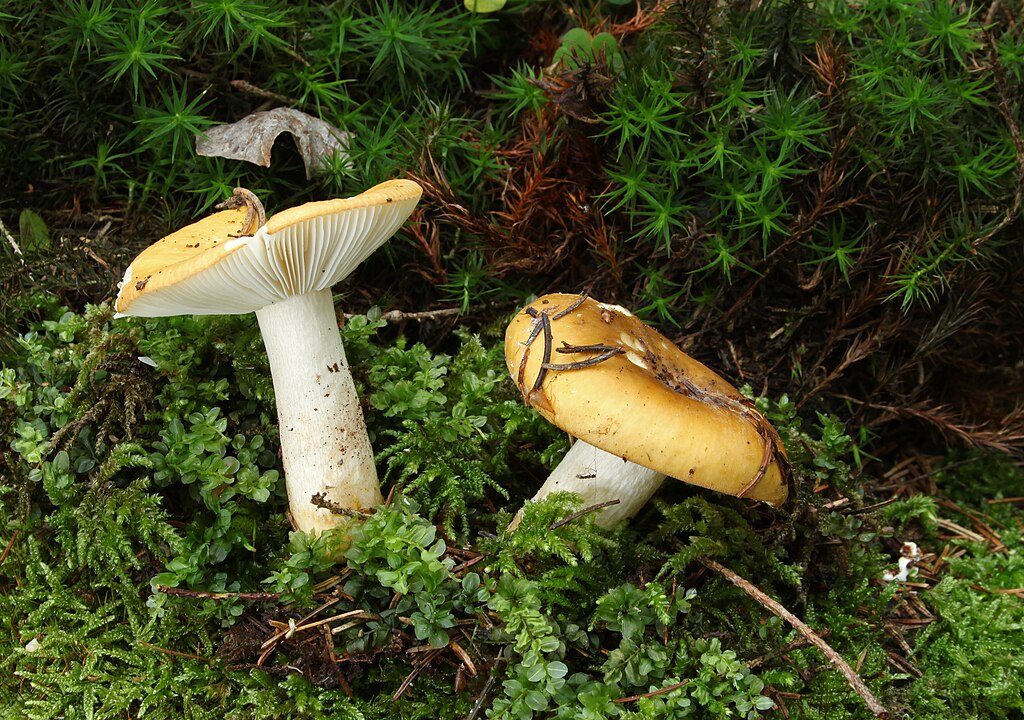
This common species grows on soil in both broad-leaved and coniferous woodlands. It typically appears in groups and prefers relatively dry environments, often found covered in forest debris.
Photos
Appearance
- Cap
- Measuring 4 to 12 cm across, the cap begins hemispherical to convex before flattening with a slight central dip. It is ochre-yellow or greenish-yellow, becomes sticky when wet, and the skin can be peeled away up to two-thirds of the radius. The edge is smooth at first, later developing grooves.
- Stem
- Standing 4 to 7 cm tall, the stem is cylindrical or tapers slightly towards the top. It is white but develops greyish tints with age or in wet conditions, and may show cracking at the base.
- Gills
- White to cream-colored, these are attached narrowly to the stem. Their spacing can vary from crowded to relatively distant.
- Flesh
- The interior is white and fragile. It has a mild smell and a taste that ranges from mild to slightly peppery or hot.
- Spore print
- White to pale cream.
Sporecast is better in the app
Plan ahead with 10-day forecasts, see what people are finding nearby, get photo IDs, and track your finds.
Edibility
This mushroom is slightly toxic if consumed raw and should be cooked before eating. While generally mild in flavor, the flesh or gills can sometimes be slightly hot, peppery, or acrid. It is easily confused with various yellow brittlegills, including the poisonous Russula grata, which smells of almonds, and the poisonous R. farinipes, which has a very hot taste. Other similar lookalikes include the edible Yellow Swamp Brittlegill, which lacks this species' ochre-yellow tone, and the inedibly hot Geranium and Primrose Brittlegills.
Misidentification can be fatal. Never eat a mushroom unless you're 100% sure. This information may be inaccurate. Always consult multiple sources.
Nutrient Source
EctomycorrhizalIt forms a symbiotic relationship with trees, exchanging nutrients with their root systems.
Common Names
- Basque
- gibelokre hankazuria, Gibelokre hankazuri
- Danish
- Okkergul skørhat
- English
- Common Yellow Russula, Ochre Brittlegill
- German
- Ockergelber Täubling
- Spanish
- rúsula ocre y blanca, Russula blanco-ocrácea, rúsula blanco-ocrácea
- Welsh
- Tegyll Brau Melyn
Synonyms
- Agaricus ochroleucus
- Russula citrina
- Russula fingibilis
- Russula granulosa