
Habitat
This mushroom is found on soil in deciduous woodlands. It grows in association with broad-leaved trees, particularly oak and beech. It typically appears in groups or troops and is distributed across temperate and subtropical regions of Europe, North Africa, and Asia.
Photos
Appearance
- Cap
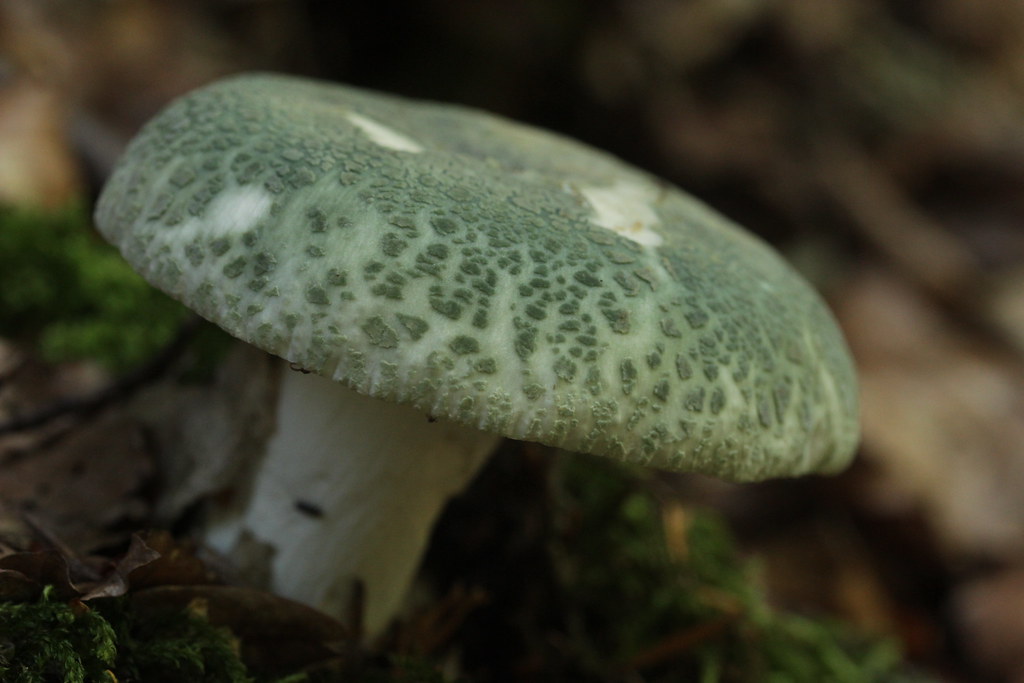
- 5–14 cm across; initially globose or hemispherical, becoming convex to flat with a central depression; surface is dry, velvety, and breaks into a mosaic of small, angular, scurfy green or verdigris scales on an ochre or cream background; margin is often wavy, lobed, or slightly grooved; skin is half-peeling.
- Stem
- 4–9 cm long, 2–4 cm thick; white to pale cream, sometimes browning slightly at the base; stout and cylindrical, with a powdery or floury texture at the apex.
- Gills
- Crowded and brittle; cream-colored; adnexed to almost free; featuring visible veins connecting the bases.
- Flesh
- White, firm, and brittle; features a mild, nutty, or fruity taste and a faint smell that can become fishy or unpleasant with age.
- Spore print
- Whitish to pale ivory or cream.
Sporecast is better in the app
Plan ahead with 10-day forecasts, see what people are finding nearby, get photo IDs, and track your finds.
Edibility
The mild, nutty, or fruity flavor and brittle flesh can be enjoyed raw, grilled, or fried. While the cracked, scaly cap is distinctive, foragers must be extremely careful not to confuse green-capped species with the deadly Deathcap, which is distinguished by its volva and ring. The smell is initially pleasant but can become fishy or unpleasant as the mushroom ages.
Misidentification can be fatal. Never eat a mushroom unless you're 100% sure. This information may be inaccurate. Always consult multiple sources.
Nutrient Source
EctomycorrhizalIt forms a symbiotic relationship with trees, exchanging nutrients with their roots.
Common Names
- Basque
- guibelurdiña, gibelurdin, kororo
- Catalan
- cualbra i cualbra llora
- Danish
- Spanskgrøn skørhat
- Dutch
- Ruwe russula
- English
- Green Russula, Greencracked Brittlegill
- Finnish
- ruutuhapero
- French
- Palomet
- German
- Grüngefelderter Täubling
- Norwegian Bokmål
- rutekremle
- Norwegian Nynorsk
- rutekremle
- Spanish
- puagra llora verda, Gorro verde, seta de cura, guibel-undiña, llora, palometa
- Swedish
- rutkremla
- Ukrainian
- Сироїжка луската
- Welsh
- Tegyll Brau Craciog
Synonyms
- Agaricus virescens
- Russula viridirubrolimbata