
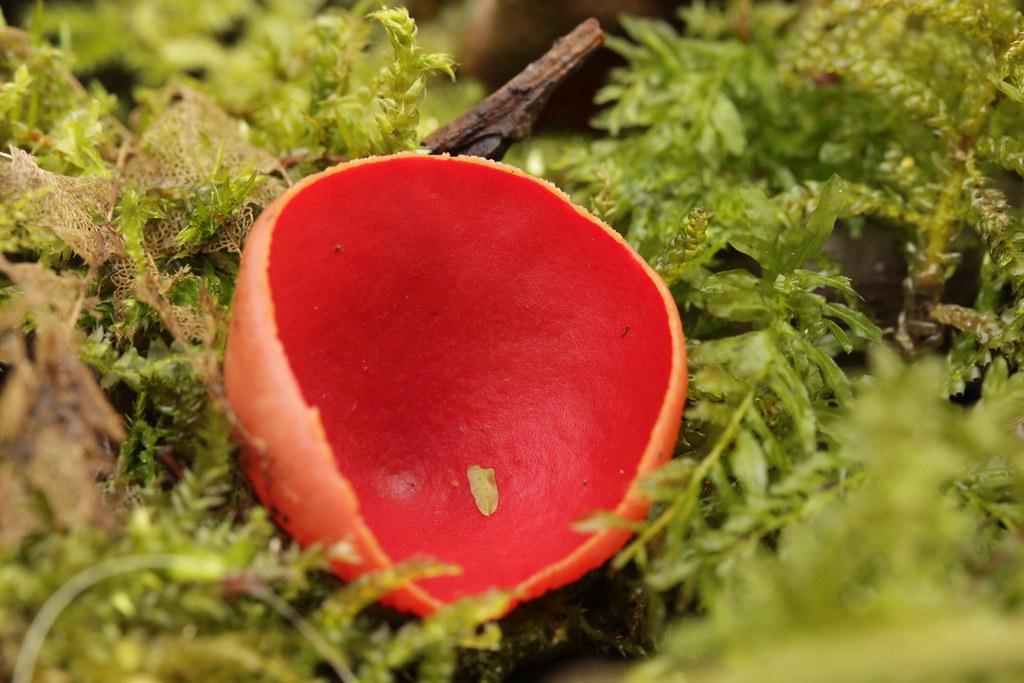
Habitat
These fungi serve as decomposers, found on dead or rotting wood, specifically decomposing twigs and branches. They are typically located on the forest floor in broadleaf or mixed forests, flourishing on damp wood from trees such as maple, sycamore, hazel, beech, elm, and mossy willow. Fruitbodies may grow solitarily but more frequently appear in small tufted groups or gregarious clusters.
Photos
Appearance
- Fruit body
- Cup-shaped, ranging from 1 to 7 cm across and 2 to 3 cm high; initially deeply cup-shaped with an inrolled margin, becoming shallower and more irregular or tattered as it expands.
- Inner surface
- Vibrant scarlet to red, smooth, and concave; may fade to reddish-orange with age.
- Outer surface
- Whitish to pale ochre and frequently wrinkled; densely covered in fine, white, curly or coiled hairs.
- Stem
- Whitish to ochre colored and typically short, measuring 5 to 30 mm long; can be prominent, sharply tapered, or occasionally almost absent.
- Spore print
- Hyaline in mass.
Sporecast is better in the app
Plan ahead with 10-day forecasts, see what people are finding nearby, get photo IDs, and track your finds.
Edibility
This species is considered edible but is not often sought after as it is not very substantial. It is nearly identical to Sarcoscypha coccinea and Sarcoscypha dudleyi, which are difficult to distinguish without microscopic examination of the spores and surface hairs.
Misidentification can be fatal. Never eat a mushroom unless you're 100% sure. This information may be inaccurate. Always consult multiple sources.
Nutrient Source
SaprotrophicThis mushroom obtains nutrients by decomposing dead plant material, such as fallen branches, rather than living organisms.
Common Names
- Danish
- Krølhåret pragtbæger
- Dutch
- Krulhaarkelkzwam
- English
- Scarlet Elfcup
- Finnish
- punamaljakas
- German
- Roter Kelchbecherling
- Norwegian Bokmål
- skarlagen vårbeger
- Norwegian Nynorsk
- skarlaksvårbeger
- Swedish
- scharlakansskål
- Welsh
- Cwpan Robin Goch
Synonyms
- Lachnea austriaca
- Lachnea austriaca
- Molliardiomyces coccineus
- Peziza austriaca
- Peziza imperialis
- Plectania austriaca
- Scutellinia imperialis