
Habitat
Woodland
This species grows on the dead or dying wood of poplar and occasionally willow trees. It is typically found in small, often overlapping or tufted clusters.
Photos
Appearance
- Fruit body
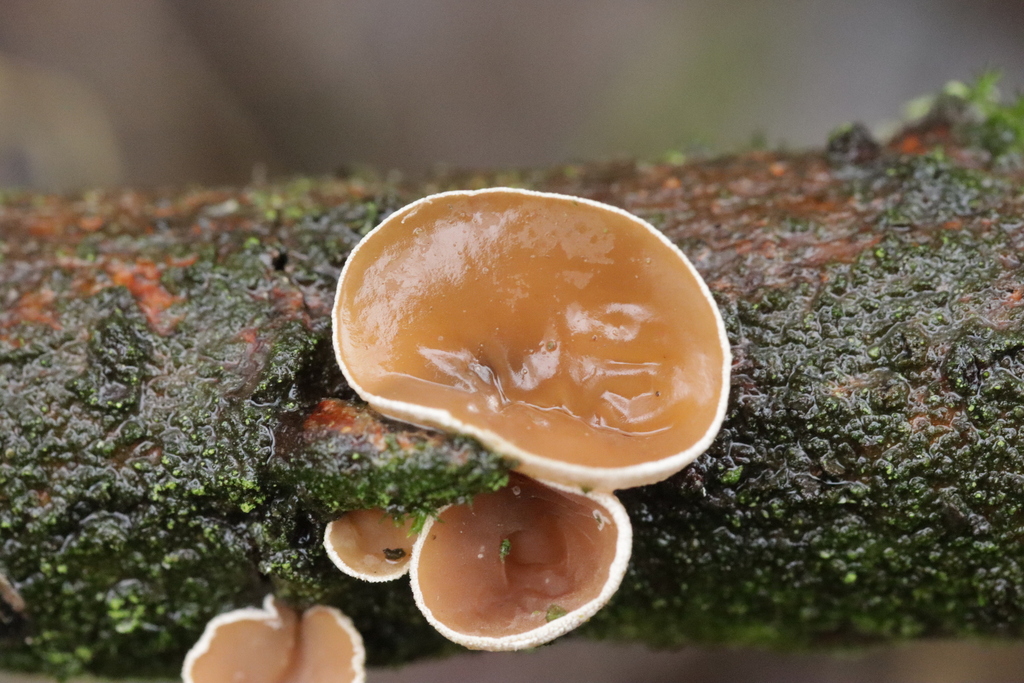
- Small, cup-shaped structures measuring 0.5 to 2 cm, which appear gelatinous when wet and become hard when dried out. They often grow in small, overlapping clusters or tufted groups.
- Outer surface
- Densely covered in white hairs or downy fuzz, creating a sharp contrast with the inner surface.
- Inner surface
- The spore-bearing surface is smooth or marked by fine radial folds, colored ochre-brown with a distinct white margin.
- Stem
- Not present.
- Flesh
- Particularly thin, colorless, and gelatinous in texture.
- Spore print
- White.
Sporecast is better in the app
Plan ahead with 10-day forecasts, see what people are finding nearby, get photo IDs, and track your finds.
Edibility
unknown
Misidentification can be fatal. Never eat a mushroom unless you're 100% sure. This information may be inaccurate. Always consult multiple sources.
Nutrient Source
SaprotrophicIt obtains nutrients by breaking down dead wood from hardwood trees.
Common Names
- Danish
- Poppel-hængeøre, Hængeøre
- Dutch
- vals judasoor, Vals judasoor
- English
- Poplar Bells
- Finnish
- poimuheltta
- German
- Judasöhrchen
- Swedish
- hängöra
- Welsh
- Clychau Poplys
Synonyms
- Auricularia flocculenta
- Auricularia leveillei
- Auricularia syringae
- Auriculariopsis ampla
- Auriculariopsis flocculenta
- Cantharellus coemansii
- Chaetocypha ampla
- Chaetocypha cyclas
- Corticium flocculentum
- Corticium syringae
- Cyphella ampla
- Cyphella cyclas
- Cyphella flocculenta
- Cytidia flocculenta
- Cytidia simulans
- Lomatina flocculenta
- Merulius amplus
- Merulius coemansii
- Stereum pubescens
- Terana flocculenta
- Thelephora flocculenta