
Habitat
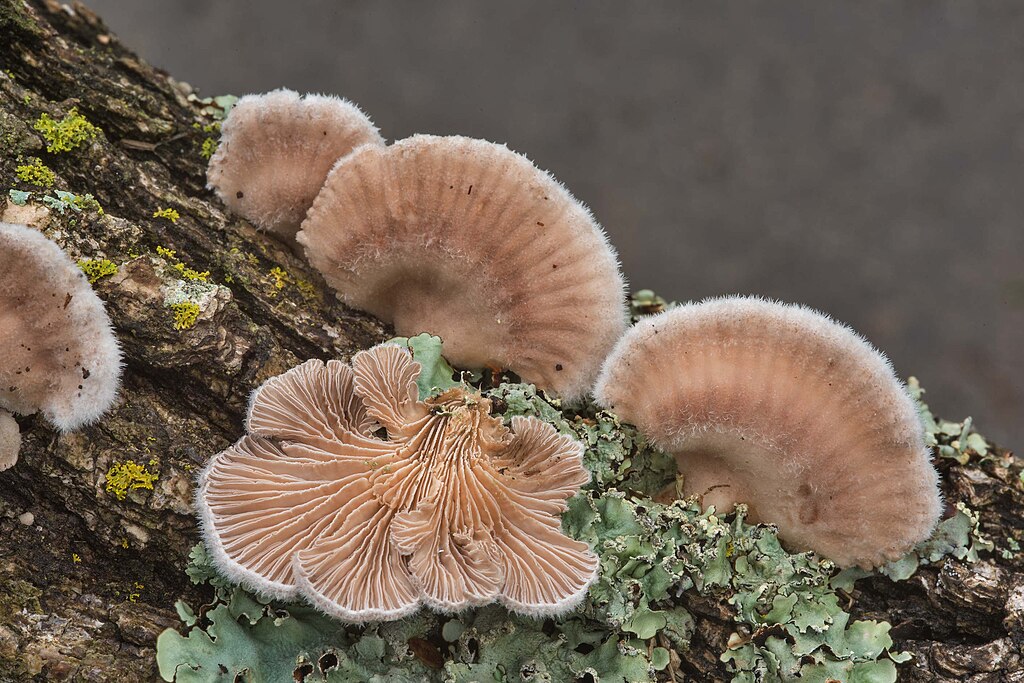
This species is primarily found as a wood decomposer on dead wood, fallen branches, and decaying limbs of deciduous trees, such as beech, live oak, and California bay laurel. It also occurs on conifer wood, cut timber, and milled hardwood lumber. In addition to wood, it colonizes various organic substrates including hay or silage bales (frequently those wrapped in plastic), straw, bamboo, and occasionally leather. It typically grows in small, overlapping, or tufted clusters and is found worldwide in a diverse range of environments.
Photos
Appearance
- Cap
- 1–4 cm wide, fan-shaped or shell-shaped, often lobed or wavy; the surface is dry and densely covered in white, grey, or purplish-tinged hairs and velvety down.
- Gills
- Distinctive, radiating from the attachment point; they are split lengthwise along the edges and roll inward when dry to protect the spore-bearing surface. Color ranges from white and grey to pale pinkish-tan or ochraceous.
- Stem
- Usually absent, or occasionally appears as a rudimentary, short lateral attachment point.
- Flesh
- Thin, very tough, and leathery; color varies from white or pale grey to brownish.
- Spore print
- White to pale cream.
Sporecast is better in the app
Plan ahead with 10-day forecasts, see what people are finding nearby, get photo IDs, and track your finds.
Edibility
Though often considered too small or tough for consumption, this mushroom is traditionally eaten in parts of Mexico, India, and Southeast Asia. Extraordinarily, it is a human pathogen that can infect the lungs, sinuses, and brain, particularly in those with compromised immune systems; for this reason, smelling the mushroom closely is discouraged. Characterized by a leathery texture and an indistinct or mild flavor, it is also notable for its ability to absorb uranium from contaminated environments.
Misidentification can be fatal. Never eat a mushroom unless you're 100% sure. This information may be inaccurate. Always consult multiple sources.
Nutrient Source
facultativeIt normally obtains nutrients by breaking down dead plant material such as wood, but it can also act as a pathogen, infecting and deriving nutrients from living plants and animals.
Common Names
- Danish
- Kløvblad
- Dutch
- Waaiertje
- English
- Common Porecrust, Split Gill Fungus, Splitgill Mushroom, Splitgill
- Finnish
- halkiheltta
- French
- Schizophylle commun
- German
- Spaltblättling
- Norwegian
- oldersopp
- Norwegian Bokmål
- kløyvsopp
- Norwegian Nynorsk
- kløyvsopp
- Swedish
- klyvblad
- Welsh
- Crawen Dyllog
Synonyms
- Agaricus alneus
- Agaricus alneus
- Agaricus multifidus
- Agaricus villosocanescens
- Apus alneus
- Daedalea commune
- Hyponevris alneus
- Merulius alneus
- Merulius alneus
- Merulius communis
- Pleuropus alneus
- Scaphophoeum agaricoides
- Scaphophoeum agaricoides
- Scaphophorum agaricoides
- Schizophyllum alneum
- Schizophyllum alneum
- Schizophyllum multifidum
- Schizophyllus communis