
Habitat
Woodland
Frequently found on oak, functioning as both a saprobe on stumps, logs, and fallen branches and as a weak parasite on standing wood. While it primarily favors oak where it induces white pocket rot, it occasionally occurs on other broad-leaved deciduous trees.
Photos
Appearance
- Fruit body
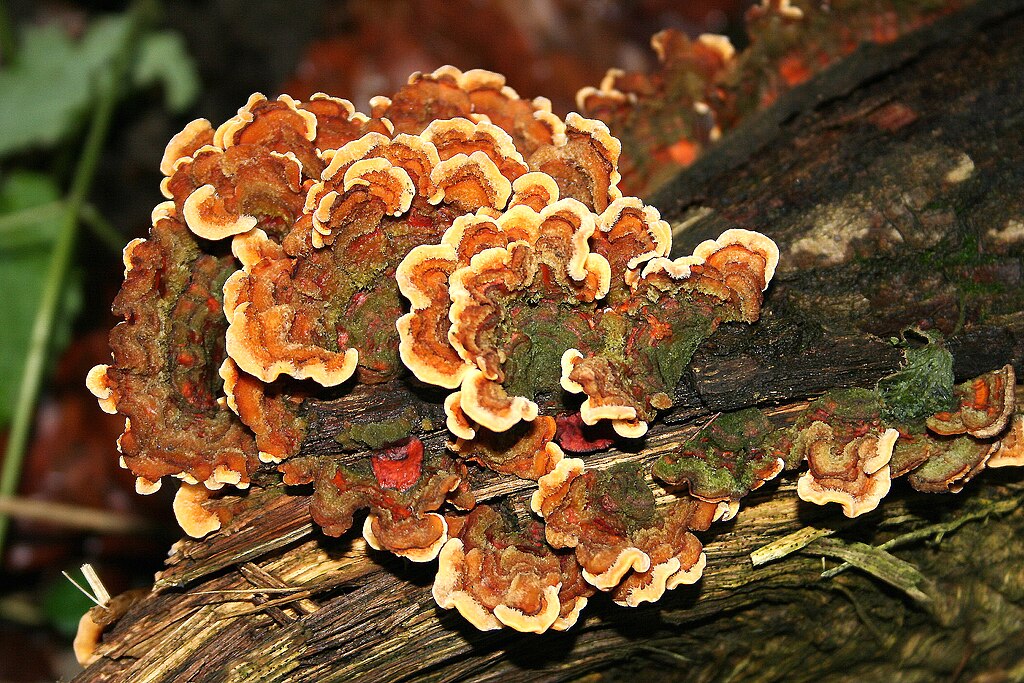
- Forms small, tiered brackets or flat patches attached to the wood surface, measuring 1 to 4 cm across. Brackets are tough, leathery, and often fused in overlapping groups with wavy, distinct edges.
- Upper surface
- Marked with concentric color zones of ochre-brown to grey-red-brown, featuring a paler or white margin and a very fine, velvety or hairy texture.
- Lower surface
- Smooth or finely warty, ranging in color from pale chestnut to dark grey-brown. It releases a red fluid when cut or bruised while fresh.
- Flesh
- Thin, elastic, and reddish-ochre in color; it becomes hard and brittle as it dries.
- Spore print
- White.
Sporecast is better in the app
Plan ahead with 10-day forecasts, see what people are finding nearby, get photo IDs, and track your finds.
Edibility
Not edible
The flesh of this mushroom is tough, leathery, and elastic when fresh, becoming hard and brittle once dried.
Misidentification can be fatal. Never eat a mushroom unless you're 100% sure. This information may be inaccurate. Always consult multiple sources.
Nutrient Source
SaprotrophicIt obtains nutrients by decomposing dead wood from oak trees, indicating it breaks down dead organic matter.
Common Names
- Danish
- Tynd lædersvamp
- Dutch
- Eikenbloedzwam, Eikebloedzwam
- English
- Bleeding Oak Crust
- Finnish
- tamminahakka
- German
- Zottiger Eichen-Schichtpilz
- Norwegian Bokmål
- eikelærsopp
- Norwegian Nynorsk
- eikelêrsopp
- Swedish
- brunskinn
- Welsh
- Crawen Waedlyd y Derw
Synonyms
- Cladoderris gausapata
- Haematostereum gausapatum
- Stereum cristulatum
- Stereum quercinum
- Thelephora gausapata
- Thelephora spadicea