
Habitat
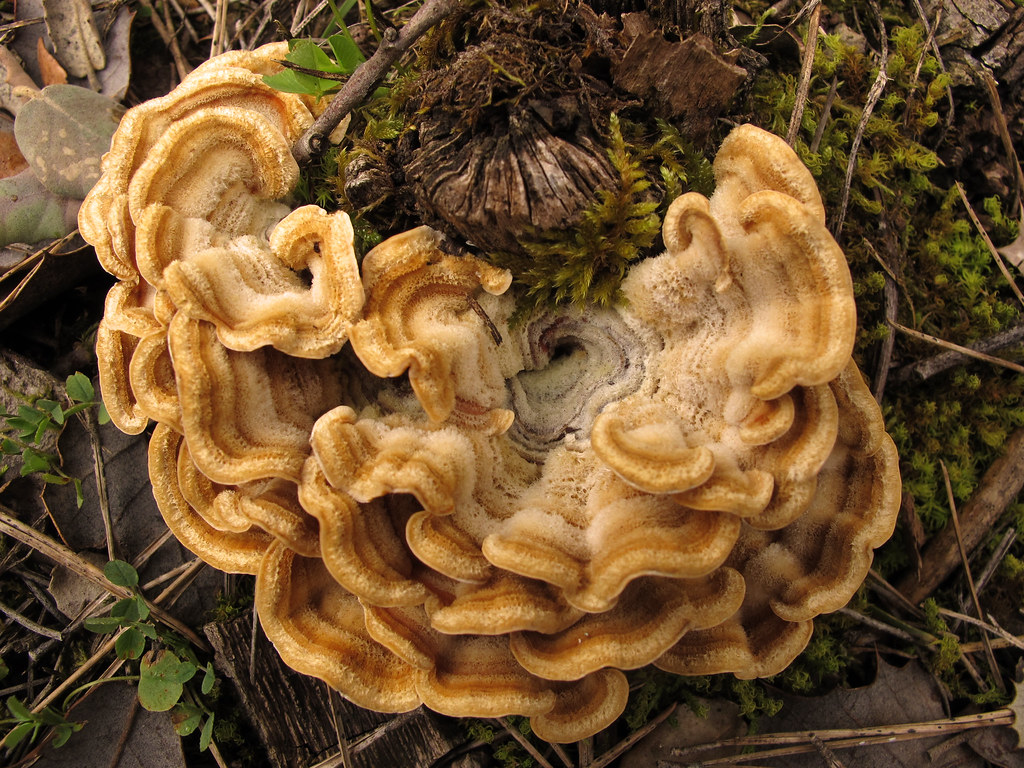
This extremely common species grows on stumps, logs, and fallen branches of deciduous trees, and occasionally on conifers. It acts as both a saprobe on dead wood and as a weak parasite on live hardwoods, particularly oaks and tanoaks. It typically forms large, overlapping clusters or fused rows that can appear as brackets, fan-shaped shelves, or crusts on the underside of wood.
Photos
Appearance
- Fruit body
- Variable form from spread-out crusts to tough, leathery, fan-shaped or semicircular brackets. Brackets measure 3–10 cm across and often grow in dense, overlapping, fused rows or tiered clusters.
- Cap
- Distinctly hairy or downy surface with concentric color zones in shades of yellow-orange, reddish-brown, beige, or greyish. The margin is often pale, wavy, lobed, or ruffled.
- Spore-bearing surface
- Located on the underside; smooth to finely warty and lacking pores. Colors range from bright yellow or orange to duller brownish or greyish with age. It does not bleed red when cut.
- Flesh
- Thin, tough, and leathery or elastic. Color ranges from whitish-ochre to yellow or reddish-brown.
- Spore print
- White.
- Odor
- Indistinct.
- Taste
- Indistinct.
Sporecast is better in the app
Plan ahead with 10-day forecasts, see what people are finding nearby, get photo IDs, and track your finds.
Edibility
This mushroom is not edible due to its tough, leathery, and cartilaginous texture. It can be easily confused with Turkey Tail (Trametes versicolor), which is distinguished by having visible pores on the underside instead of a smooth surface. Other lookalikes include Chondrostereum purpureum, which has a purplish spore-bearing surface, and Stereum sanguinolentum, which grows on conifers and bleeds red when cut.
Misidentification can be fatal. Never eat a mushroom unless you're 100% sure. This information may be inaccurate. Always consult multiple sources.
Nutrient Source
facultativeIt obtains nutrients by decomposing dead wood, and can also act as a plant pathogen, infecting living trees.
Common Names
- Basque
- azal horia, azal hori
- Danish
- Håret lædersvamp
- Dutch
- Gele korstzwam
- English
- Hairy Curtain Crust, Hairy Stereum
- Finnish
- karvanahakka
- French
- Stérée hirsute
- German
- Striegeliger Schichtpilz
- Norwegian Bokmål
- ragglærsopp
- Norwegian Nynorsk
- ragglêrsopp
- Scottish Gaelic
- stereum molach, stereuman molach
- Spanish
- Estereo peludo, Estéreo peludo, estéreo hirsuto, estereo peludo
- Swedish
- kvistraggskinn, raggskinn
- Welsh
- Crawen Flewog
Synonyms
- Auricularia aurantiaca
- Auricularia laevis
- Auricularia reflexa
- Boletus auriformis
- Corticium reisneri
- Helvella acaulis
- Helvella agaricus
- Helvella hirsute
- Stereum amoenum
- Stereum aratae
- Stereum hepaticum
- Stereum hirsutum — Hairy Curtain Crust
- Stereum kalchbrenneri
- Stereum neuwirthii
- Stereum ochraceum
- Stereum persoonianum
- Stereum rameale
- Stereum rameale
- Stereum reflexum
- Stereum sarmienti
- Thelephora hepatica
- Thelephora hirsuta
- Thelephora papyracea
- Thelephora ramealis
- Thelephora reflexa