
Habitat
Woodland
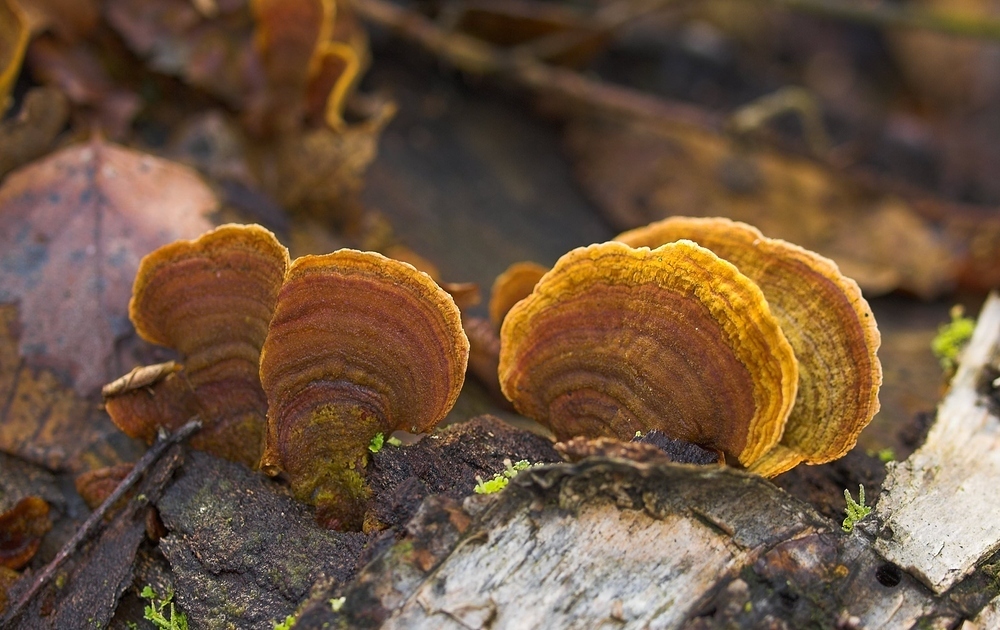
Occurs on the fallen or decaying wood of deciduous trees, with a specific affinity for sycamore and beech. Frequently found growing in large, fused clusters or groups.
Photos
Appearance
- Fruit body
- Semicircular to leafy brackets that attach to the substrate with a short, stalk-like base; often found fused together in large, wavy clusters.
- Upper surface
- Marked with concentric zones and initially covered in fine, woolly down; becomes smooth with age and is frequently colored green by algae, though the margin remains paler.
- Underside
- The surface is smooth to slightly warty and may crack when dry; it turns yellow when bruised in fresh specimens.
- Flesh
- White to ochre in color with a leathery and tough texture that becomes hard once dry.
- Spore print
- White.
Sporecast is better in the app
Plan ahead with 10-day forecasts, see what people are finding nearby, get photo IDs, and track your finds.
Edibility
Not edible
The yellow-bruising flesh of this species is described as leathery and becomes hard once it has dried.
Misidentification can be fatal. Never eat a mushroom unless you're 100% sure. This information may be inaccurate. Always consult multiple sources.
Nutrient Source
SaprotrophicIt decomposes dead hardwood, most commonly beech trees, by breaking down tough organic material.
Common Names
- Danish
- Smuk lædersvamp
- Dutch
- Waaierkorstzwam
- English
- Yellowing Curtain Crust
- Finnish
- leppänahakka
- French
- Stérée remarquable
- German
- Samtiger Schichtpilz
- Norwegian Bokmål
- viftelærsopp
- Norwegian Nynorsk
- viftelêrsopp
- Swedish
- sammetsskinn
- Welsh
- Crawen Gedennog